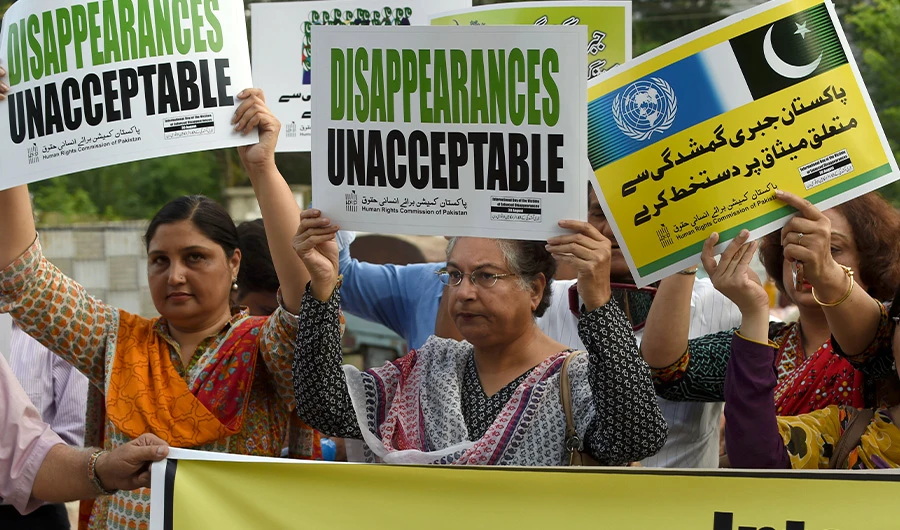
- Last week’s mysterious disappearance of SECP official Sajid Gondal has highlighted continuing cases of enforced disappearances and need for new legislation to curb them
- Ministry of human rights says sent bill on enforced disappearances to law ministry in Jan 2019, draft then forwarded to interior ministry last month for additional vetting
ISLAMABAD: A draft bill to criminalize enforced disappearances, which has been with the law ministry for ‘vetting’ for over a year and a half, is now being reviewed by the interior ministry with no deadline on when it will be finalized, several officials have said, as last week’s mysterious disappearance of a government official has once more put the spotlight on cases of enforced disappearances in Pakistan.
Sajid Gondal, a joint director at the SECP, went missing on Thursday night, his family said. On Wednesday he tweeted that he was back home.
In an interview with Arab News on Tuesday, Gondal’s wife called his disappearance an “abduction” and said the family had no information about his whereabouts and had been told by police it had no leads.
“If there is any allegation or charge on him, he must be produced before the court,” Sajeela Sajid said.
Media first reported that unknown abductors had freed Gondal on the outskirts of Islamabad. On Wednesday, however, local TV channels quoted Gondal as saying he had spent the days in which he was missing in Pakistan’s picturesque northern areas, on a trip with friends.
Many journalists and rights defenders raised questions over the explanation, asking why Gondal disappeared without a word while driving home from work and left his car unattended on a roadside, the key still in the ignition. Gondal made no attempt to contact his family or friends in the days he was gone.
The Islamabad High Court has also raised questions about Gondal’s disappearance this week, saying it would summon the prime minister to provide an explanation if the government failed to safeguard citizens’ fundamental rights.
“Abduction of citizens and failure on part of law enforcing agencies to trace their whereabouts and prosecute and punish the perpetrators of this most heinous crime appears to have become a norm,” the court said. “There is no accountability. The protectors of fundamental rights have become silent spectators to this most abhorrent violation of fundamental rights.”
Investigation officer Malik Naeem appeared before the court and said he was investigating 50 cases of missing persons in Islamabad alone.
A federal Commission of Inquiry on Enforced Disappearances set up by the government in 2011 listed 6,506 such cases nationwide by the end of 2019. And despite the pledges of successive Pakistani governments to criminalize the practice, there has been slow movement on legislation and people continue to be forcibly disappeared.
“Ministry of Human Rights bill aimed to criminalize enforced disappearance as a separate, autonomous offense through amendments in PPC [Pakistan Penal Code] and CrPC [Code of Criminal Procedure],” Rabiya Javeri Agha, secretary at the human rights ministry, told Arab News.
When asked about the status of the bill, she said it was with the ministry of law for “vetting.” The ministry of law confirmed it had received the bill in January 2019.
The bill sat at the law ministry until last month, when around four weeks ago it was passed on to the interior ministry for another review, said Lalarukh Waheed, a spokesperson for the Ministry of Interior, adding that the bill was now at the interior secretary’s office for review.
Despite repeated calls and text messages, officials at the law and interior ministries did not disclose details of current discussions around the bill or why there was a delay in processing it.
Human rights minister Shireen Mazari also declined repeated requests for an interview for this piece.
“SPECIFIC LAW IS REQUIRED”
Ali Nawaz Chowhan, chairman of the government’s National Commission for Human Rights, said delays in introducing a new law to curb continuing enforced disappearances had put the credibility of the government at stake.
“A specific law is required to declare the enforced disappearances illegal and collect the required evidence to produce and retrieve a missing person,” he told Arab News. “The enforced disappearances have tarnished our international image … and this will continue till we put an end to the menace.”
Families of disappeared persons currently have two legal remedies, barrister Omer Malik said: They can file a petition of habeas corpus with a session or high court, which would require a person under arrest to be brought before a judge or into court, or register an abduction case with the police.
“These laws are effective to recover a missing or abducted person from the custody of civilians,” Malik said. “In the case of state agencies, they simply deny having custody of a person, and then police or judiciary have no specific powers to locate a person in their custody and get them retrieved.”
Pakistan’s secret services are often blamed for enforced disappearances, though they vociferously deny the allegations.
Last year, the military said it had set up a special cell on missing persons at its headquarters in Rawalpindi. The army also issued a statement sympathizing with families of missing people, while saying that some may have joined militant groups and “not every person missing is attributable to the state.”
Meanwhile, journalists and rights defenders remain under threat.
In July, journalist Matiullah Jan, a well-known critic of the Pakistani security establishment, government and judiciary, was abducted by plainclothes abductors and gunmen in state security uniforms from outside the school where his wife is employed. He was returned in 24 hours.
In November last year, human rights defender and former Amnesty International consultant Idris Khattak, who has spent a lifetime working on enforced disappearances, was taken in broad daylight from his car in northern Pakistan.
Over half a year after he was last heard from, military intelligence finally admitted on the record that Khattak was in custody and would be charged under the 1923 Official Secrets Act, which carries a punishment of 14 years in prison, or death. Authorities have not provided specific details of the activities for which he has been charged.
In January this year, the defense ministry accepted before the Lahore High Court that lawyer Inamur Rahim was in custody and being tried under the Official Secrets Act. Rahim has filed numerous petitions against the practice of missing persons and was abducted from his home in December 2019.
In December 2010, in a landmark court session, the Inter-Services Intelligence and Military Intelligence agencies confessed before the Supreme Court that 11 missing inmates of the Adiala Jail in Rawalpindi were in their custody and being tried under the Army Act. The 11 men were also produced before the court by military officials.
FAMILIES AWAIT ANSWERS
In the provincial capital of Balochistan, a southwestern province racked by insurgency, a daily sit-in against enforced disappearances began on June 28, 2009 and continues to date.
Pakistan’s ethnic Pashtun community, 30 million strong, has been leading peaceful protests across the country for over two years, seeking details on hundreds of their young men who they say have “disappeared”.
Talia Khattak, the 20-year-old daughter of Idris Khattak, who is also Pashtun, said she was “emotionally broken” worrying about the whereabouts and health of her father, who is a diabetes patient and requires daily medication.
Khattak has a long career working on the documentation of human rights abuses and enforced disappearances in Pakistan’s northwestern Khyber Pakhtunkhwa province and the former Federally Administered Tribal Areas.
Though authorities have finally admitted Khattak is in their custody, his daughter said the family had still not been allowed to see him.
“I am living a life of hopelessness,” she said. “I don’t know if my father is alive and will he ever return home.”
Khattak’s lawyer said the Peshawar High Court was expected to take up the case in the second week of September.
“Under the law, any security agency is bound to produce an accused before the court within 24 hours,” Latif Afridi told Arab News. “There is no lacunae in the laws [regarding enforced disappearances], but the real challenge is their implementation.”
Outside the court this week, the mother of SECP official Gondal sat on a footpath and said she only had God to turn to.
“How will they face God?” she said, referring to her son’s abductors and crying in a video that has gone viral on social media. “Don’t they know one day they will be facing their Lord? The highest court is God’s court. I seek justice from my Lord. God ask them, God should punish them.”