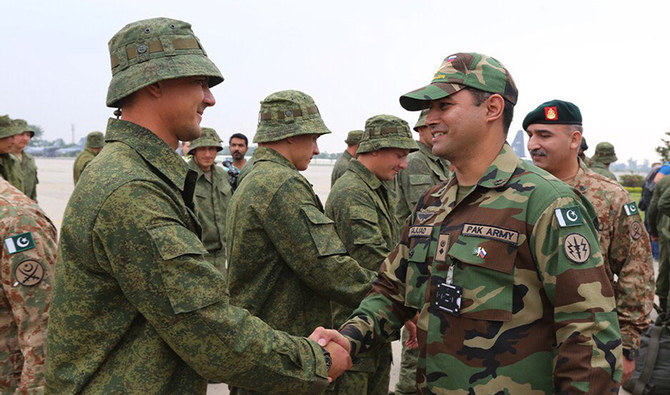
BEIJING: Chinese and Russian forces will take part in joint military exercises in southern Russia later this month along with troops from Armenia, Belarus, Iran, Myanmar, Pakistan and others, China’s defense ministry announced Thursday.
The “Caucus 2020” drills will deploy wheeled vehicles and light weaponry to be flown to the drill location by China’s latest version transport aircraft, the ministry said in a news release.
The exercises running Sept. 21-26 will focus on defensive tactics, encirclement and battlefield control and command, the ministry said.
The exercises have special meaning for China-Russia ties “at this important moment when the whole world is fighting the pandemic,” the ministry said.
China has seen no new domestic coronavirus cases in weeks, while Russia is continuing to see new cases and has reported more than 1 million people infected.
Since establishing a “comprehensive strategic partnership” two decades ago, China and Russia have cooperated increasingly closely on military matters and diplomacy, largely to counter US influence. Their militaries regularly hold joint exercises and they regularly back each other in the United Nations over issues including Syria and North Korea.


Pakistan, others to be part of joint military drills in Russia
https://arab.news/v6nsg
Pakistan, others to be part of joint military drills in Russia

- Exercises running Sept. 21-26 will focus on defensive tactics, encirclement and battlefield control and command
- Since establishing strategic partnership two decades ago, China and Russia have cooperated closely on security and diplomacy

Pakistan says responding to Afghan ‘offensive operations’ after border fire as tensions escalate
- Afghan Taliban spokesperson says “large-scale offensive operations” launched against Pakistani military bases
- Pakistan says Afghan forces opened “unprovoked” fire across multiple sectors along shared border
ISLAMABAD: Afghanistan’s Taliban authorities said on Thursday they had launched “large-scale offensive operations” against Pakistani military bases and installations, prompting Pakistan to say its forces were responding to what it described as unprovoked fire along the shared border.
The escalation follows Islamabad’s weekend airstrikes targeting what it said were Tehreek-e-Taliban Pakistan (TTP) and Daesh militant camps inside Afghanistan in response to a wave of recent bombings and attacks in Pakistan. Islamabad said the strikes killed over 100 militants, while Kabul said dozens of civilians were killed and condemned the attacks as a violation of its sovereignty.
In a post on social media platform X, Afghan government spokesperson Zabihullah Mujahid said Afghanistan had launched “large-scale offensive operations” in response to repeated violations by the Pakistani military.
Pakistan’s Ministry of Information said Afghan forces had initiated hostilities along multiple points of the frontier.
“Afghan Taliban regime unprovoked action along the Pakistan–Afghanistan border given an immediate, and effective response,” the ministry said in a statement.
The statement said Pakistani forces were targeting Taliban positions in the Chitral, Khyber, Mohmand, Kurram and Bajaur sectors, claiming heavy Afghan casualties and the destruction of multiple posts and equipment. It added that Pakistan would take all necessary measures to safeguard its territorial integrity and the security of its citizens.
Separately, security officials said Pakistani forces had carried out counterattacks in several border sectors.
“Pakistan’s security forces are giving a befitting reply to the unprovoked Afghan aggression with full force,” a security official said, declining to be named.
“The Pakistani security forces’ counter-attack destroyed Taliban’s hideouts and the Khawarij fled,” they added, referring to TTP militants.
The claims from both sides could not be independently verified.
Cross-border violence has intensified in recent weeks, with Pakistan blaming a surge in suicide bombings and militant attacks on militants it says are based in Afghanistan. Kabul denies providing safe havens to anti-Pakistan militant groups.
The clashes mark the third major escalation between the neighbors in less than a year. Similar Pakistani strikes last year triggered weeklong clashes before Qatar, Türkiye and other regional actors mediated a ceasefire in October.
The 2,600-kilometer (1,600-mile) frontier, a key trade and transit corridor linking Pakistan to landlocked Afghanistan and onward to Central Asia, has faced repeated closures amid tensions, disrupting commerce and humanitarian movement. Trade between the two nations has remained closed since October 2025.