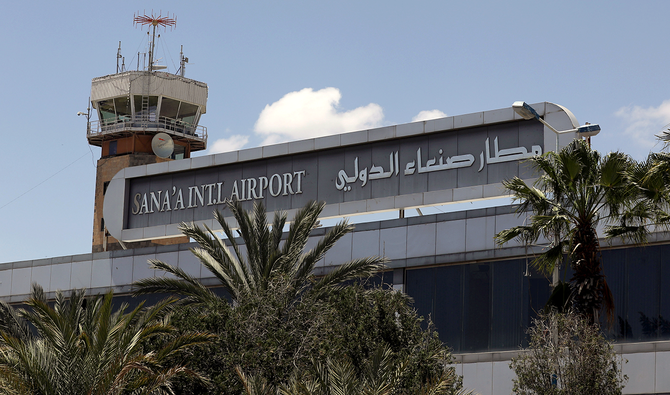

AL-MUKALLA: The Iran-backed Houthi militia on Tuesday closed Sanaa airport citing a fuel shortage, a move that could exacerbate the humanitarian crisis and coronavirus control efforts in the war-torn country.
The World Health Organization, UNICEF and other organizations have used the airport to bring in vital medical supplies during the pandemic.
Houthi official media reported on Monday that the militia had officially informed international bodies in Sanaa about the closure decision.
Yemen’s internationally recognized government condemned the closure and strongly denied Houthi accusations that it, along with the Arab coalition, had obstructed oil shipments to militia-controlled territories.
Yemen’s Foreign Ministry said the Houthis were using the airport, along with a decaying oil tanker in the Red Sea, as cards for blackmailing the international community.
“We condemn the Houthi militia announcement to close Sanaa airport against relief and humanitarian flights, including those of the United Nations, and their continued trading on the suffering of Yemenis,” the ministry said in a statement carried by the official Saba news agency.
It added that 53 percent of the 3.2 million tons of imported fuel from January to August this year was shipped into Houthi-controlled territories through Hodeidah seaport.
“The closure of Sanaa airport by the Houthis is a miserable attempt to cover up (their) plundering of YR50 billion ($199.69 million) of oil revenues in Hodeidah, intended to pay the salaries of civil servants in Yemen,” the statement said.
Densely populated cities in northern Yemen have suffered from severe fuel shortages over the last couple of months, triggering long lines of vehicles outside oil stations and a black market where oil is sold at inflated prices.
The government said imported fuel through the Houthi-held seaport in Hodeidah was enough to meet demand for at least seven months.
Under the Stockholm Agreement, the government agreed to halt a military offensive on Hodeidah in exchange for the Houthis depositing revenues from the seaport into the city’s branch of the central bank.
The proceeds were to be used for paying the salaries of thousands of public servants. The government said that the Houthis lately withdrew more than YR50 billion from the central bank to fund their military activities.
Yemeni parliament speaker, Sultan Al-Barkani, said the government was under huge public pressure to quit the Stockholm Agreement due to the Houthis’ continued breaches in Hodeidah and their assaults on Marib.
During a virtual meeting with the UK’s ambassador to Yemen Michael Aron on Tuesday, Al-Barkani said the Houthis exploited a cease-fire in Hodeidah and the government’s adherence to the agreement in order to escalate their military operations in the central province of Marib and other locations.
He also urged the international community not to bow to Houthi pressure over the decaying oil tanker. The Safer tanker, off the western city of Hodeidah, carries more than a million barrels of oil and has not undergone any maintenance since early 2015.
The Houthis have neither agreed to empty it nor allowed UN experts to board the ship to examine the damage.
There have been warnings of a massive environmental disaster in the Red Sea if the tanker were to fall apart.