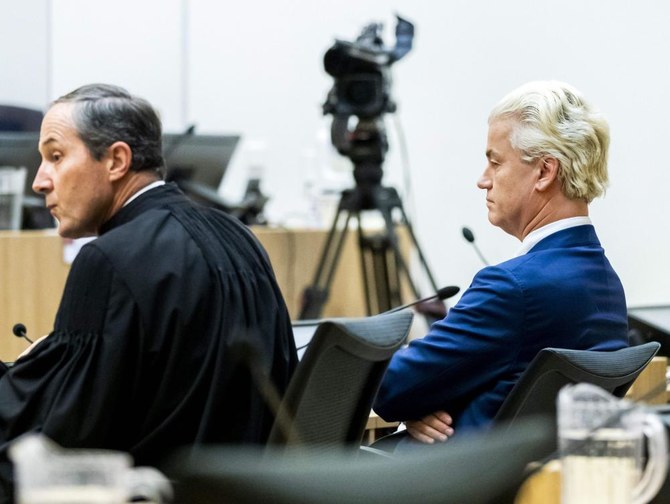
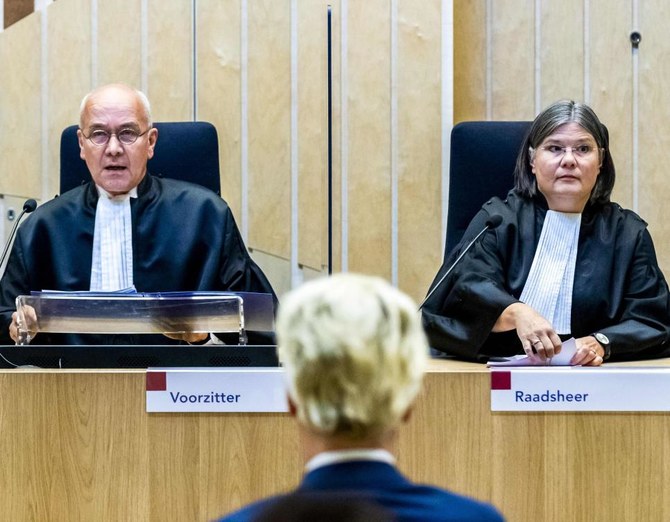
THE HAGUE, Netherlands: A Dutch appeals court upheld Friday the conviction of anti-Islam lawmaker Geert Wilders for insulting Moroccans in comments he made at an election night gathering in 2014. However, the court overturned Wilders’ conviction for inciting discrimination.
The appeals court did not punish Wilders for his conviction, which he can appeal to the Dutch Supreme Court.
The comments for which Wilders was convicted “can contribute to polarization within Dutch society, while in our democratic, pluralistic society respect for others, especially minority groups, is of great importance,” said Presiding Judge Jan Maarten Reinking.
Wilders, whose political career has been based largely on his strident anti-Islam rhetoric, was convicted in December 2016 of insulting and inciting discrimination against Moroccans in 2014. He was not given a punishment.
Wilders made no immediate comment in court Friday.
The Party for Freedom leader has always insisted he is innocent and branded his prosecution a politically-motivated attempt to muzzle him and an attack on the freedom of speech. The appeals court rejected his claims of political interference in the case and said that free speech also has limits.
Friday’s conviction was based on comments Wilders made on the night of Dutch municipal elections in 2014 at a meeting in a Hague cafe. In what appeals judges said was a carefully prepared exchange, Wilders asked supporters whether they wanted more or fewer Moroccans in the Netherlands. That sparked a chant of “Fewer! Fewer! Fewer!” — to which he replied, “we’ll take care of it.”
The ruling Friday comes some six months before national parliamentary elections in the Netherlands. According to a poll of polls, Wilders’ party is the largest opposition party.


![]()
![]()


Dutch appeals court convicts anti-Islam lawmaker Wilders of insulting Moroccans
Short Url
https://arab.news/cbq85
Dutch appeals court convicts anti-Islam lawmaker Wilders of insulting Moroccans
- Wilders, whose political career has been based largely on his strident anti-Islam rhetoric, was convicted in December 2016 of insulting and inciting discrimination against Moroccans in 2014
- The appeals court did not punish Wilders for his conviction, which he can appeal to the Dutch Supreme Court


France moves to bar US Ambassador Charles Kushner from direct government access
- French authorities had summoned Kushner to the Quai d’Orsay, which houses the Foreign Affairs Ministry, on Monday evening but he did not show up
- Jean-Noel Barrot: ‘We reject any instrumentalization of this tragedy (killing of Quentin Deranque), which has plunged a French family into mourning, for political ends’
PARIS: France’s top diplomat Monday requested that US Ambassador Charles Kushner no longer be allowed direct access to members of the French government after he skipped a meeting to discuss comments by the Trump administration over the beating death of a far-right activist.
French authorities had summoned Kushner to the Quai d’Orsay, which houses the Foreign Affairs Ministry, on Monday evening but he did not show up, according to diplomatic sources.
Jean-Noel Barrot, the foreign affairs minister, moved to restrict Kushner’s access “in light of this apparent misunderstanding of the basic expectations of the mission of an ambassador, who has the honor of representing his country.”
The ministry, however, left the door open for reconciliation.
“It remains, of course, possible for Ambassador Charles Kushner to carry out his duties and present himself at the Quai d’Orsay, so that we may hold the diplomatic discussions needed to smooth over the irritants that can inevitably arise in a friendship spanning 250 years,” it said.
Kushner had been summoned following a statement by the State Department’s Counterterrorism Bureau, which posted on X that “reports, corroborated by the French Minister of the Interior, that Quentin Deranque was killed by left-wing militants, should concern us all.” The US Embassy had posted that statement on social media.
Deranque, a far-right activist, died of brain injuries this month from a beating in the French city of Lyon. He was attacked during a fight on the margins of a student meeting where a far-left lawmaker was a keynote speaker.
His killing highlighted a climate of deep political tension ahead of next year’s presidential vote.
“We reject any instrumentalization of this tragedy, which has plunged a French family into mourning, for political ends,” Barrot said over the weekend. “We have no lessons to learn, particularly on the issue of violence, from the international reactionary movement.”
The State Department said in its post that “violent radical leftism is on the rise and its role in Quentin Deranque’s death demonstrates the threat it poses to public safety. We will continue to monitor the situation and expect to see the perpetrators of violence brought to justice.”
Kushner was summoned in August over his letter to French President Emmanuel Macron alleging the country did not do enough to combat antisemitism. France’s foreign officials met with a representative of the US ambassador since the diplomat did not show up.
French authorities had summoned Kushner to the Quai d’Orsay, which houses the Foreign Affairs Ministry, on Monday evening but he did not show up, according to diplomatic sources.
Jean-Noel Barrot, the foreign affairs minister, moved to restrict Kushner’s access “in light of this apparent misunderstanding of the basic expectations of the mission of an ambassador, who has the honor of representing his country.”
The ministry, however, left the door open for reconciliation.
“It remains, of course, possible for Ambassador Charles Kushner to carry out his duties and present himself at the Quai d’Orsay, so that we may hold the diplomatic discussions needed to smooth over the irritants that can inevitably arise in a friendship spanning 250 years,” it said.
Kushner had been summoned following a statement by the State Department’s Counterterrorism Bureau, which posted on X that “reports, corroborated by the French Minister of the Interior, that Quentin Deranque was killed by left-wing militants, should concern us all.” The US Embassy had posted that statement on social media.
Deranque, a far-right activist, died of brain injuries this month from a beating in the French city of Lyon. He was attacked during a fight on the margins of a student meeting where a far-left lawmaker was a keynote speaker.
His killing highlighted a climate of deep political tension ahead of next year’s presidential vote.
“We reject any instrumentalization of this tragedy, which has plunged a French family into mourning, for political ends,” Barrot said over the weekend. “We have no lessons to learn, particularly on the issue of violence, from the international reactionary movement.”
The State Department said in its post that “violent radical leftism is on the rise and its role in Quentin Deranque’s death demonstrates the threat it poses to public safety. We will continue to monitor the situation and expect to see the perpetrators of violence brought to justice.”
Kushner was summoned in August over his letter to French President Emmanuel Macron alleging the country did not do enough to combat antisemitism. France’s foreign officials met with a representative of the US ambassador since the diplomat did not show up.
Latest updates


Recommended


© 2026 SAUDI RESEARCH & PUBLISHING COMPANY, All Rights Reserved And subject to Terms of Use Agreement.