



KARACHI: Health experts and medical practitioners in Pakistan’s densely populated southern port city warned on Thursday that diseases like dengue and malaria could spread in the country's commercial capital if immediate precautionary measures were not taken by relevant authorities.
Ponds of rainwater contaminated with black sewage can be seen in different parts of Karachi after it recently witnessed massive urban flooding.
Doctors maintain they have already seen a significant increase in waterborne diseases in the city.
“If steps are not taken, you may see a dengue or malaria epidemic,” Dr. Muneer Sadiq, a Karachi-based health expert, told Arab News, adding that the number of patients complaining of diarrhea and vomiting had suddenly increased. “I have examined today 12 patients of diarrhea. This is despite the fact that we usually get an average of one such patient on a daily basis under normal circumstances.”
Dr. Omar Sultan, a consultant physician at the Jinnah Postgraduate Medical Center, said that other waterborne diseases had surged as well, though the real threat was the spread of dengue.
“Different waterborne diseases have increased in the city,” he informed. “If the situation persists without large scale disinfection drives, end of September and beginning of October could see a high number of dengue patients.”
According to the Ministry of National Health Services, some 90,400 dengue cases and 169 related deaths were reported across Pakistan between 2015 and 2019. Last year alone witnessed a massive jump from 3,204 cases in 2018 to 45,120 cases in 2019.
Sindh witnessed a record number of 16,925 dengue cases last year. According to a report by the provincial health department that is based on 15 years of statistics, the province has recorded 49,322 cases of dengue and 275 related deaths between 2005 and 2020. The data also signify that last year was the worst with 16,925 cases and 46 deaths.
During the ongoing year, the province has reported 733 dengue cases in the first eight months. About 92 percent of them—or 677—were recorded in Karachi. During the last three days, at least 10 more dengue cases have been reported in the city.
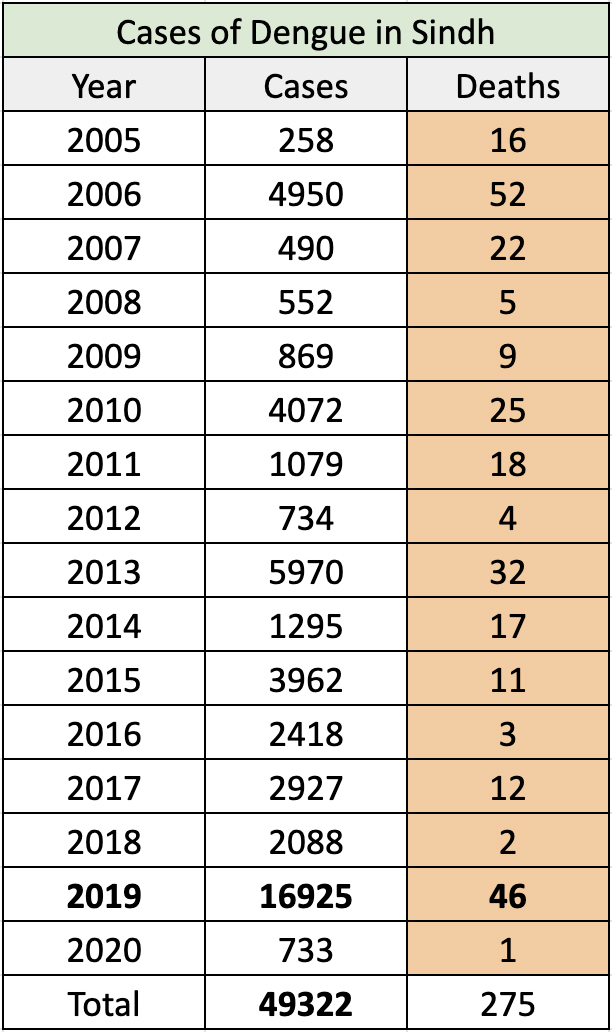
Source: Sindh Health Department
The Sindh health department spokesperson, Meeran Yousuf, told Arab News that an increase in waterborne diseases, especially dengue and malaria, was anticipated by health authorities that were trying to prevent that from happening.
“The health department is spraying disinfectants to get rid of larvae whereas the process of putting up banners to create greater awareness about the disease across the province is also underway,” she added.
In a video message shared with Arab News, the provincial health and population welfare minister, Dr. Azra Fazal Pechuho, said that dengue and malaria could spread at a rapid pace due to stagnant water that gathered in different areas after the recent monsoon rains.
“I request you to drain water from your houses. Even a cup full of water can be enough for dengue mosquitoes to breed,” she said while addressing people through social media.
“We have conducted meetings and are using sprays to kill mosquito larvae,” she said, adding that "health department teams immediately rush to neighborhoods where dengue cases are reported to spray disinfectants.”


