KARACHI: In a first, hundreds of residents of the Defense Housing Authority (DHA) neighborhood in Pakistan’s port city of Karachi staged a major sit-in outside the head office of the Cantonment Board Clifton (CBC), after torrential rains caused floods to inundate houses and shops in one of the city’s most upscale areas.
The CBC is a civic body which works under the military land department and administers the upmarket areas of Defense and Clifton.
In the sprawling Pakistani metropolis of Karachi, the backbone of the nation’s economy, management of infrastructure and services has been hamstrung by disputes between different levels of government for decades.
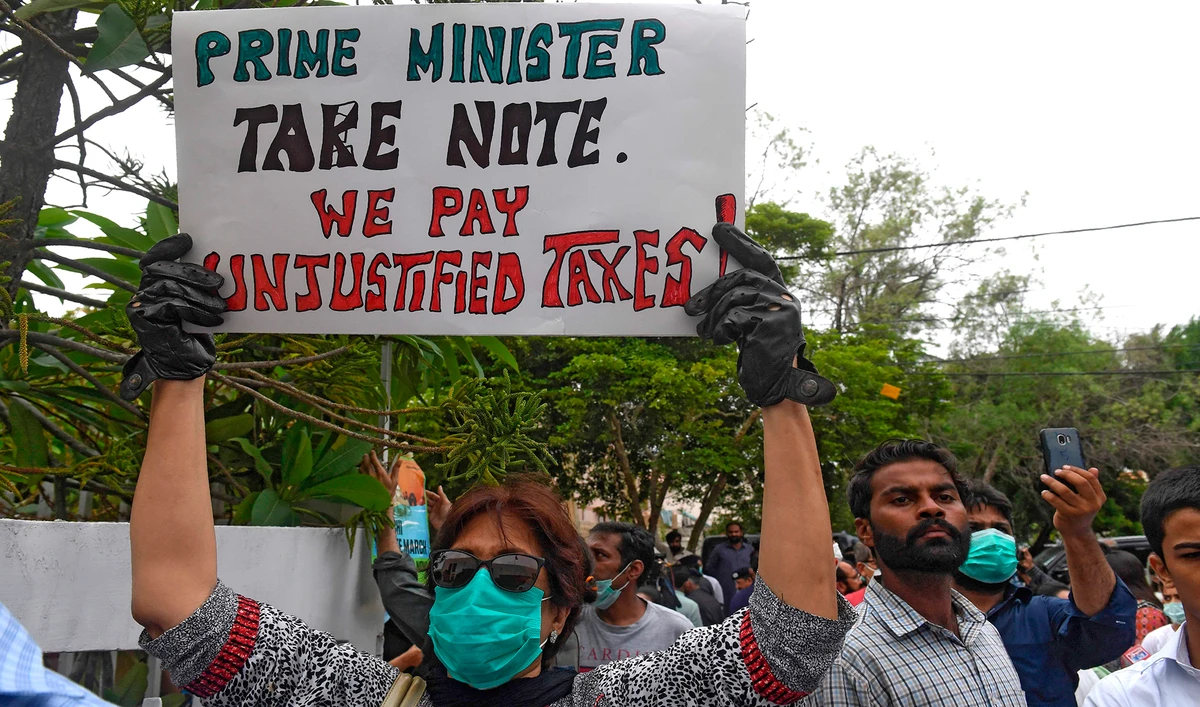
A protest group was formed on Sunday night, with hundreds of residents demonstrating on Monday, among them women and children, who called for a “Petition against DHA & CBC.” Inside and outside the CBC offices, enraged protesters held up placards and shouted “Go CBC Go” slogans against the board, demanding the resignation of the CBC CEO and DHA administrator, improvement in the sewerage system and audit of flood relief and development taxes.
Footage from the protest also showed citizens attempting to storm the CBC office before being stopped by police officials.
Karachi has a network of 550 stormwater drains which zig-zag through the city and flow out into the Arabian Sea, but many are obstructed by illegal construction, waste and sludge.
Saqib, a resident of DHA’s Phase-6 area, who only wanted to be identified by his first name, said he had never in the last two decades seen streets flooded the way they had been in the past few days, mostly because of choked drains.
“My basement still has water,” the resident said. “I am now getting black and stinky water and mosquitoes [are flying] all over inside the house,” he added, saying the area had had no power since Thursday.
“We have gathered here because our houses are submerged by water but we have no water and gas,” a woman protester who declined to be named told Arab News.
Muhammad Salman, a resident of DHA Phase-5, said he paid Rs50,000 monthly tax and Rs30,000 to a private water company to get drinking water at his residence.
“The present management of the board cannot be held responsible because this is the outcome of the neglect of three decades,” Salman said.
“You will have to resolve the problem of Karachi to fix the issue of DHA,” Salman added. “Apathy toward Karachi can be seen everywhere. This is the condition of the highest tax paying neighborhood.”

In a first, elites protest outside office of military-run civic body in Pakistan’s Karachi
https://arab.news/wcn6t
In a first, elites protest outside office of military-run civic body in Pakistan’s Karachi
- Karachi was plunged into chaos all of last week with power cuts, streets under water and cellphone outages caused by heavy rains
- The suffering of Karachi saw no end on Monday as parts of the city remained waterlogged and without power
Pakistan condemns Sudan attack that killed Bangladeshi UN peacekeepers, calls it war crime
- Six peacekeepers were killed in a drone strike in Kadugli as fighting between Sudan’s army and the RSF grinds on
- Pakistan, a major troop contributor to the UN, says perpetrators of the attack must be identified, brought to justice
ISLAMABAD: Pakistan on Sunday extended condolences to the government and people of Bangladesh after six United Nations peacekeepers from the country were killed in a drone strike in southern Sudan, condemning the attack and describing it as a war crime.
The attack took place amid a full-scale internal conflict that erupted in April 2023 between the Sudanese Armed Forces (SAF) and the Rapid Support Forces (RSF), a powerful paramilitary group, following a power struggle after the collapse of Sudan’s post-Bashir political transition.
Omar Al-Bashir, who ruled Sudan for nearly three decades, was ousted by the military in 2019 after months of mass protests, but efforts to transition to civilian rule later faltered, plunging the country back into violence that has since spread nationwide.
The drone strike hit a logistics base of the United Nations Interim Security Force for Abyei (UNISFA) in Kadugli, the capital of South Kordofan state, on Saturday, killing the Bangladeshi peacekeepers. Sudan’s army blamed the RSF for the attack, though there was no immediate public claim of responsibility.
“Pakistan strongly condemns the attack on @UNISFA in Kadugli, resulting in the tragic loss of 6 Bangladeshi peacekeepers & injuries to several others,” the country’s permanent mission to the UN said in a social media message. “We honor their supreme sacrifice in the service of peace, and express our deepest condolences to the government and people of #Bangladesh.”
“Such heinous attacks on UN peacekeepers amount to war crimes,” it added. “Perpetrators of this horrific attack must be identified and brought to justice. As a major troop-contributing country, we stand in complete solidarity with all Blue Helmets serving the cause of peace in the perilous conditions worldwide.”
According to Pakistan’s UN mission in July, the country has deployed more than 235,000 peacekeepers to 48 UN missions across four continents over the past eight decades.
Pakistan also hosts one of the UN’s oldest peacekeeping operations, the United Nations Military Observer Group in India and Pakistan (UNMOGIP), and is a founding member of the UN Peacebuilding Commission.
More than 180 Pakistani peacekeepers have lost their lives while serving under the UN flag.
Pakistan and Bangladesh have also been working in recent months to ease decades of strained ties rooted in the events of 1971, when Bangladesh — formerly part of Pakistan — became independent following a bloody war.
Relations have begun to shift following the ouster of former Bangladeshi prime minister Sheikh Hasina last year amid mass protests.
Hasina later fled to India, Pakistan’s neighbor and arch-rival, creating space for Islamabad and Dhaka to rebuild their relationship.