Kastellorizo, idyllic island at heart of Greece-Turkey row

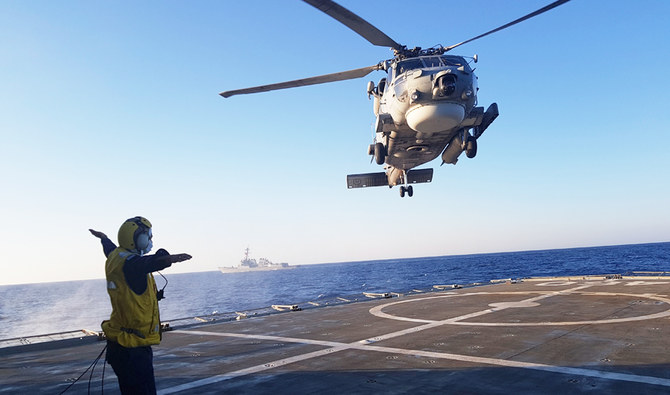
In this photo provided by the Greek National Defense Ministry, an helicopter takes part in a Greek-US military exercise south of the island of Crete, on Monday, Aug. 24, 2020. (AP)
Short Url
Updated 30 August 2020
Follow

Kastellorizo, idyllic island at heart of Greece-Turkey row

  • Kastellorizo is the Greek island furthest removed from the European mainland, a rocky, arid outcrop of around 9 square kilometers.

KASTELLORIZO, GREECE: The tiny island of Kastellorizo, peeking out of the turquoise waters of the Eastern Mediterranean just 2 km off the Turkish coast, may not look like the focus of an international incident.
And it does not feel that way to the sun-baked inhabitants, even as diplomatic tensions mount and Greece, Turkey and their allies mount rival military exercises in nearby waters in a row over gas exploration rights. “Nobody at all is afraid here,” says Giorgos Karagiannis.
The 45-year old says he is “used to these games that serve the politicians, but which don’t knock the islanders off course.”
Born on the island with its little harbor ringed with pastel-colored houses, Karagiannis’ boat plies the waters between Kastellorizo — with its two Greek flags painted onto the bare rock — and the Turkish mainland every day, carrying tourists to the island and islanders to do their shopping.
“I’ve been doing this for 30 years, and my family were doing it before me. There’s no reason for it to change,” he insists.
At present, the only thing blocking exchanges with the town of Kas across the strait is the coronavirus pandemic.
With half of the island’s 500-strong population members of the armed forces, people in military uniforms and swimwear mingle on the waterfront of Kastellorizo’s little port.
But the mirror-smooth waters belie the fierce international staring match going on over the treasures to be found beneath.
Kastellorizo is the Greek island furthest removed from the European mainland, a rocky, arid outcrop of around 9 square kilometers.
Its inhabitants are “used to” being the pivot around which Greece and Turkey’s longstanding enmity turns, says 62-year-old Foteini Dritsa.
Outside her souvenir shop, modern semi-rigid Zodiac dinghies and traditional rowing boats are pulled up side by side on the beach.
Between the Greek islanders and their Turkish counterparts “there are ties and friendships,” Dritsa says.
Deputy mayor Stavros Amygdalos agrees that “we have very good relations with our neighbors; we’re twinned with the town opposite; we put on a cultural festival together; there are significant economic ties.”
As the political pressure mounts in far-off capitals, “we’re keeping an eye out, but we’re staying calm and not changing anything about our everyday life,” Amygdalos adds.
On August 10, Turkish navy ships escorted an exploration vessel, the Oruc Reis, into the waters south of Kastellorizo.
Four days before, Greece had signed an agreement with Egypt on the two countries’ respective maritime economic zones, which the parliament in Athens waved through on Thursday.
But its claim that the waters around the island are under Greek sovereignty had Ankara seeing red.
Recent discoveries of large gas deposits in the eastern Mediterranean set the countries around the sea’s rim salivating.
Turkish President Recep Tayyip Erdogan fumed that acknowledging Greek jurisdiction in the region would mean “imprisoning Turkey within its coastline.”
“The way Greece laid out Kastellorizo’s Exclusive Economic Zone (EEZ) links Greece’s zone to Cyprus’s, de facto restricting Turkey’s to the Antalya bay area,” explains Panayotis Tsakonas, director of the security program at the Hellenic Foundation for European and Foreign Policy (ELIAMEP).
“If the two countries can’t agree, they’ll have to bring their dispute to an international tribunal that will set the dividing line,” Tsakonas predicted.
Ahead of any such move, both sides are flexing their muscles with military maneuvers, aiming also to draw allies to their side in mutual displays of force.
But the exercises are conducted “out on the open sea, and life on the island isn’t changing,” one coast guard who asked to remain anonymous tells AFP.
“It’s been the same thing ever since I was born,” says fisherman Dimitries Achladiotis with a smile from among his nets. “Tomorrow the Turks are going to invade the island!“
For now, the only things causing a ripple in the crystal-clear waters around Kastellorizo are the sea turtles.


Columbia student detained by ICE is abruptly released after Mamdani meets with Trump

Updated 3 sec ago
Follow

Columbia student detained by ICE is abruptly released after Mamdani meets with Trump

NEW YORK: Federal immigration authorities arrested a Columbia University student early Thursday, triggering protests on campus along with allegations that agents had entered the university-owned residence under false pretenses.
Just hours after detaining student Ellie Aghayeva, though, the federal government abruptly reversed course, permitting her to walk free after an apparent intervention by President Donald Trump.
In a social media post Thursday afternoon, Mayor Zohran Mamdani said he expressed concerns about the arrest during an unrelated meeting with Trump, who then agreed to release her immediately.
“I am safe and okay,” Aghayeva wrote on Instagram, minutes after Mamdani’s post, adding she was in “complete shock” from the experience.
The head-spinning series of events marked the latest development to emerge from the Republican president’s unlikely relationship with a democratic socialist mayor he once threatened to have deported.
On Thursday, while pitching Trump on a massive housing project, Mamdani also called on the president to drop cases against several other current and former students facing deportation for their roles in protests against Israel.
Aghayeva, a senior from Azerbaijan studying neuroscience and politics, hasn’t been publicly linked to any of the pro-Palestinian demonstrations that roiled Columbia’s campus. A self-described content creator, she has amassed a large social media following by sharing day-in-the-life videos and tips for navigating college as an immigrant.
Early Thursday, federal agents gained entry to her apartment by claiming they were searching for a missing person, according to a petition from her lawyers and a statement released by Columbia. She quickly dashed off a message to her more than 100,000 followers on Instagram: “DHS illegally arrested me. Please help.” A photo accompanying the post appeared to show her legs in the backseat of a vehicle.
A Department of Homeland Security spokesperson said Aghayeva’s student visa had been terminated in 2016 for failing to attend classes. Inquiries to Columbia about her visa status and how long she had been enrolled in the university were not returned.
In their petition, attorneys for Aghayeva said she had entered the country on a visa in or around 2016. They declined to provide additional comment, including details about her immigration status.
A spokesperson for DHS, Tricia McLaughlin, denied allegations levied by some state officials that agents had gained entry to her apartment by posing as New York City police officers. She didn’t respond to questions about whether they had claimed to be seeking a missing person.
The use of disguises or other misrepresentations by immigration authorities has drawn attention in recent months, after federal agents were seen posing as utility workers and other service employees in Minneapolis and elsewhere.
The practice is legal, in most cases. But immigration attorneys say such ruses are becoming increasingly common, adding to concerns about the Trump administration’s dramatic reshaping of immigration enforcement tactics nationwide.
In recent weeks, Trump has once again intensified his attacks on several universities, including Harvard and UCLA. The arrest would seem to mark the first federal enforcement action against at Columbia since the university agreed to pay more than $220 million to the administration over the summer.
“It’s a horrifying sign that the roving eye of the administration is turning back to Columbia,” said Michael Thaddeus, a mathematics professor at Columbia and vice president of the university’s chapter of the American Association of University Professors, which has sued Trump. “The idea that secret police would abduct and imprison students in our midst is something we’d expect from an authoritarian regime.”
Many students and faculty called on Columbia to increase protections for international students following the arrest last March of Mahmoud Khalil, a former graduate student and pro-Palestinian activist, whose deportation case remains ongoing.
In an email to the Columbia community Thursday, acting president Claire Shipman said that residential staff had been reminded not to allow federal law enforcement into university buildings without a subpoena or warrant.
“If you encounter or observe DHS/ICE agents conducting enforcement activities on or near campus, immediately contact Public Safety,” Shipman wrote. “Do not allow them to enter non-public areas or accept service of a warrant or subpoena.”