Pakistan jails three accused of financing Mumbai attacks

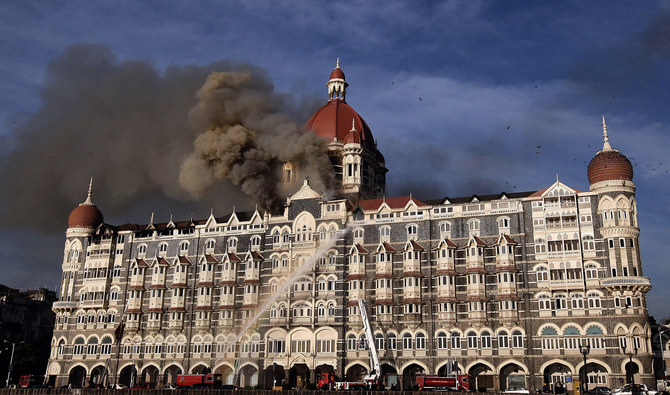
Indian firefighters attempt to put out a fire as smoke billows out of the historic Taj Mahal Hotel in Mumbai on Nov. 27, 2008, one of the sites of attacks by militant gunmen. (AFP/File)
Short Url
Updated 28 August 2020
Follow

Pakistan jails three accused of financing Mumbai attacks

  • The men were associates of Hafiz Saeed, who was sentenced to a total of 11 years in prison in February
  • The sentencing comes ahead of the Financial Action Task Force's September deadline for Pakistan

LAHORE: A court in Pakistan has sentenced to prison three leaders of Jamat-ud-Dawa, an organization accused by India and the United States of masterminding the 2008 attacks in Mumbai.
The sentencing comes ahead of a September deadline for Pakistan to avoid being blacklisted for failing to curb terror financing by global financial watchdog the Financial Action Task Force (FATF).
Inclusion on the blacklist, alongside Iran and North Korea, would mean being shunned by international financial institutions. The watchdog has called for Pakistan to prosecute those funding terrorism, as well as to enact laws to help track and stop terror financing.
Malik Zafar Iqbal and Abdul Salam were each handed 16-1/2 year total sentences on four charges, to be served concurrently, while a third man, Hafiz Abdul Rehman Makki, got 1-1/2 years on one charge, according to a court judgment seen by Reuters.
The men were associates of Hafiz Saeed, who was sentenced to a total of 11 years in prison in February. All the sentences are concurrent so Saeed, Iqbal and Salam will serve five years.
Saeed founded and led Lashkar-e-Taiba (LeT), or the Army of the Pure, a group blamed by India and the United States for the 2008 Mumbai attacks, which killed 160 people, including Americans and other foreigners.
Saeed and his associates also face a further slew of cases for allegedly financing militant activities, while Iqbal and Makki have already been convicted in several cases.
Saeed says his network, which spans 300 seminaries and schools, hospitals, a publishing house and ambulance services, has no ties to militant groups. Jamat-ud-Dawa funds the militant wing LeT.
A 2011 US sanctions designation describes Iqbal as a co-founder of LeT and in charge of its financing activities. Salam is described as the interim leader of the group during the brief periods when Saeed was arrested in the aftermath of the Mumbai attacks, and running its network of seminaries.


Pakistan says Indian minister initiated handshake in Dhaka, first contact since May conflict

Updated 5 sec ago
Follow

Pakistan says Indian minister initiated handshake in Dhaka, first contact since May conflict

  • Pakistan’s Ayaz Sadiq and India’s Subrahmanyam Jaishankar met on the sidelines of Khaleda Zia’s funeral
  • The National Assembly of Pakistan says Islamabad has consistently emphasized dialogue with New Delhi

ISLAMABAD: Pakistan said on Wednesday Indian External Affairs Minister Subrahmanyam Jaishankar initiated a brief handshake with Speaker of the National Assembly Sardar Ayaz Sadiq in Dhaka, marking the first high-level contact between the two nuclear-armed rivals since their military conflict in May.

The encounter took place on the sidelines of the funeral of former Bangladeshi prime minister Khaleda Zia, attended by senior officials and diplomats from multiple countries.

Ties between India and Pakistan have remained frozen since a four-day military confrontation in May, during which both sides exchanged missile, drone and air strikes before a ceasefire brokered by Washington.

“During Speaker NA Sardar Ayaz Sadiq’s visit to the Parliament of Bangladesh ... the Indian External Minister Dr. S. Jaishankar approached the Speaker National Assembly and [shook] hands,” Pakistan’s National Assembly said in a post on social media platform X.

It added that Jaishankar introduced himself to Sadiq during the brief interaction. India has not commented publicly on the exchange.

“It is noteworthy that Pakistan has consistently emphasized dialogue, restraint, and cooperative measures, including proposals for peace talks,” the post continued.

Tensions between the two neighbors escalated in April after a militant attack in Indian-administered Kashmir killed more than 20 tourists. New Delhi blamed Pakistan for supporting the attack, an allegation Islamabad denied, calling instead for an independent and transparent investigation.

Officials from both countries have largely avoided public interactions since the conflict, with senior figures refraining from handshakes or exchanges at international gatherings.

Sadiq was in Dhaka to attend Zia’s funeral and to convey condolences from Pakistan’s leadership and people. He also met Zia’s son Tarique Rahman, the acting chairman of the Bangladesh Nationalist Party, according to Pakistan’s high commission in Bangladesh.

Speaking to Pakistan’s Geo TV, Sadiq confirmed that Jaishankar approached him in full media glare and exchanged pleasantries.

Responding to a question about being photographed with the Indian minister, he said: “Cameras arrived with them. Our people took the photographs later.”