



LAHORE: Private schools in the Pakistani cities of Lahore and Islamabad are still undecided over whether to reopen in September as per government instructions, several administrators said this week, citing apprehensions over safety amid rising concerns about the capacity to enforce coronavirus standard operating procedures.
Pakistan, which had recorded 295,053 COVID-19 infections and 6,283 deaths by August 28, shut down schools and universities in March to stem the spread of the coronavirus. Cases have since significantly decreased, prompting the government to announce that all educational institutes would reopen on September 15 if case numbers remained low.
A final decision on the issue is expected on September 7 but the stakes are rising for educators and families in the face of emerging research that shows children could be a risk for spreading the new coronavirus.
Several large studies have shown the vast majority of children who contract COVID-19, the disease caused by the virus, have milder illness than adults. But more recent studies are starting to show how contagious infected children, even those with no symptoms, might be.
“Until things are not to our level of satisfaction, we will not resume physical classes, even if other schools do,” a senior administrator at Ecole des Lumieres, a French-American institute in Islamabad, told Arab News, declining to be named. “We are not taking this lightly. Students are not guinea pigs.”
Another private institute in Lahore, the Learning Alliance, also said it was still mulling options.
“The school reopening is contingent on how the situation around the COVID-19 pandemic unfolds,” a representative for the school told Arab News via email. “The health and safety of our students and teachers is our top most priority, therefore, we will only open following strict safety protocols as per international standards.”

Chairs marked for parents to submit their children’s holiday homework at a school in Lahore, Pakistan on Aug. 24, 2020. (AN photo by Natasha Zai)
On their part, provincial governments have put out health and safety guidelines for schools to follow when they reopen.
In Punjab province, of which Lahore is the capital, school administrations have been ordered to ensure that children wash their hands frequently, wear face masks and maintain a distance of six feet from each other. Classrooms are to be regularly disinfected, the occupancy of hostels is to be reduced to 30 percent and schools transportation will only be allowed to be half full, the Punjab government has said.
The All Pakistan Private Schools’ Federation, which represents all 207,000 private schools in the country, is confident the official guidelines are enforceable.
“I do think they are implementable to quite an extent,” Kashif Mirza, the Federation’s president, told Arab News. “To maintain social distance, we have asked schools to divide classes between morning and afternoon sessions.”
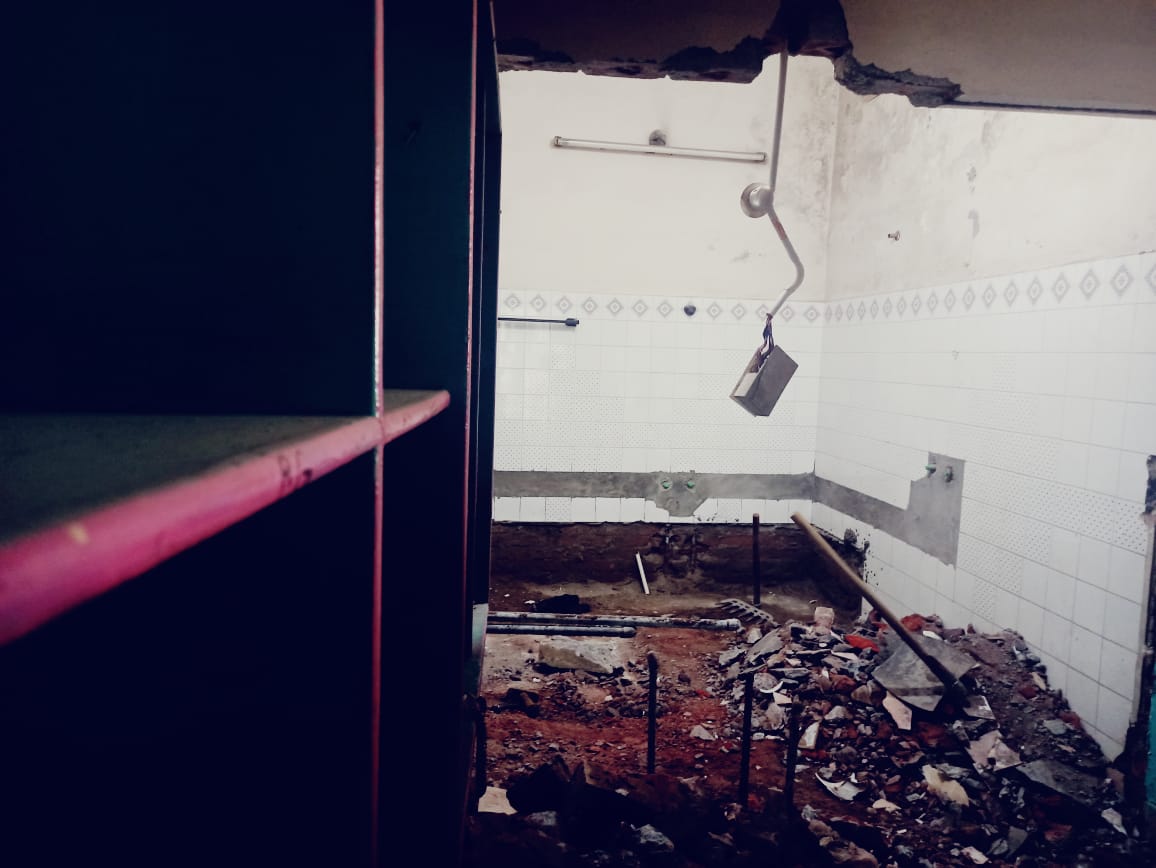
A view of a school bathroom being renovated to comply with social distancing requirements at a school in Lahore, Pakistan, on Aug. 24, 2020. (AN photo by Natasha Zai)
Mirza said the most popular proposal for the new academic year was to hold classes in shifts -- one session from 7:30 a.m. to 10:30 a.m. and another from 11:30 a.m. to 2:30 p.m., with no breaks in between.
The Federation has also decided that no school would be allowed to take disciplinary action against children whose parents did not allow them to return to school.
But Mirza said the real concern for the government was public schools, where applying standard operating procedures would be much harder given limited space and fewer resources.
Shafqat Mahmood, the minister for education, said the government could not make a distinction between high- and low-income schools.
“We cannot make separate health guidelines for income brackets,” he told Arab News. “I understand that [smaller schools] will have a harder time implementing the guidelines, but the government cannot relax [health] restrictions for low-income schools."
He agreed that enforcing SOPs would push up the cost for public schools, as they would have to regularly disinfect campuses and ensure that students wore face masks and sanitized their hands.
“Cost is definitely an issue,” Mahmood said. “We are calculating how much money will be required. In some cases, the government may consider helping the schools, but we are still working out details.”

An online class being conducted at the Laureate School System in Lahore, Pakistan, on Aug. 24, 2020. (AN photo by Natasha Zia)
The chairman of Laureate, a small private school in Lahore, said he expected his costs to double.
“We will need to hire more teachers and other staff,” Hafiz Abdul Ghafoor said. “Social distancing in small campuses will be a big problem.”
But health experts say the fear of schools becoming breeding grounds for the virus will stick for a few years, or at least until a vaccine became widely available, but life had to return to normalcy for both students and parents.
“I think now is the right time to open schools,” Dr. Javed Akram, a senior doctor in Punjab, told Arab News, “but only with proper standard operating procedures.”


