

Fighting resumes in Abyan as separatists pull out of talks

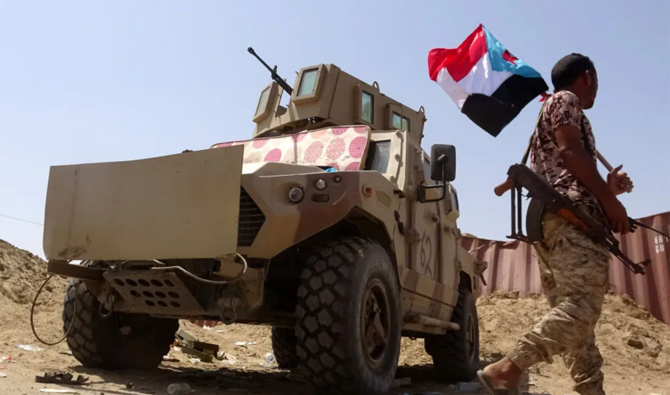
A fighter loyal to Yemen's separatist Southern Transitional Council (STC) holds the separatist flag in the southern Abyan province. (AFP)
Short Url
Updated 26 August 2020
Follow

Fighting resumes in Abyan as separatists pull out of talks

  • Yemeni govt, STC blame each other for clashes, undermining Riyadh Agreement

AL-MUKALLA, Yemen: Large explosions rocked many areas in Yemen’s southern province of Abyan on Wednesday as government forces and pro-independence Southern Transitional Council (STC) troops traded heavy fire, residents and military officers said.

The STC on Tuesday announced the suspension of its participation in ongoing consultations on forming a new government under the Riyadh Agreement.

Shortly after the announcement, residents in Abyan’s capital Zinjibar and other contested areas in the province told Arab News that both sides resumed fighting and there were large explosions.

Last month, Saudi Arabia made a major breakthrough toward implementing the Riyadh Agreement by suggesting a proposal that led to the appointment of a new governor and new chief security for Aden, and the naming of a new prime minister by Yemeni President Abed Rabbo Mansour Hadi, in exchange for separatists canceling self-rule.

Ratified by both sides last year, the Riyadh Agreement was meant to defuse tensions between the government and separatists, and unite forces against the Iran-backed Houthi militias.

Yemeni government and STC officials accused each other of starting the clashes in Abyan, and of undermining efforts to implement the Riyadh Agreement.

Mohammed Al-Naqeeb, spokesman for STC forces in Abyan, tweeted that they pushed back a government offensive in the region of Tarea.

“Our southern armed forces are at the highest level of readiness for all eventualities, including a full-scale battle,” Al-Naqeeb said.

Army commanders denied the STC’s claims, saying separatists reinforced their troops on the ground, shelled government forces with heavy weapons, dug trenches and built fortifications.

“They breached the truce many times by shelling our forces and building fortifications,” an army officer from Abyan told Arab News on condition of anonymity because he is not authorized to speak to reporters.

Local officers say Saudi military observers, who were deployed in Abyan in June to monitor a truce between the warring sides, are intensifying discussions with their Yemeni counterparts to de-escalate the situation.

Residents in the port city of Aden and southern Yemeni provinces expressed concern about an escalation of violence in their areas, urging both the government and the STC to adhere to commitments to stop hostilities.

Zinjibar resident Adani Bahadi said the fighting between government forces and separatists has undermined peace and security in the city, ruined public services and claimed the lives of many young people.

“The fighting must stop. The bloodshed must stop. This conflict has fueled hatred among Yemenis and southerners, and claimed the lives of many young people,” Bahadi told Arab News.

Meanwhile, dozens of Houthi fighters have been killed over the last 48 hours in heavy clashes with government forces in the central provinces of Marib and Al-Bayda.

Yemen’s Defense Ministry said at least 40 Houthis were killed in Al-Bayda when government forces attacked their positions in the district of Qania.

Saudi-led coalition warplanes bombed Houthi military positions and gatherings in Marib, killing at least 16, injuring many others and setting their military vehicles ablaze.


Iran says can fight intense war for months

Updated 3 sec ago
Follow

Iran says can fight intense war for months

  • Iran’s security chief accuses Trump administration of seeking to replicate a scenario similar to Venezuela
  • Analysts warn there is still no clear path to ending a conflict that could last a month or longer
TEHRAN: Iran’s Revolutionary Guards said Sunday that the country’s forces could fight an intense war for six months against the United States and Israel.
Israeli Prime Minister Benjamin Netanyahu has vowed to press on with the war against Iran “with all our force,” with a plan to eradicate the country’s leadership after joint US-Israeli raids killed supreme leader Ayatollah Ali Khamenei last week, sparking the regional conflict.
Despite the threat, the Revolutionary Guards said Sunday that the Islamic republic’s forces could wage an “intense war” for six months at the current speed of fighting.
Guards spokesman Ali Mohammad Naini said Iran had so far used “first and second generation” missiles, but will use “advanced and less-used long-range missiles” in the coming days.
‘Trapped’
The widening reach of the war and Iran’s ability to inflict damage and harm were underscored by US President Donald Trump attending the return of six American service members killed in a drone strike on a US base in Kuwait last Sunday.
Iran’s security chief Ali Larijani accused the Trump administration of seeking to replicate a scenario similar to Venezuela where it ousted leader Nicolas Maduro.
“Their perception was that it would be like Venezuela — they would strike, take control and it would be over — but now they are trapped,” he said in a pre-recorded interview broadcast on state TV on Saturday.
Iran’s hardline judiciary chief Gholamhossein Mohseni Ejei also warned Middle East neighbors which are “openly and covertly at the disposal of the enemy” that “the heavy attacks on these targets will continue.”
Iranian President Masoud Pezeshkian said Sunday that Tehran “will be forced to respond” if a neighboring country were to be used as a launchpad for any attack or invasion attempt.
Tehran had vowed to go after US assets in the region, and Saudi Arabia, Qatar, the United Arab Emirates and Kuwait on Sunday all reported new attacks.
No clear way out
Analysts warn there is still no clear path to ending a conflict that US and Israeli officials say could last a month or longer.
Trump has suggested Iran’s economy could be rebuilt if a leader “acceptable” to Washington replaces the late supreme leader, which Tehran has rejected.
China and Russia have largely stayed on the sidelines despite close ties with Tehran.
China’s top diplomat Wang Yi said on Sunday that the war in the Middle East should “never have happened.”
“This is a war that should never have happened,” he told a press conference in Beijing, adding that “a strong fist does not mean strong reason. The world cannot return to the law of the jungle.”