

Canada and victims’ families press Iran for answers over downed Ukrainian jetliner

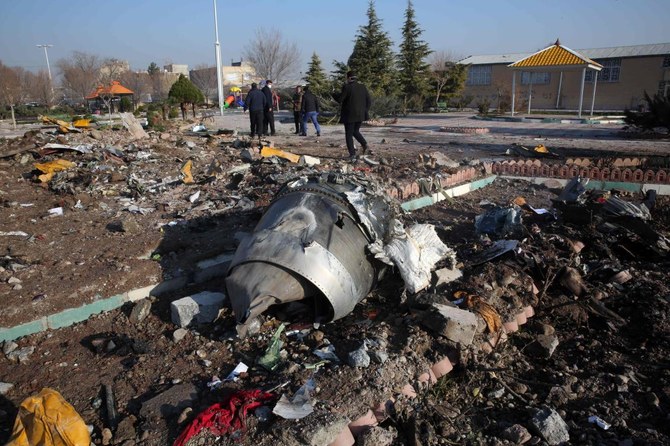
In this file photo rescue teams work amidst debris after a Ukrainian plane carrying 176 passengers crashed near Imam Khomeini airport in the Iranian capital Tehran early in the morning on January 8, 2020, killing everyone on board. (AFP/File Photo)
Short Url
Updated 24 August 2020
Follow

Canada and victims’ families press Iran for answers over downed Ukrainian jetliner

  • Many of the 176 victims killed in the crash were Canadian citizens or permanent residents
  • Iran’s Revolutionary Guard has said it accidentally shot down Ukraine International Airlines Flight PS752 on Jan. 8

MONTREAL: Canada and families of the victims of a downed Ukrainian jetliner are pressing Iran for additional answers, after an announcement by Tehran on Sunday provided “limited and selected information.”
The announcement by the head of Iran’s Civil Aviation Organization marked the first official report on the contents of the cockpit voice and data recordings, which were sent to France for analysis in July.
Iran’s Revolutionary Guard has said it accidentally shot down Ukraine International Airlines Flight PS752 on Jan. 8, mistaking it for a missile at a time when tensions were high between Iran and the United States.
Many of the 176 victims killed in the crash were Canadian citizens or permanent residents.

******

READ MORE: Iran says European insurers should pay compensation for downed Ukrainian plane

Iran sends downed Ukrainian plane’s black box to France

******

Tehran said the analysis shows the plane was hit by two missiles 25 seconds apart and that passengers were still alive for some time after the impact of the first blast.
“This preliminary report only provides limited and selected information regarding this tragic event,” Canada’s Transport Minister Marc Garneau and Foreign Affairs Minister Francois-Philippe Champagne said in a statement on Sunday night.
“The report only mentions what transpired after the first missile strike but not the second.”
They asked why the missiles were launched and why Iran’s air space was open.
An association representing families of the plane’s victims dismissed the report in a statement that said they needed to know why a second missile was fired at the aircraft.
Earlier on Sunday, Canada’s Transportation Safety Board (TSB) questioned why commercial airlines continued operating in the area affected by the conflict.
Under UN rules, Iran retains overall control of the investigation while the US and Ukraine are accredited as the countries where the jet was respectively built and operated. Canada has also played a role as the home of many of the victims on the downed plane.


Iran’s new supreme leader ‘safe and sound’ despite war injury reports: president’s son

Updated 37 min 51 sec ago
Follow

Iran’s new supreme leader ‘safe and sound’ despite war injury reports: president’s son

TEHRAN: Iran's new supreme leader Mojtaba Khamenei is "safe and sound" despite reports of an injury during the war with Israel and the United States, said the son of the Iranian president on Wednesday.
"I heard news that Mr Mojtaba Khamenei had been injured. I have asked some friends who had connections. They told me that, thank God, he is safe and sound," said Yousef Pezeshkian, who is also a government adviser, in a post on his Telegram channel.
State television had called Khamenei a "wounded veteran of the Ramadan war" but never specified his injury.
The new supreme leader is the son and successor of the Islamic republic's longtime ruler Ayatollah Ali Khamenei, who was killed in US-Israeli strikes on Iran on February 28 which triggered a war across the Middle East.
The 56-year-old Mojtaba Khamenei, a discreet figure who has rarely appeared in public or spoken at official events, has yet to address the nation or issue a written statement since he was declared supreme leader on Sunday.
In a Wednesday report, the New York Times quoting three unnamed Iranian officials said that Khamenei "had suffered injuries, including to his legs, but that he was alert and sheltering at a highly secure location with limited communication".