

Three with COVID-19, Syria constitution talks ‘on hold’: UN envoy

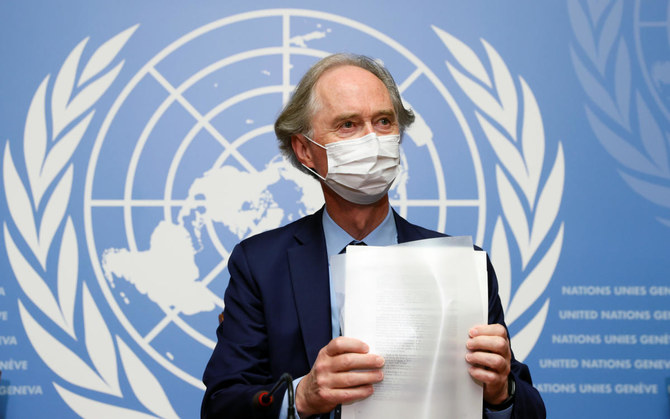
UN Special Envoy for Syria Geir Pedersen attends a news conference ahead of a meeting of the Syrian Constitutional Committee at the United Nations in Geneva, Switzerland August 21, 2020. (Reuters)
Short Url
Updated 24 August 2020
Follow

Three with COVID-19, Syria constitution talks ‘on hold’: UN envoy

  • The UN’s Syria envoy, Geir Pedersen, is hosting the three, 15-member teams from Syria at the UN offices in Geneva
  • Pedersen said last week he is hoping to build “trust and confidence” in a UN-led process that has produced few concrete results so far

GENEVA: Syrian constitutional talks at the United Nations were put on hold just hours after they began on Monday after three delegates tested positive for COVID-19, the UN said.

The office of UN special envoy for Syria Geir Pedersen said it received confirmation that “three members of the Syrian Constitutional Committee Small Body tested positive for COVID-19” and the session in Geneva “is currently on hold.”

Syrian government, opposition and civil society delegations were resuming meetings in Geneva to discuss a possible new constitution — a step seen by the UN mediator as a prospective “door-opener” to a final resolution of the country’s devastating nine-year civil war

The UN’s Syria envoy, Geir Pedersen, is hosting the three, 15-member teams from Syria, while major regional and world powers — Iran, Russia, Turkey and the United States — are expected to be present on the sidelines during the week-long gathering at the UN offices in Geneva.

With a fragile cease-fire largely holding in the rebel-held region of Idlib, Pedersen said last week he is hoping to build “trust and confidence” in a UN-led process that has produced few concrete results so far.

The Syrian war broke out in 2011, leading to hundreds of thousands of deaths and the exile of millions from their homes. The opposition wants a new constitution drafted, while the government says the current charter should be amended.

The meeting will be the first of its kind in nine months, before the COVID-19 outbreak forced the postponement of one planned in March. Participants were tested for the coronavirus before and after arrival in Geneva.

US envoy for Syria James Jeffrey, who is in Geneva, noted this month a “shift at least in tone” from Syrian President Bashar Assad by acknowledging the UN-backed process in ways that he had not previously. Jeffrey said the United States will keep watch on whether the government had changed “at least tactically” its approach in the talks.

A larger group of 150 delegates is also part of the process, but is not meeting this week.


Egypt coordinates with Greece to return victims of migrant incident, warns against irregular routes

Updated 4 sec ago
Follow

Egypt coordinates with Greece to return victims of migrant incident, warns against irregular routes

Egypt’s Ministry of Foreign Affairs said Foreign Minister Badr Abdelatty has instructed the Egyptian embassy in Athens to step up coordination with Greek authorities, Ahram Online reported on Tuesday. 

The move aims to support survivors and expedite the repatriation of the victims’ bodies once legal procedures are completed.

The ministry added that the embassy has been in contact with the families of those who died to arrange the transfer of the remains back home.

Offering its condolences to the victims’ families, the ministry renewed its warning to citizens about the risks of irregular migration, urging Egyptians to safeguard their lives by using legal and regulated travel channels.

Egypt has intensified its efforts to curb irregular migration since launching a national strategy in 2016, with officials stressing that the country will not be used as a transit route to Europe.

Authorities say no migrant boats have departed from Egyptian shores since the strategy was introduced, despite Egypt hosting nearly 10 million foreign nationals, including refugees, asylum seekers, and migrants from 133 countries.

The approach has continued to evolve over the years, most recently with the adoption of the 2024–2026 national action plan by the National Committee for Combating and Preventing Illegal Migration and Trafficking in Persons.

Earlier initiatives have also supported these efforts, including the 2019 “Lifeboats” programme, which allocated EGP 250 million to create job opportunities in villages considered most vulnerable to irregular migration.

Egypt’s measures have drawn international support, with the European Union pledging €200 million in grants in March 2024 to bolster border management, search-and-rescue capabilities, and efforts to combat migrant smuggling.