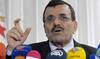
BERLIN: Russian dissident Alexei Navalny, who is in a coma after a suspected poisoning, arrived in Berlin on a special flight early Saturday for treatment by specialists at the German capital’s main hospital.
A representative of the NGO that arranged the flight confirmed that the plane had landed and that Navalny was in stable condition.
“Navalny is in Berlin,” Jaka Bizilj, of the German organization Cinema For Peace, told The Associated Press.
“He survived the flight and he’s stable.”
He said all other information on the 44-year-old’s health would have to come from his family and the German doctors now looking after him.
“He’s being treated at the Charite hospital,” Bizilj said.
Navalny, a politician and corruption investigator who is one of Russian President Vladimir Putin’s fiercest critics, was admitted to an intensive care unit in the Siberian city of Omsk on Thursday. His supporters believe that tea he drank was laced with poison — and that the Kremlin is behind both his illness and the delay in transferring him to a top German hospital.
When German specialists arrived aboard a plane equipped with advanced medical equipment Friday morning at his family’s behest, Navalny’s physicians in Omsk initially said he was too unstable to move.
Navalny’s supporters denounced that as a ploy by authorities to stall until any poison in his system would no longer be traceable. The Omsk medical team relented only after a charity that had organized the medevac plane revealed that the German doctors examined the politician and said he was fit to be transported.
Deputy chief doctor of the Omsk hospital Anatoly Kalinichenko then told reporters that Navalny’s condition had stabilized and that physicians “didn’t mind” transferring the politician, given that his relatives were willing “to take on the risks.”
The Kremlin denied that resistance to the transfer was political, with spokesman Dmitry Peskov saying that it was purely a medical decision. However, the reversal came as international pressure on Russia’s leadership mounted.
It would not be the first time a prominent, outspoken Russian was targeted in such a way — or the first time the Kremlin was accused of being behind it.
On Thursday, leaders of France and Germany said the two countries were ready to offer Navalny and his family any and all assistance and insisted on an investigation into what happened.
The most prominent member of Russia’s opposition, Navalny campaigned to challenge Putin in the 2018 presidential election but was barred from running. Since then, he has been promoting opposition candidates in regional elections, challenging members of the ruling party, United Russia.
His Foundation for Fighting Corruption has been exposing graft among government officials, including some at the highest level. But he had to shut the foundation last month after a financially devastating lawsuit from a businessman with close ties to the Kremlin.
Navalny fell ill on a flight back to Moscow from Siberia on Thursday and was taken to the hospital after the plane made an emergency landing. His team made arrangements to transfer him to Charité, a clinic in Berlin that has a history of treating famous foreign leaders and dissidents.
Dr. Yaroslav Ashikhmin, Navalny’s physician in Moscow, told The Associated Press that being on a plane with specialized equipment, including a ventilator and a machine that can do the work of the heart and lungs, “can be even safer than staying in a hospital in Omsk.”
Navalny’s spokesperson, Kira Yarmysh posted pictures of what she said was a bathroom inside the hospital that showed squalid conditions, including walls with paint peeling off, rusting pipes, and a dirty floor and walls.
While his supporters and family members continue to insist that Navalny was poisoned, doctors in Omsk denied that and put forward another theory.
The hospital’s chief doctor, Alexander Murakhovsky, said in a video published by Omsk news outlet NGS55 that a metabolic disorder was the most likely diagnosis and that a drop in blood sugar may have caused Navalny to lose consciousness.
Another doctor with ties to the politician, Dr. Anastasia Vasilyeva, said that diagnosing Navalny with a “metabolic disorder” says nothing about what may have caused it — and it could have been the result of a poisoning.
Ashikhmin, who has been Navalny’s doctor since 2013, said the politician has always been in good health, regularly went for medical checkups and didn’t have any underlying illnesses that could have triggered his condition.
Western toxicology experts expressed doubts that a poisoning could have been ruled out so quickly.
“It takes a while to rule things out. And particularly if something is highly toxic — it will be there in very low concentrations, and many screening tests would just not pick that substance up,” said Alastair Hay, an emeritus professor and toxicology expert from the school of medicine at the University of Leeds.
Like many other opposition politicians in Russia, Navalny has been frequently detained by law enforcement and harassed by pro-Kremlin groups. In 2017, he was attacked by several men who threw antiseptic in his face, damaging an eye.
Last year, Navalny was rushed to a hospital from jail where he was serving a sentence on charges of violating protest regulations. His team also suspected poisoning then. Doctors said he had a severe allergic reaction and sent him back to detention the following day.


Comatose Russian dissident stable upon arrival in Germany


https://arab.news/pg2dh
Comatose Russian dissident stable upon arrival in Germany

- German doctors had flown on Friday to the Siberian city of Omsk to evacuate Navalny
- Navalny was delivered to Omsk airport in an ambulance and his plane took off two hours later


Isolated Kremlin critics lament lost future at Nemtsov memorial
- Hundreds used to flock to the makeshift memorial on the anniversary of his death
- Since Russia ordered troops into Ukraine it has intensified a crackdown on dissent, with almost no opposition to the Kremlin visible on the street
MOSCOW: On a bridge next to the Kremlin on a drizzly Friday morning, a lone Russian police officer stood looking at the half-dozen bunches of flowers laying in memory of slain opposition figure Boris Nemtsov.
The symbolism was almost too much.
Four years into Moscow’s full-scale offensive on Ukraine, which has seen President Vladimir Putin eradicate all forms of dissent and usher in strict military censorship laws that have silenced his critics, few Russians dared, or wanted, to pay tribute.
Nemtsov, a longtime Putin opponent, was shot and killed on February 27 2015, meters from the Kremlin’s red walls. He was 55.
Hundreds used to flock to the makeshift memorial on the anniversary of his death, which came on Friday.
This year, there was barely a trickle. Those who turned up were visibly nervous.
“So few people, they’ve all forgotten,” lamented one elderly man, who refused to give his name.
“Everybody is afraid,” a woman standing nearby added.
Since Russia ordered troops into Ukraine it has intensified a crackdown on dissent, with almost no opposition to the Kremlin visible on the street.
AFP reporters on Friday morning saw only around a dozen mourners alongside Western ambassadors laying red carnations.
“Keep moving, don’t gather in a crowd, don’t block the way for other citizens,” a police officer said through a megaphone.
Three days after Russia launched its offensive on Ukraine in 2022, protesters had staged an impromptu rally against the war at the memorial on the anniversary of Nemtsov’s death.
Nemtsov’s supporters have always accused Chechen leader and key Putin ally Ramzan Kadyrov of ordering his killing.
Kadyrov has rejected the claims.
Five Chechens were convicted of a contract killing but investigators never said who it was ordered by.
- ‘Everything is persecuted’ -
For his followers, Nemtsov is a totemic figure in Russian political life — seen as a once-future leader who might have taken the country on a different path.
“I come here every year,” said 79-year-old scientist Sergei at the bridge on Friday.
“Russia should have had — though unfortunately it didn’t work out — a leader exactly like Nemtsov,” he told AFP, declining to give his surname.
“Right now everything here is suppressed, everything is persecuted, people are sitting in prisons.”
A physicist by education, Nemtsov rose to fame in the 1990s as a young, liberal provincial governor, and was widely tipped to take over from Boris Yeltsin.
He gave his hesitant backing to Putin when the ex-KGB spy was tapped to enter the Kremlin instead, but became an early — and fierce — opponent of what he cast as the Russian leader’s creeping authoritarianism.
He had largely lost popularity and was only a marginal figure in Russian politics when he was killed in 2015. Still, his murder shocked the country and the world.
“The hopes of the whole country were pinned on him — of all the people who wanted it to be free here,” said Olga Vinogradova, a 66-year-old volunteer who tends to the pop-up memorial to Nemtsov on the bridge.
“When this man was killed, naturally, all of us were, we were all just executed at that moment. Because our hopes were destroyed,” she said.
“With this memorial, we remind people that there was a different path for Russia. And that there was a real person who could have led us down this path.”
- ‘Forced out’ -
Nemtsov had strongly opposed Putin’s 2014 annexation of Crimea from Ukraine and Moscow’s military backing for pro-Russian separatists in eastern Ukraine.
He was also a close and early ally of Alexei Navalny, who died in 2024 in an Arctic prison in what his supports say was a poisoning.
Open opposition to the Kremlin is unheard of inside Russia since the first days of the Ukraine offensive — when riot police cracked down hard on the thousands that took to the streets to protest.
All major critics of the Kremlin are in exile, prison or dead.
Those that remain have been silenced.
“Many have been forced out of the country, some have been killed,” said Gleb, a 23-year-old photographer.
A movement or person like Nemtsov was “impossible” to imagine right now, he said.
Still, he held on to a slither of hope.
“But everything can change at any moment.”