

Pakistani mango export to Arab countries at 41% as export target surpassed

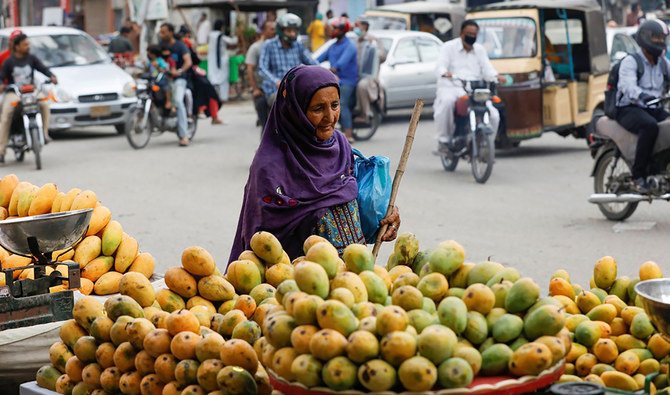
A woman walks past mango stalls at the retail market in Karachi on June 11, 2020. (REUTERS/File)
Short Url
Updated 21 August 2020
Follow

Pakistani mango export to Arab countries at 41% as export target surpassed

  • Despite the pandemic, the country exported 125,000 tons of mangoes worth $72 million against the season’s target of 80,000 tons
  • Pakistani exporters say they are confident the overall mango export would reach 150,000 tons in the next few weeks

KARACHI: Pakistan’s export of mangoes to Arab countries stood at 51,140 tons, or 41 percent of the country’s overall export of the fruit, during the current season, said exporters on Thursday, adding that the country sold more mangoes in the international market during the current season than expected and surpassed its target by 56 percent despite the COVID-19 constraints.
“During the current season, mango export increased by 45,000 tons to 125,000 tons mainly due to our aggressive marketing. The country has earned $72 million in revenue despite several challenges arising out of the COVID-19 pandemic,” Waheed Ahmed, patron-in-chief of the All Pakistan Fruit and Vegetable Exporters, Importers and Merchants Association (PFVA), told Arab News.


Pakistan’s de facto commerce minister, Abdul Razak Dawood, also commended the achievement, saying in a Twitter post: “I congratulate our mango exporters who have been able to achieve this remarkable result. A meeting is being arranged to strategize on a long term for exporting this great Pakistani product. Well done to all.”


Pakistani exporters had set a target of selling 80,000 tons of mangoes in the international market during the current season after the coronavirus outbreak that resulted in global lockdowns and travel suspensions. They are now confident, however, that the overall mango export would reach 150,000 tons since they are hoping to sell an additional 25,000 tons during the next one and a half months.
Mango season starts from May and lasts till the end of October, but Pakistani mangoes reached the Arab lands in June this year due to the coronavirus pandemic.
The 51,140 tons of mango or 41 percent of the country’s overall exports by August 14, 2020, was made to the Middle Eastern countries where, according to the PFVA data, the United Arab Emirates imported 33,019 tons, Oman 11,469 tons, Saudi Arabia 2,997 tons, Qatar 2,875 tons, Bahrain 1,685 tons, and Kuwait 580 tons.


Pakistani officials said that Arabs had developed the taste for Pakistani mangoes and the country was hoping to export even more of the fruit during the next season.
“Based on our promotional activities in the Gulf region, particularly Saudi Arabia, our exports are expected to increase by 30 to 40 percent if nothing unfavorable happens,” Ehtisham Farooq, trade development officer at the Embassy of Pakistan, told Arab News on the phone from Riyadh on Wednesday.
“This season was among the most difficult one for us,” Waheed Ahmed of the PFVA said. “However, we adopted aggressive and realistic marketing strategies and the government also supported us in this endeavor.”
“After the COVID-19 outbreak, Vitamin C became the most sought after food supplement and we made it part of our marketing strategy,” he added. “This worked particularly well in the Gulf region. We also got support from airline services that reduced freight charges by about 50 percent.”
Pakistan’s mango exports also benefitted from the country’s “mango diplomacy” that was carried out by the trade missions abroad that presented the fruit to officials and other high-profile individuals in foreign lands.
The Trade and Development Authority of Pakistan (TDAP) promoted mangoes in 24 cities across the world and sent the “gift of Pakistani mangoes” to 30 heads of states.
Pakistani exporters say they are optimistic they can take their country’s mango exports to 200,000 tons within three years. They also believe that the volume of the value-added mango products can be increased to $350 million within the same period. However, they are concerned about declining yield due to the changing climate which brought down the total production level from 1.8 million to 1.3 million tons last year, according to the PFVA. 


Pakistan opposition to continue protest over ex-PM Khan’s health amid conflicting reports

Updated 16 February 2026
Follow

Pakistan opposition to continue protest over ex-PM Khan’s health amid conflicting reports

  • Pakistan’s government insists that the ex-premier’s eye condition has improved
  • Khan’s personal doctor says briefed on his condition but cannot confirm veracity

ISLAMABAD: Pakistan’s opposition alliance on Monday vowed to continue their protest sit-in at parliament and demanded “clarity” over the health of jailed former prime minister Imran Khan, following conflicting medical reports about his eye condition.

The 73-year-old former cricket star-turned-politician has been held at the high-security Adiala prison in Rawalpindi since 2023. Concerns arose about his health last week when a court-appointed lawyer, Barrister Salman Safdar, was asked to visit Khan at the jail to assess his living conditions. Safdar reported that Khan had suffered “severe vision loss” in his right eye due to central retinal vein occlusion (CRVO), leaving him with just 15 percent sight in the affected eye.

On Sunday, a team of doctors from various hospitals visited the prison to examine Khan’s eye condition, according to the Adiala jail superintendent, who later submitted his report in the court. On Monday, a Supreme Court bench led by Chief Justice Yahya Afridi observed that based on reports from the prison authorities and the amicus curiae, Khan’s “living conditions in jail do not presently exhibit any perverse aspects.” It noted that Khan had “generally expressed satisfaction with the prevailing conditions of his confinement” and had not sought facilities beyond the existing level of care.

Having carefully perused both reports in detail, the bench observed that their general contents and the overall picture emerging therefrom are largely consistent. The opposition alliance, which continued to stage its sit-in for a fourth consecutive day on Monday, held a meeting at the parliament building on Monday evening to deliberate on the emerging situation and discuss their future course of action.

“The sit-in will continue till there is clarity on the matter of [Khan's] health,”  Sher Ali Arbab, a lawmaker from Khan's Pakistan Tehreek-e-Insaf (PTI) party who has been participating in the sit-in, told Arab News, adding that PTI Chairman Gohar Ali Khan and Opposition Leader in Senate Raja Nasir Abbas had briefed them about their meeting with doctors who had visited Khan on Sunday.

Speaking to reporters outside parliament, Gohar said the doctors had informed them that Khan’s condition had improved.

“They said, 'There has been a significant and satisfactory improvement.' With that satisfactory improvement, we also felt satisfied,” he said, noting that the macular thickness in Khan’s eye had reportedly dropped from 550 to 300 microns, a sign of subsiding swelling.

Gohar said the party did not want to politicize Khan’s health.

“We are not doctors, nor is this our field,” he said, noting that Khan’s personal physician in Lahore, Dr. Aasim Yusuf, and his eye specialist Dr. Khurram Mirza had also sought input from the Islamabad-based medical team.

“Our doctors also expressed satisfaction over the report.”

CONFLICTING ACCOUNTS

Despite Gohar’s cautious optimism, Khan’s personal physician, Dr. Yusuf, issued a video message on Monday, saying he could neither “confirm nor deny the veracity” of the government’s claims.

“Because I have not seen him myself and have not been able to participate in his care... I’m unable to confirm what we have been told,” Yusuf said.

He appealed to authorities to grant him or fellow physician, Dr. Faisal Sultan, immediate access to Khan, arguing that the ex-premier should be moved to Shifa International Hospital in Islamabad for specialist care.

Speaking to Arab News, PTI’s central information secretary Sheikh Waqas Akram said Khan’s sister and their cousin, Dr. Nausherwan Burki, will speak to media on Tuesday to express their views about the situation.

The government insists that Khan’s condition has improved.

“His eye [condition] has improved and is better than before,” State Minister Talal Chaudhry told the media in a brief interaction on Monday.

“The Supreme Court of Pakistan is involved, and doctors are involved. What medicine he receives, whether he needs to be hospitalized or sent home, these decisions are made by doctors. Neither lawyers nor any political party will decide this.”