

Saudi oil minister salutes the ‘three Cs’ of oil stability — cuts, compliance, compensation

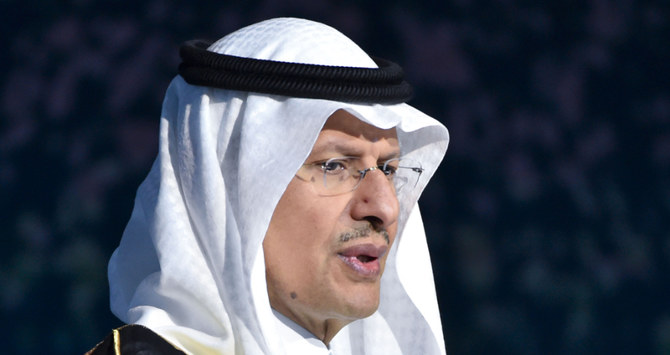
Saudi Energy Minister Prince Abdul Aziz bin Salman. (AFP)
Short Url
Updated 20 August 2020
Follow

Saudi oil minister salutes the ‘three Cs’ of oil stability — cuts, compliance, compensation

  • OPEC+ oil producers had achieved “unprecedented” levels of compliance with the historic cuts in April

 DUBAI: Global oil markets are “on the path to rebalancing” as OPEC+, the alliance led by Saudi Arabia and Russia, sticks by its tough new regime to limit crude production, Saudi Energy Minister Prince Abdul Aziz bin Salman said on Wednesday.

The minister said the improved outlook was due to increased demand as pandemic-hit economies re-open, but also because of what he called “the three Cs — cuts, compliance and compensation.”

“The world now recognizes that OPEC+ has been instrumental in bringing stability to oil markets, the energy industry and the global economy,” he said at the monthly virtual meeting of energy ministers to monitor world oil markets. Some energy experts have predicted oil demand will be at 97 per cent of pre-pandemic levels this year.

OPEC+ oil producers had achieved “unprecedented” levels of compliance with the historic cuts in April, with average compliance reaching 97 per cent and some members — notably Iraq and Nigeria — hitting record levels.

Both countries have also agreed to compensate OPEC+ for past over-production to help eliminate the oil surplus, but Prince Abdul Aziz hinted that the compensation deal would be phased out as markets approached rebalance.

“We should endeavor to put this temporary compensation regime behind us, by clearing all the past over-production by end of September,” he said.

The meeting closed with the level of cuts, 7.7 million barrels per day, unchanged. In private session, delegatesstressed the need to comply 100 per cent with agreed cuts.

Prince Abdul Aziz said there were encouraging signs of rebalancing between oil supply and demand in the draw-down of global oil inventories, the reduction in “floating storage” in tankers, and a recovery in demand for gasoline and diesel in many countries, including Saudi Arabia.

He warned, however, that “the jury is still out” on how fast and uniform the global economic recovery would be because of the ongoing threat from COVID-19.

Oil prices took some heart from the OPEC+ gathering. Brent crude, the global benchmark, traded at $45.95, more than 2 per cent up.


Saudi Aramco, ExxonMobil, Samref ink deal to study Yanbu refinery upgrade

Updated 08 December 2025
Follow

Saudi Aramco, ExxonMobil, Samref ink deal to study Yanbu refinery upgrade

RIYADH: Energy giants Saudi Aramco, ExxonMobil, and Samref have signed a venture framework agreement to upgrade the Yanbu refinery and expand it into an integrated petrochemical complex.

As a part of the deal, the companies will explore capital investments to upgrade and diversify production, including high-quality distillates that result in lower emissions and high-performance chemicals, according to a joint press statement.

The agreement will also see the parties explore opportunities to improve the refinery’s energy efficiency and reduce environmental impacts from operations through an integrated emissions-reduction strategy.

Samref is an equally owned joint venture between Aramco and Mobil Yanbu Refining Co. Inc., a wholly owned subsidiary of Exxon Mobil Corp.

The refinery currently has the capacity to process more than 400,000 barrels of crude oil per day, producing a diverse range of energy products, including propane, automotive diesel oil, marine heavy fuel oil, and sulfur.

“This next phase of Samref marks a step in our long-term strategic collaboration with ExxonMobil. Designed to increase the conversion of crude oil and petroleum liquids into high-value chemicals, this project reinforces our commitment to advancing Downstream value creation and our liquids-to-chemicals strategy,” said Aramco Downstream President, Mohammed Y. Al Qahtani.

He added that the deal will help position Samref as a key driver of the Kingdom’s petrochemical sector’s growth.

The press statement further said that companies will commence a preliminary front-end engineering and design phase for the proposed project, which would aim to maximize operational advantages, enhance Samref’s competitiveness, and help to meet growing demand for high-quality petrochemical products in Saudi Arabia.

The firms added that these plans are subject to market conditions, regulatory approvals, and final investment decisions by Aramco and ExxonMobil.

“We value our partnership with Aramco and our long history in Saudi Arabia. We look forward to evaluating this project, which aligns with our strategy to focus on investments that allow us to grow high-value products that meet society’s evolving energy needs and contribute to a lower-emission future,” said Jack Williams, senior vice president of Exxon Mobil Corp.