German group first to climb Pakistan peak after COVID-19 restrictions eased

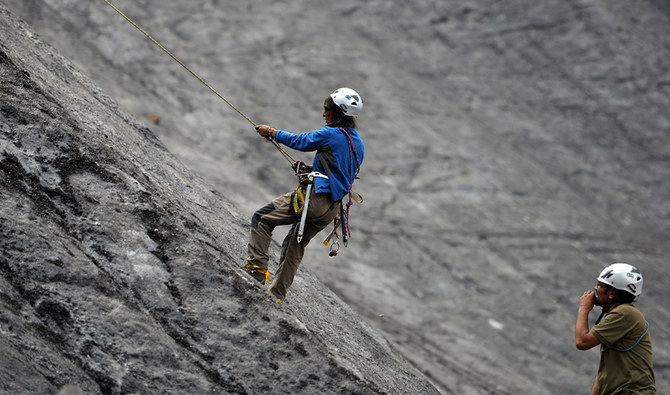
In this photograph taken on August 4, 2014, a Pakistani student from the Shimshal Mountaineering School climbs a slope on a glacier as trainer Niamat Karim (R) looks on near the Shimshal village in the northern Hunza valley. (AFP)
Short Url
Updated 17 August 2020
Follow

German group first to climb Pakistan peak after COVID-19 restrictions eased

  • Five-member team begins trek of 6,500mts mountain in Shimshal Valley
  • Follows Pakistan lifting its anti-virus lockdown on August 10 

ISLAMABAD: A group of five Germans will be the first foreigners to climb the over 6,500-meter-high peak in Shimshal Valley of Gilgit-Baltistan, after Pakistan lifted its anti-coronavirus restrictions last week and reopened its mountains for the trekking season. 

“A five-member German team led by climber Felix Berg arrived in Pakistan as the country has seen a significant drop in COVID-19 cases and is gradually returning to normalcy,” Karrar Haidri, Secretary Alpine Club of Pakistan told Arab News on Monday. 

Home to five of the world’s 14 tallest mountains, Pakistan had shut down its tourism sector in March this year to limit the spread of the coronavirus outbreak, which has killed 6,175 and infected 289,214 people thus far, out of a population of 220 million. 

Khyber Pakhtunkhwa and Gilgit-Baltistan, the two main hubs for domestic and international tourism, were the worst affected by the lockdown imposed five months ago.

Haidri said that while nearly 40 expeditions had been conducted and more than 100 foreign climbers and trekking groups had visited the country last year, the pandemic had dealt a severe blow to the tourism sector this year. He was, however, hopeful that the trend would pick up soon. 

“More foreigners are expected to arrive in the country in the coming days,” he said, without divulging more details. 


Pakistan to begin first phase of Hajj 2026 trainings from today

Updated 31 December 2025
Follow

Pakistan to begin first phase of Hajj 2026 trainings from today

  • Training programs to be held in phases across Pakistan till February, says religion ministry
  • Saudi Arabia allocated Pakistan a total quota of 179,210 pilgrims for Hajj 2026

ISLAMABAD: Pakistan’s religious affairs ministry has said that it will begin the first phase of mandatory Hajj 2026 training for pilgrims intending to perform the pilgrimage from today, Thursday.

The one-day Hajj training programs will be held in phases across the country at the tehsil level until February. The ministry directed intending pilgrims to bring their original identity cards and the computerized receipt of their Hajj application to attend the training sessions.

“Pilgrims should attend the one-day training program according to their scheduled date,” Pakistan’s Ministry of Religious Affairs (MoRA) said in a statement.

The ministry said training schedules are being shared through the government’s Pak Hajj 2026 mobile application as well as via SMS. It added that details of the schedule are also available on its website.

According to the ministry, training programs will be held in Abbottabad on Jan. 2; Ghotki, Thatta and Kotli on Jan. 3; and Tando Muhammad Khan and Khairpur on Jan. 4.

Hajj training sessions will be held in Rawalakot, Badin and Naushahro Feroze on Jan. 5, while pilgrims in Fateh Jang, Dadu and Tharparkar will receive the training on Jan. 6.

The ministry said training programs will be conducted in Umerkot and Larkana on Jan. 7, followed by sessions in Mirpurkhas, Shahdadkot and Mansehra on Jan. 8.

Pakistan’s religious affairs ministry has previously said these trainings will be conducted by experienced trainers and scholars using multimedia.

It said the training has been made mandatory to ensure that intending pilgrims are fully aware of Hajj rituals and administrative procedures.

Saudi Arabia has allocated Pakistan a quota of 179,210 pilgrims for Hajj 2026, of which around 118,000 seats have been reserved under the government scheme, while the remainder will be allocated to private tour operators.

Under Pakistan’s Hajj scheme, the estimated cost of the government package ranges from Rs1,150,000 to Rs1,250,000 ($4,049.93 to $4,236), subject to final agreements with service providers.