Pakistan launches ‘mango diplomacy’ to enhance export to Saudi Arabia

Pakistan’s embassy in Saudi Arabia organized a mango festival in Riyadh on August 14, 2020, to mark the country’s Independence Day and promote Pakistani fruits and vegetables in the kingdom. (Photo courtesy Pakistan’s embassy in Riyadh)
Short Url
Updated 16 August 2020
Follow

Pakistan launches ‘mango diplomacy’ to enhance export to Saudi Arabia

  • Officials say the country’s overall export to the kingdom surged by 19 percent in July 2020 
  • Pakistan’s overall fruit and vegetable exports recorded an increase of 12.5 percent to $730 million in FY20 

KARACHI: Pakistan’s embassy in Saudi Arabia organized a mango festival in Riyadh on Friday to promote different varieties of the famous Pakistani fruit on the 74th Independence Day of the country.

“The mango festival is part of the mango diplomacy initiative of Pakistan to introduce different varieties of Pakistani mangoes worldwide to different nationalities and ethnicities,” said an official statement issued by the country’s diplomatic mission.

The event was inaugurated by the country’s envoy in Saudi Arabia, Raja Ali Ejaz, and it was attended by Arab dignitaries, diplomats and people belonging to different nationalities.
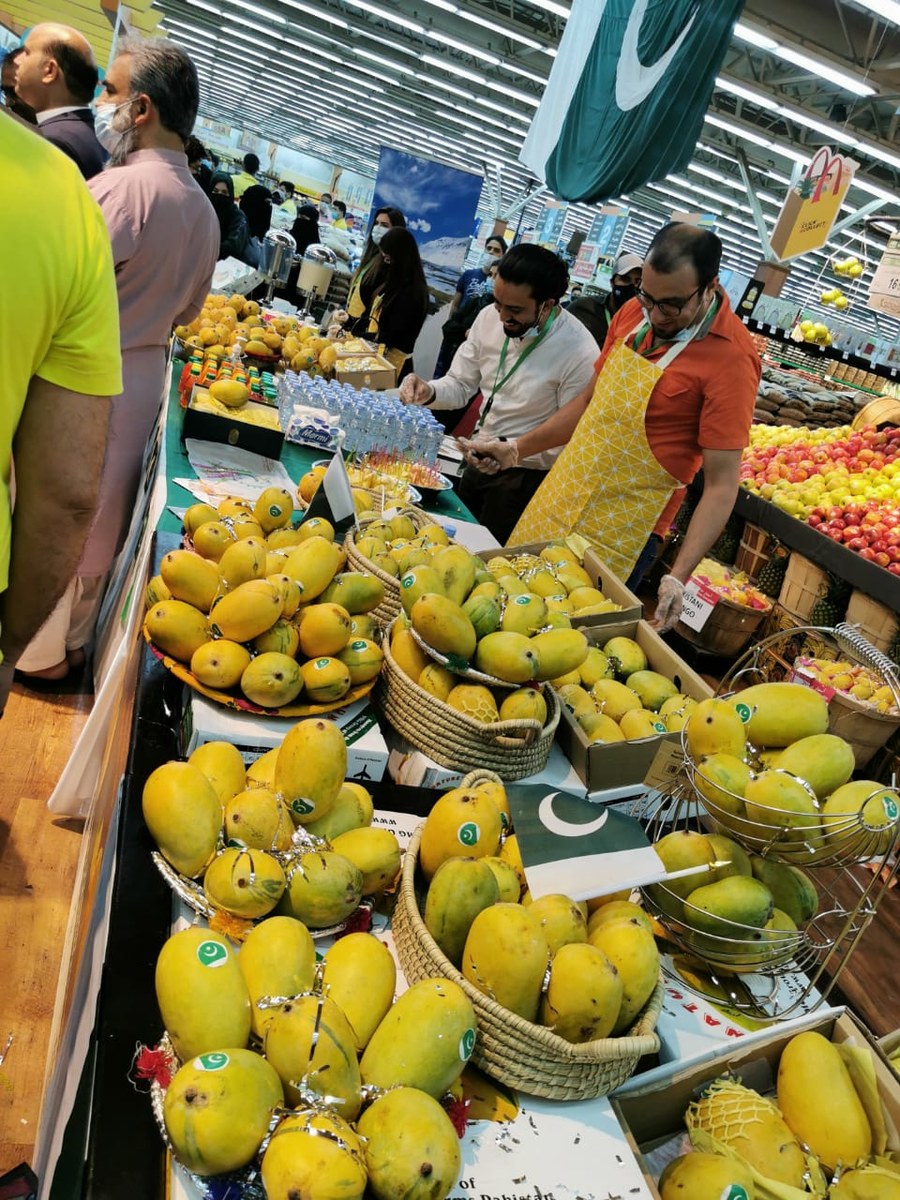


Pakistan’s embassy in Saudi Arabia organized a mango festival in Riyadh on August 14, 2020, to mark the country’s Independence Day and promote Pakistani fruits and vegetables in the kingdom. (Photo courtesy Pakistan’s embassy in Riyadh) 

“Arabs have developed a taste for Pakistani mangoes,” Azhar Ali Dahar, who works with the trade and investment wing of the Pakistan embassy in Riyadh, told Arab News on the phone. “The Pakistani mango is now being imported not only from Pakistan but also from other Middle Eastern markets.”

Pakistani diplomats in the kingdom are optimistic that their country’s export of mango will increase by 30 to 40 percent during the next season.

“We have gifted about 1,000 kilograms of mangoes to the notables of the kingdom and hope that this will bring about further growth in the export of the fruit during the next season,” Ehtisham Farooq, trade development officer at the embassy, said.

Pakistan’s overall exports to Saudi Arabia also recorded an increase of 18.85 percent during the first month of the current fiscal year as compared to the same month last year as the country’s trade mission in the kingdom adopted a product diversification strategy.
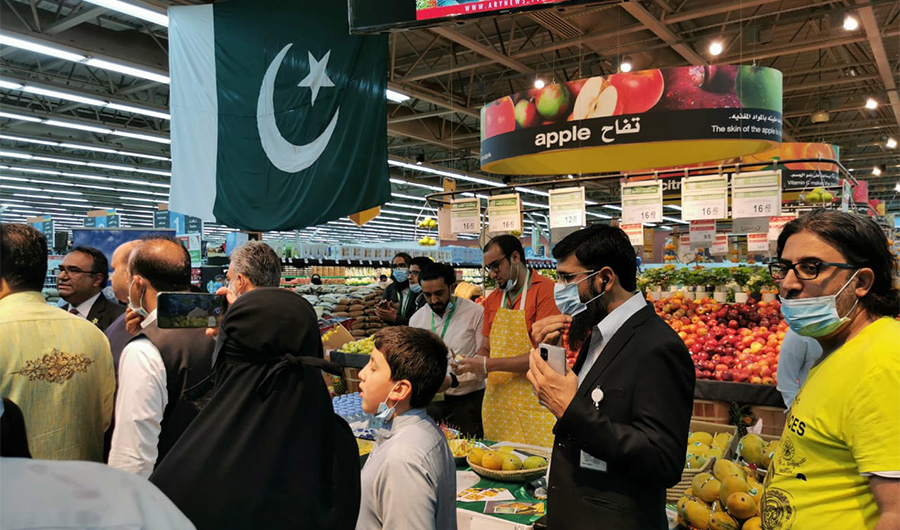


Pakistan’s embassy in Saudi Arabia organized a mango festival in Riyadh on August 14, 2020, to mark the country’s Independence Day and promote Pakistani fruits and vegetables in the kingdom. (Photo courtesy Pakistan’s embassy in Riyadh) 

“During July 2020, Pakistan’s export to the kingdom witnessed a surge of 18.85 percent to $42.32 million as compared to $35.61 million worth of exports in July 2019,” Dahar said. “The demand for food items has also increased the demand of Pakistani products during and after the virus-related lockdown.”

“We are also negotiating with local authority to allow the import of fish from Pakistan which will further increase our exports,” he added.

During the outgoing fiscal year, despite the all the impediments caused by the novel coronavirus, the country’s export of fruits and vegetables surged by 12.5 percent, amounting to $730 million.

“Pakistani exporters adopted land and sea routes when it became difficult to export their products by air,” Waheed Ahmed, patron-in-chief of the All Pakistan Fruit and Vegetable Exporters, Importers and Merchants Association, said.

“The federal government extended its support and assistance to the exporters and took timely decisions in removing barriers to the enhancement of exports,” he added.

Ahmed noted that the efforts also resulted in the reduction of air freight, facilitating exporters to compete in the highly demanding Middle Eastern and Gulf markets.

Pakistan’s imports from Saudi Arabia also increased by 5.57 percent to $162.55 million in July 2020 as compared to $153.97 million in July 2019. Pakistan’s overall exports during July 2020 increased by six percent to $2 billion.


Anti-fuel smuggling drive boosts Pakistan revenues 82%, PM office says

Updated 9 sec ago
Follow

Anti-fuel smuggling drive boosts Pakistan revenues 82%, PM office says

  • Crackdown targets illegal petroleum trade using GPS tracking and pump registration
  • July–November gains cited as government intensifies tax, customs enforcement

ISLAMABAD: The Pakistani prime minister’s office said on Friday revenues from petroleum products rose 82% between July and November 2025 after a nationwide crackdown on fuel smuggling, as the government steps up enforcement to curb tax evasion and losses that have long strained public finances.

The increase was cited during a weekly performance review of the Federal Board of Revenue (FBR), where Prime Minister Shehbaz Sharif directed authorities to accelerate action against smuggling and tax evasion, according to a statement issued by the PM’s Office.

Fuel smuggling has been a persistent problem in Pakistan, where subsidised or untaxed petroleum products are often trafficked across borders or sold through unregistered pumps, depriving the state of revenue and distorting domestic energy markets. Successive governments have blamed the practice for billions of rupees in annual losses, while international lenders have repeatedly urged tighter enforcement as part of broader fiscal reforms.

“Every year the nation loses billions due to smuggling,” Sharif was quoted as saying in a statement, praising customs authorities for successful operations and noting that revenues from petroleum products increased by 82% from July to November 2025 compared with the same period last year.

The PM said stricter enforcement had brought several goods back into the formal economy, adding that there would be “no leniency” toward those involved in tax evasion or illegal trade.

Officials briefed the prime minister that Pakistan Customs has rolled out a nationwide enforcement framework, including GPS tracking of petroleum product transportation, registration of fuel stations through a digital monitoring system, and legal action against illegal machinery under updated petroleum laws.

The government has also instructed provincial administrations to cooperate fully with federal authorities in shutting down illegal petrol pumps, the statement said.

Sharif said enforcement efforts would continue until smuggling networks were dismantled and tax compliance improved, as the government seeks to strengthen revenues amid ongoing economic reforms.

Pakistan has struggled for years with weak tax collection and a narrow revenue base, forcing repeated bailouts from the International Monetary Fund. Smuggling of fuel, cigarettes, electronics and consumer goods has been identified by policymakers as a major obstacle to improving revenues and stabilising the economy.

Independent research shows that Pakistan loses an estimated Rs750 billion (about $2.7 billion) annually in tax revenue due to illicit trade and smuggling across sectors such as petroleum, tobacco and pharmaceuticals. Broader analyzes suggest total tax revenue losses linked to the informal economy and smuggling may reach as high as Rs3.4 trillion (around $12.1 billion) a year, roughly a quarter of the government’s annual tax targets.

Smuggled petroleum products alone are thought to cost the state about Rs270 billion (around $960 million) a year in lost revenue, underscoring why authorities have focused recent enforcement efforts on fuel tracking and pump registration.