Iran cries victory after UN rejects US bid to extend arms embargo

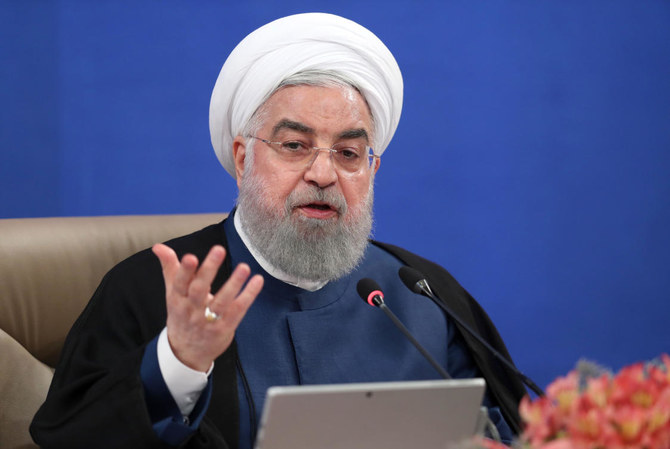
President Hassan Rouhani said the United States had failed to kill off what he called the “half alive” 2015 deal. (File/AFP)
Short Url
Updated 15 August 2020
Follow

Iran cries victory after UN rejects US bid to extend arms embargo

  • Only two of the Council’s 15 members voted in favor of the US resolution seeking to extend the embargo
  • The result increases the likelihood that the US will try to unilaterally force a return of UN sanctions

TEHRAN: Iran on Saturday hailed a UN Security Council vote rejecting a US bid to extend an arms embargo on the Islamic republic, saying its foe has “never been so isolated.”
President Hassan Rouhani said the United States had failed to kill off what he called the “half alive” 2015 deal with major powers that gave Iran relief from sanctions in exchange for curbs on its nuclear program.
“The United States failed in this conspiracy with humiliation,” Rouhani told a televised news conference.
“In my opinion, this day will go down in the history of our Iran and in the history of fighting global arrogance.”
Only two of the Council’s 15 members voted in favor of the US resolution seeking to extend the embargo, highlighting the division between Washington and its European allies since President Donald Trump withdrew from the Iran nuclear accord in May 2018.
Washington’s European allies all abstained, and Iran mocked the Trump administration for only winning the support of one other country, the Dominican Republic.
“In the 75 years of United Nations history, America has never been so isolated,” said foreign ministry spokesman Abbas Mousavi.
“Despite all the trips, pressure and the hawking, the United States could only mobilize a small country (to vote) with them,” he tweeted.
The result increases the likelihood that the US will try to unilaterally force a return of UN sanctions, which experts say threatens to plunge the Council into one of its worst-ever diplomatic crises.
“The Security Council’s failure to act decisively in defense of international peace and security is inexcusable,” said US Secretary of State Mike Pompeo.
The embargo on conventional arms is due to expire on October 18 under the terms of a resolution that blessed the Iran nuclear deal, officially known as the Joint Comprehensive Plan of Action.
Since Trump pulled out of the JCPOA and slapped unilateral sanctions on Iran under a campaign of “maximum pressure,” Tehran has since taken small but escalating steps away from compliance with the nuclear accord as it presses for sanctions relief.
European allies of the United States — who, along with Russia and China, signed the deal with Iran — have voiced support for extending the 13-year-long conventional arms embargo, saying an expiry threatens stability in the Middle East.
However, their priority is to preserve the JCPOA.
The US text, seen by AFP, effectively called for an indefinite extension of the embargo on Iran, which diplomats said would threaten the nuclear agreement.
Iran says it has the right to self-defense and that a continuation of the ban would mean an end to the nuclear deal.
Pompeo announced that members had failed to back the proposal around 30 minutes before Indonesia, the current president of the Security Council, announced that the official results included two votes against and 11 abstentions.
Russia and China opposed the resolution.
“The result shows again that unilateralism enjoys no support, and bullying will fail,” China’s UN mission tweeted.
Ambassador Gunter Sautter of Germany, which abstained, said “more consultations are needed” to find a solution that is acceptable to all council members.
During a call between Trump and French President Emmanuel Macron, the leaders “discussed the urgent need for UN action to extend the arms embargo on Iran.”
Hours earlier, Russian President Vladimir Putin called on China, France, Russia, Britain, the US, Germany and Iran to convene an emergency video summit to avoid an escalation of tensions in the Gulf.
Washington has threatened to try to force a return of UN sanctions if it is not extended by using a controversial technique called “snapback.”
Pompeo has offered the contested argument that the US remains a “participant” in the nuclear accord as it was listed in the 2015 resolution — and therefore can force a return to sanctions if it sees Iran as being in violation of its terms.
European allies have been skeptical on whether Washington can force sanctions and warn that the attempt may delegitimize the Security Council.
Nevertheless, the US is expected to deliver the snapback letter next week, AFP understands.
Analysts suspect that Washington purposefully put forward a hard-line draft that it knew Council members would not be able to accept.
“The fact is that everybody at the UN believes this (resolution) is just a prelude to a US effort to trigger snapback and sink the Iranian nuclear deal,” Richard Gowan, a UN expert at the International Crisis Group, told AFP.


Sudan’s war puts charity kitchen workers feeding displaced families at risk

Updated 7 sec ago
Follow

Sudan’s war puts charity kitchen workers feeding displaced families at risk

CAIRO: Enas Arbab fled Sudan’s western region of Darfur after her hometown fell to Sudanese paramilitary forces, taking only her year-old son with her and the memory of her father, who was killed, she said, simply for working at a charity kitchen serving people displaced by the fighting.
The Rapid Support Forces — or RSF, a paramilitary group that has been at war with the Sudanese army since April 2023 — had laid siege on el-Fasher in the western Darfur region, starving people out before it overran the city.
UN officials say several thousand civilians were killed in the RSF takeover of el-Fasher last October. Only 40 percent of the city’s 260,000 residents managed to flee the onslaught, thousands of whom were wounded, the officials said. The fate of the rest remains unknown.
During the fighting, Arbab says RSF fighters took her father, Mohamed ِArbab, from their home after beating him in front of the family, and demanded a ransom. When the family couldn’t pay, they told them they had killed him, she says. To this day, the family doesn’t know where his body is.
When her husband disappeared a month later, Enas Arbab decided to flee north, to Egypt. “We couldn’t stay in el-Fasher,” she said. “It was no longer safe and there was no food or water.”
Her father was one of more than 100 charity kitchen workers who have been killed since the war began, according to workers who spoke with The Associated Press and the Aid Workers Security database, a group that tracks major incidents around the world impacting aid workers.
In areas of intense fighting — especially in Darfur — famine is spreading and food and basic supplies are scarce. The community-led public kitchens have become a lifeline but many working there have been abducted, robbed, arrested, beaten or killed.
Grim numbers in a brutal war
Volunteer Salah Semsaya with the Emergency Response Rooms — a group that emerged as a local initiative and now operates in 13 provinces across Sudan, with 26,000 volunteers — acknowledges the dangers faced by workers in charity kitchens.
The real number of workers killed is likely far higher than the estimated 100, he says, but the war has prevented reliable data collection and record-keeping.
Semsaya shared records showing that 57 percent of the documented killings of charity kitchen workers occurred in Khartoum, mainly while the Sudanese capital was under RSF control, before the army retook it last March. At least 21 percent of the killings were in Darfur.
More than 50 of those killed in Khartoum worked with his group, Semsaya said.
Sudan’s war erupted after tensions between the army and the RSF escalated into fighting that began in Khartoum and spread nationwide, killing thousands and triggering mass displacement, disease outbreaks and severe food insecurity. Aid workers were frequently targeted.
Dan Teng’o, communications chief at the UN office for humanitarian affairs, says it’s unclear whether charity kitchen workers are targeted because of their work or because of their perceived affiliation with one side or other in the war.
The kitchen workers are prominent in their communities because of the work they do, making them obvious targets, activists say. Ransom demands typically range from $2,000 to $5,000, often rising once families make initial payments.
“A clear deterioration in the security context ... has significantly affected local communities, including volunteers supporting community kitchens,” Teng’o said.
Kitchen workers face risks
Farouk Abkar, a 60-year-old from el-Fasher, spent a year handing out sacks of grain at a charity kitchen in Zamzam camp, just 15 kilometers (9 miles) south of the city. He survived drone strikes and remembers the day RSF fighters attacked his kitchen. One of them punched him in the face, knocking some of his teeth out.
Abkar said he fled el-Fasher at night with his daughter, walking for 10 days. Along the way, some RSF fighters fired birdshot, which hit him in the head, leaving a chronic headache.
Now in Egypt, he shares an apartment with at least 10 other Sudanese refugees and can’t afford medical care. The harrowing images from his hometown still haunt him.
“Many things happened in el-Fasher,” he said. “There was death. There was starvation.”
Mustafa Khater, a 28-year-old charity kitchen worker, fled with his pregnant wife to Egypt a few days before el-Fasher fell to the RSF.
During the 18-month siege, some el-Fasher residents collaborated with the RSF, telling the paramilitary fighters who the kitchen workers were, Khater said. Many disappeared.
“They would take you to an area where there is a dry riverbed and kill you there,” Khater said.
A volunteer working with Semsaya’s aid group in Darfur said some of his colleagues were beaten, arrested and interrogated, with their attackers accusing them of receiving “illicit funds” for the kitchen. The volunteer spoke on condition of anonymity for fear of reprisals.
Despite the challenges, many charity kitchens remain the only reliable food source in areas gripped by conflict and a place people can come to and give each other support, Semsaya said.
Struggling to feed thousands
The town of Khazan Jedid in East Darfur province has three charity kitchens feeding about 5,000 people daily, said Haroun Abdelrahman, a spokesperson for the Emergency Response Rooms’ branch in the area.
Abdelrahman says he was once interrogated by RSF fighters, while several of his colleagues have been robbed at knifepoint. Despite the fear and harassment, many kitchen workers are still volunteering and working, he said.
In Kassala in eastern Sudan, military agents questioned a volunteer with the branch there and his colleagues in January 2024, he said, after their kitchen started serving food and providing shelter to people who escaped nearby Wad Madani when RSF seized that town. He also spoke anonymously for fear of reprisals.
Khater, the 28-year-old who fled el-Fasher, said he heard from friends back home that after the RSF takeover, all charity kitchens in the city closed and his colleagues were either “killed or fled.”
Teng’o says the closures in areas of fighting have left “vulnerable households with no viable alternatives” and forced people to shop at local “markets where food prices are unaffordable.”
Arbab, the pregnant 19-year-old who fled with her baby boy, had hoped to rebuild her life in Egypt, her friends and a humanitarian worker said, speaking on condition of anonymity to talk about the young mother.
But while on the road to the northern city of Alexandria last month, she and her son were stopped by Egyptian authorities and deported back to Sudan.