

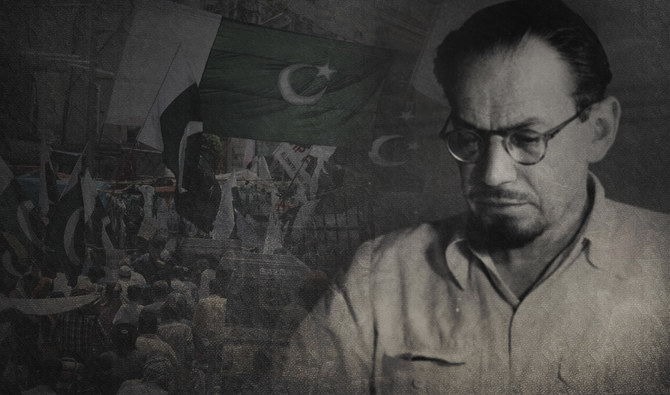

ISLAMABAD/WARSAW: Leopold Weiss, born to a Jewish family in the Polish city of Lwów, was a journalist who ardently advocated the Palestinian cause, a friend to the founding monarch of Saudi Arabia, and the translator of one of the most popular English versions of the Qur’an.
He was also the first person to officially become a Pakistani citizen.
“Muhammad Asad was the first citizen of Pakistan; he was the first one to get a Pakistani passport,” Dr. Ikram Chughtai, a prominent Pakistani historian, told Arab News.
The journey of how Asad came to carry the first Pakistani passport winds through the then Polish part of the Austrian Empire, Palestine, the Saudi cities of Makkah and Medina, and ends in India and what is present day Pakistan.
Indeed, Asad, who spent most of his adult life in the Middle East and South Asia and in 1926 converted to Islam and changed his name.
His interest in the Indian subcontinent was sparked during a stay in Saudi Arabia in the late 1920s where he met Indian expats and decided to travel to the region.
He arrived by ship in Karachi in June 1932, and then went onwards to Lahore where he met Allama Mohammad Iqbal, Pakistan’s national poet and ideological father.
Iqbal convinced Asad to stay in India and join the freedom movement that would lead to the partition of India in 1947 and the birth of a new nation, Pakistan, after independence from British rule. Later, Iqbal would also ask him to help draft the Islamic foundations of the emerging state.
In 1939, when World War II broke out, Asad, who still held an Austrian passport, was arrested by British authorities after Austria joined Nazi Germany against the allied powers. He spent the next six years in internment camps with Germans and Austrians captured across British-ruled territories in Asia.
“I was the only Muslim, and the Muslim soldiers who watched me wanted to let me escape, but I steered away from that,” Asad told German journalist Karl Guenter Simon who interviewed him and his wife at their final home in Spanish Andalusia in 1988.
Upon his release, Asad devoted himself to shaping the framework of a Muslim state for Pakistan, soon becoming involved in a diplomatic mission to Saudi Arabia.
“After its formation, Pakistan had no embassy in the (Saudi) kingdom,” Chughtai, the historian, said. “All matters related to Pakistani pilgrims were looked after by the country’s mission in Cairo. Pakistan wanted to send Muhammad Asad to Saudi Arabia in 1947 on an official visit to represent the newly formed state.”
But Asad had no travel documents valid for a visit to Saudi Arabia, as Pakistan has no passport laws at the time.
“Asad then went to Liaquat Ali Khan,” Chughtai said, referring to Pakistan’s first prime minister. “On Ali Khan’s special instruction, he was given the first passport issued by the Pakistani government. He kept that passport until his death in 1992.”
Asad’s lifelong association with Saudi Arabia began in 1927 during a Hajj trip to Makkah where he met and befriended King Abdulaziz Al-Saud, the first ruler of the kingdom.
“The king invited me to stay in his realm,” Asad said in what is believed to be his last television interview, to the Islamic Information Service (IIS). “And I stayed for six years without interruption ... It was a wonderful experience, a wonderful time … He was one of the most outstanding men I have known.”
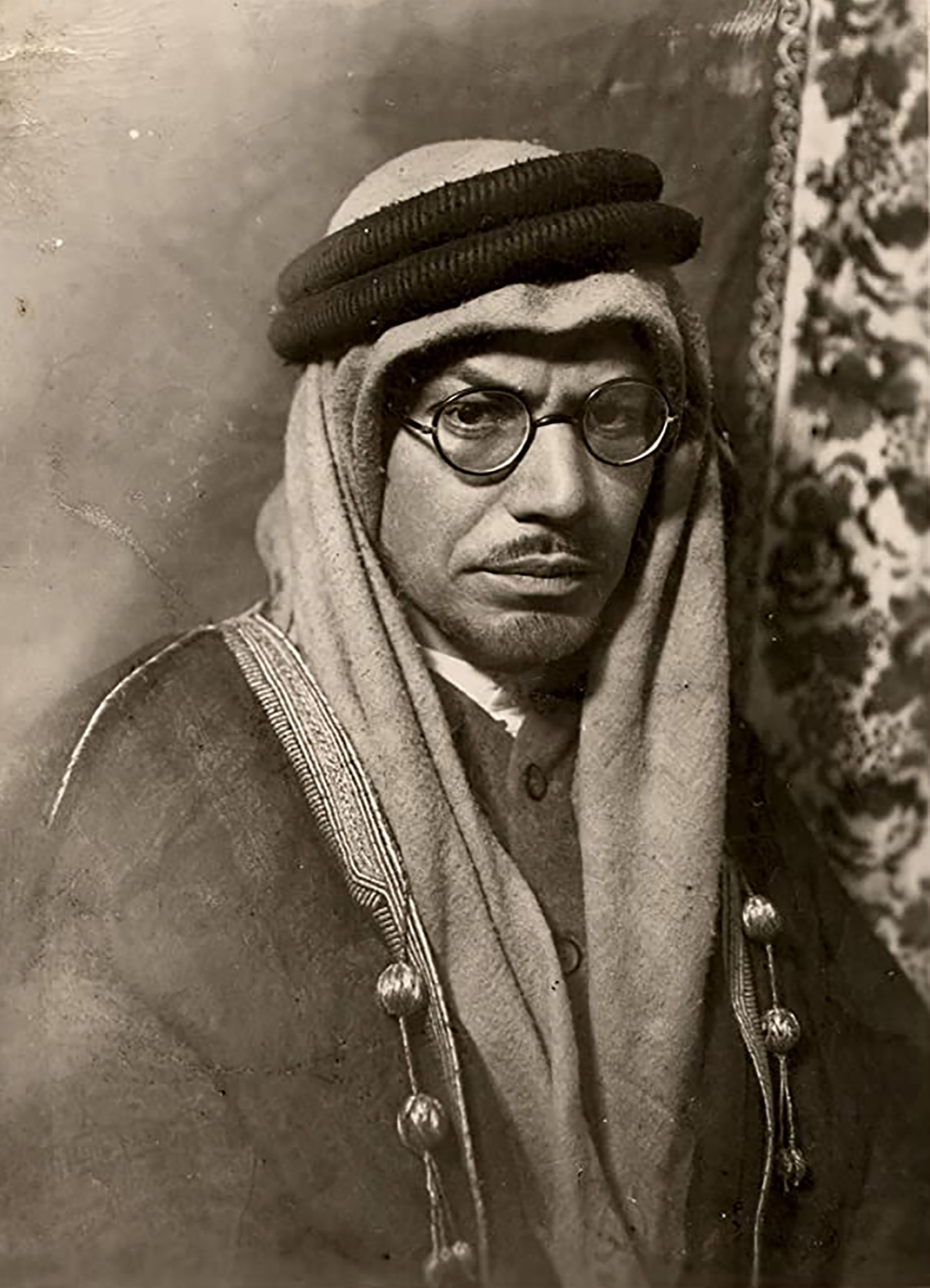
Muhammad Asad during his stay in Saudi Arabia in 1928. (Photo courtesy of Mischief Films via AN)
Asad remained close to the Saudi royal family and many years later, would use this affinity to help forge Saudi-Pakistani ties.
“Muhammad Asad was the pioneer in the establishment of friendly relations between Pakistan and Saudi Arabia. He was very close to Prince Faisal who was the foreign minister of Saudi Arabia at that time,” Chughtai said, adding that Asad had also known Prince Faisal, King Abdulaziz’s son and successor to the throne.
The personal ties with Saudi Arabia not only served the cause of Pakistani diplomacy but also Asad’s most important work — an English translation and interpretation of the Qur’an that he started to work on in the 1960s, with support from Prince Faisal.
In 1980, Asad published the full translation and commentary titled “The Message of the Qur’an,” which to date remains one of the most popular English versions of the holy scripture.
The volume was the culmination of a love affair with Islam and the Muslim world that began much earlier — in Palestine.
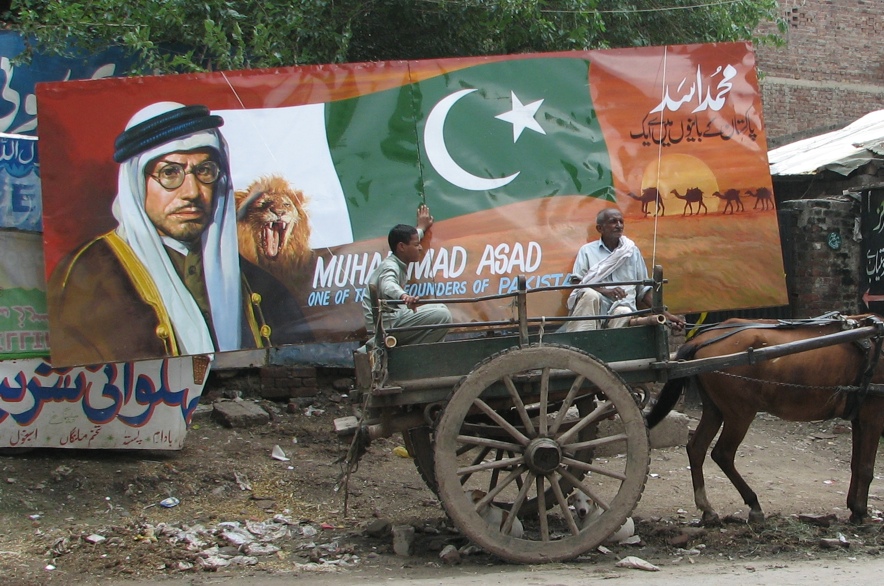
A still from "Der Weg nach Mekka," a 2008 documentary film directed by Georg Misch, shows a poster picturing Muhammad Asad during Independence Day celebrations in Pakistan. (Photo courtesy of Mischief Films via AN)
Asad was invited by his maternal uncle, a psychiatrist, to visit Jerusalem in 1922 and it is there that he learnt Arabic and became a Middle East correspondent for the Frankfurter Zeitung, where he wrote against zionism, British rule, and Muslim and Arab nationalism.
“I became averse to the idea of zionism from the very first moment of my contact with it,” Asad said in the IIS interview. “I felt from the very first moment that the aim of Jewish colonization of Palestine, by doing wrong to the Arabs, was immoral.”
Asad converted to Islam in the presence of an Indian imam, Abdul Jabbar Kheiri, the head of the Muslim community in Berlin. It was also Kheiri who suggested he change his name.
Asad recounted Kheiri’s words in the IIS interview: “He said ‘wait, your name is Leopold, Leo ... Lion. In Arabic it is Asad. Let your name be Muhammad Asad.’ And so I became Muhammad Asad, from that day on.”
It was a beautiful fit: Lwów, the name of the city of Asad’s birth, comes from the word “lew,” which also means lion.


