

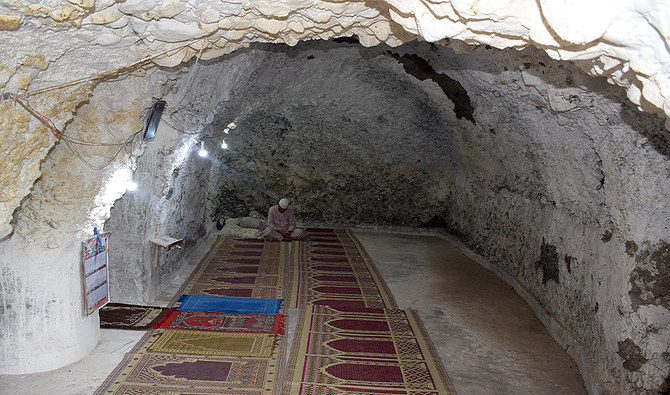
In northwestern Pakistan, a centuries-old mosque in a cave

A man reads the Quran inside the Ghar-e-Sur mosque in the South Waziristan tribal district in Pakistan on August 13, 2020. (AN Photo)
Short Url
Updated 16 August 2020
Follow

In northwestern Pakistan, a centuries-old mosque in a cave

  • Locals estimate the Ghar-e-Sur mosque in the South Waziristan tribal district is at least 300 years old
  • Archaeology department says planning restoration of heritage sites in tribal districts, including the cave mosque

SARAROGHA: At an old mosque located inside a cave in a mountainous region of northwestern Pakistan, prayers are offered five times a day. In its 300-year history, worship at the mosque has stopped only once, during military operations in the region a decade ago.
The Ghar-e-Sur mosque in Sararogha in Pakistan’s South Waziristan tribal district is a mountain tunnel with a single entrance and arches in the main prayer hall reflecting traditional tribal architecture. The mosque’s prayer leader said it could house 250 people at a time.
“We call it central Ghar-e-Sur mosque,” tribal elder Sayed Abdullah Noor told Arab News. “I am almost 65-years old. My great-grandfather said his forefather told him the mosque was built by them, which means that it is about 300 years old.”
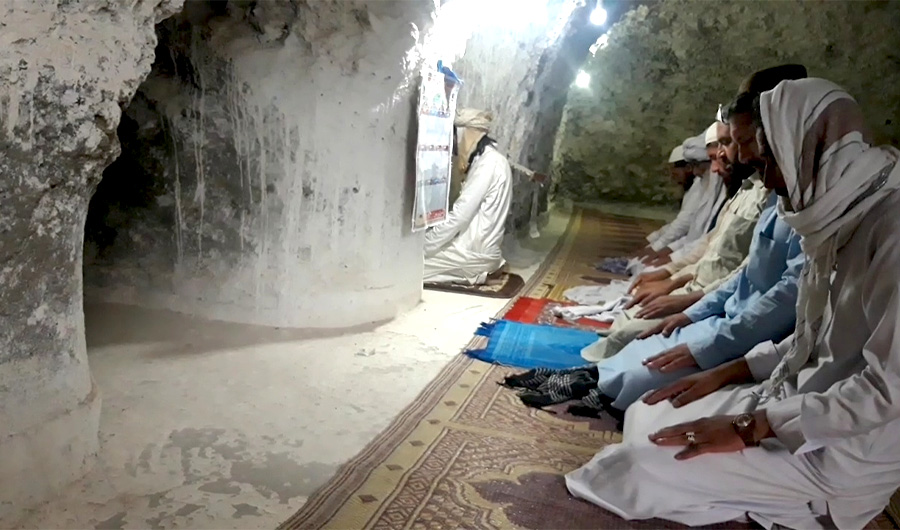


Locals offer prayers inside the Ghar-e-Sur mosque in the South Waziristan tribal district in Pakistan on August 13, 2020. (AN Photo)

The mosque also serves as a Qur’anic school, prayer leader Sayed Khairullah said, saying children from a nearby village came for lessons every day.

The mosque was abandoned when the Pakistan army launched a military operation against Taliban militants in South Waziristan in 2009. When operations eased and locals returned to the area three years later, they found the mosque in a dilapidated state.
“The mosque has no boundary wall, no proper water and electricity facilities,” Khairullah said. “The government should help protect this heritage.”


A prayer leader teaches the Quran to children outside the Ghar-e-Sur mosque in the South Waziristan tribal district in Pakistan on August 13, 2020. (AN Photo)

Fawad Khan, assistant curator at the provincial archaeology department, told Arab News funds would be allocated for the restoration of heritage sites in Khyber Pakhtunkhwa’s tribal districts, including Ghar-e-Sur mosque.
“We are planning a detailed survey to list national heritage sites throughout tribal districts, which will be completed in 2021,” he said, “After the survey, we will repair and preserve them.” 


Pakistan engages Saudi Arabia, China in bid to ease surging Middle East tensions 

Updated 10 March 2026
Follow

Pakistan engages Saudi Arabia, China in bid to ease surging Middle East tensions 

  • Pakistan’s foreign minister stresses need for de-escalation in conversations with Chinese, Saudi counterparts
  • Tensions in the Middle East continue to remain high as conflict between US, Israel and Iran intensifies

ISLAMABAD: Pakistan’s Deputy Prime Minister Ishaq Dar spoke to the foreign ministers of Saudi Arabia and China on Tuesday, stressing the importance of diplomatic engagement to de-escalate tensions in the Middle East as the Iran war intensifies. 

Pakistan has constantly engaged regional countries in efforts to broker a ceasefire in the Middle East, after the US and Isreal launched coordinated strikes against Iran on Feb. 28. 

Iran launched fresh attacks on Gulf countries on Tuesday morning, where it has targeted US military bases in recent weeks. In addition to firing missiles and drones at Israel and American bases in the region, Iran has also been targeting energy infrastructure which, combined with its stranglehold on the Strait of Hormuz, has sent oil prices soaring worldwide. 

Dar spoke to Saudi Foreign Minister Prince Faisal bin Farhan to discuss developments in the Middle East and ongoing deliberations at the UN Security Council, Pakistan’s foreign office said in a statement. 

“DPM/FM shared Pakistan’s perspective, underscoring the importance of continued coordination and diplomatic engagement to support de-escalation and promote peace and stability across the region and beyond,” the statement said. 

Dar, who also serves as Pakistan’s foreign minister, spoke to Chinese foreign minister Wang Yi over the telephone separately. The two discussed the evolving regional situation and broader global developments.

Dar underscored the need to ease tensions in the Middle East and the wider region during the conversation, the foreign office said. 

Yi appreciated Pakistan’s constructive efforts aimed at promoting de-escalation and stability in the region, it added. 

“The two leaders stressed the importance of de-escalation and emphasized the need to pursue dialogue and diplomacy in accordance with the principles of the UN Charter,” the foreign office’s statement said. 

The conflict in the Middle East has hit Pakistan hard as well, forcing Islamabad to hike petrol and diesel prices by Rs55 per liter last Friday. 

Pakistan’s government has also announced a set of austerity measures, which include closing schools and cutting down on government expenditures, as it evaluates petrol stocks and looks for alternative supply routes.