Greece thanks France for pledge to boost forces in east Med

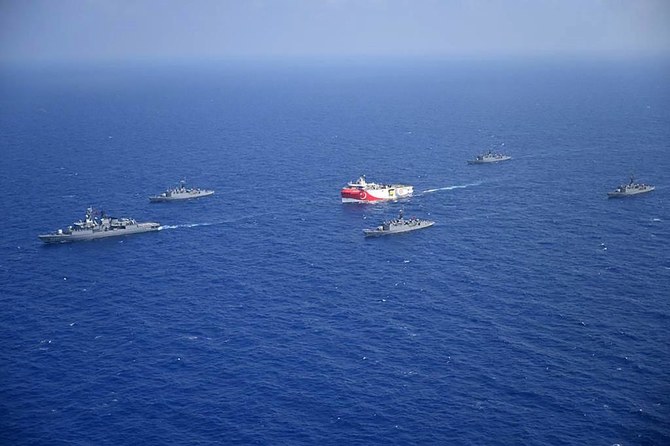
The mounting tension follows Turkey’s move Monday to send a seismic research vessel, escorted by warships, into waters between the Greek island of Crete and Cyprus to prospect for potential offshore gas and oil reserves. (File/AFP)
Short Url
Updated 13 August 2020
Follow

Greece thanks France for pledge to boost forces in east Med

  • Macron announced a temporary reinforcement of French military in Eastern Mediterranean
  • Mitsotakis warned of the “risk of an accident” in the contained area where the Greek and Turkish warships are gathered

ATHENS, Greece: Greece’s prime minister warmly thanked France Thursday for its pledge to boost its military presence in the eastern Mediterranean, where Greek and Turkish warships are closely shadowing each other over a Turkish energy exploration bid in waters Athens claims as its own.
Kyriakos Mitsotakis tweeted that French President Emmanuel Macron is “a true friend of Greece and also a fervent protector of European values and international law.”
Macron announced following a phone call with Mitsotakis late Wednesday that he has decided to “temporarily reinforce the French military presence in the Eastern Mediterranean in the coming days, in cooperation with European partners including Greece.”
Greece’s NATO and European Union ally France is the EU’s biggest military power. Complicating matters, Turkey — Greece’s historic regional rival — is also a NATO member but has poor relations with France.
The mounting tension follows Turkey’s move Monday to send a seismic research vessel, escorted by warships, into waters between the Greek island of Crete and Cyprus to prospect for potential offshore gas and oil reserves, following similar discoveries in other parts of the region.
Greece claims part of the area is over its own continental shelf and has demanded that the Turkish ships withdraw. Turkey counters that it’s entitled to conduct research in the area. Greece placed its military on alert, and sent warships to the area off Turkey’s southern coast.
In a televised statement Wednesday, Mitsotakis warned of the “risk of an accident” in the contained area where the Greek and Turkish warships are gathered.
“In such a case, responsibility lies upon the one who gives rise to these circumstances,” he said. He added that Greece is not averse to “even the toughest dialogue,” but that “dialogue becomes irrelevant in a climate of tension and provocation.”
“We will never be the ones to escalate the situation. Yet, self-restraint is only one aspect of our power,” Mitsotakis said. “No provocation will ... go unanswered.”
On Thursday, Greek Foreign Minister Nikos Dendias traveled to Israel for talks on the matter.


Pope Leo to visit Italy’s Lampedusa island in July

Updated 9 sec ago
Follow

Pope Leo to visit Italy’s Lampedusa island in July

VATICAN CITY: Pope Leo XIV in July will visit the Italian island of Lampedusa, a landing point for migrants crossing the Mediterranean Sea from North Africa, the Vatican announced om Thursday.
The US pontiff has previously thanked the people of Lampedusa, which is just 145km off the coast of Tunisia, for the welcome they have given over the years to those who arrived, often on leaky, overcrowded boats.
Leo has also repeatedly spoken out against measures to clamp down on illegal migration. 
He called the US administration’s treatment of immigrants “inhuman.”
Leo will visit Lampedusa on July 4, as part of a program of visits within Italy this summer, which includes a trip to Pompeii on May 8, the anniversary of his election, the Vatican said.
On May 23, he will meet pilgrims in the so-called “Land of Fires” in Campania, a southern Italian region blighted by toxic waste dumped by the mafia.
Leo’s predecessor, Francis, chose Lampedusa for his first official visit after becoming pontiff in July 2013.
In a definitive speech of his papacy, Francis denounced what he called “the globalization of indifference,” and the defense of migrants became a cornerstone of his papacy.
Leo became the first US head of the world’s 1.4 billion Catholics last May following Francis’s death.
In October, Leo said states had a right to protect their borders but a “moral obligation” to provide refuge.
“With the abuse of vulnerable migrants, we are witnessing, not the legitimate exercise of national sovereignty, but rather grave crimes committed or tolerated by the state,” he said, according to a speech published by the Vatican.
“Ever more inhuman measures are being adopted — even celebrated politically —that treat these ‘undesirables’ as if they were garbage and not human beings.”
Italian Prime Minister Giorgia Meloni’s government has taken a tough line on irregular migration, restricting the activities of charity rescue boats and seeking to speed up returns of people who fail to qualify for asylum.
Her ministers last week agreed on a new draft law that would allow the imposition of a “naval blockade” to stop migrant boats from entering Italian waters.
Almost 2,300 migrants have landed on Italy’s shores so far this year, compared to 5,600 in the same period in 2025 and 4,200 in the same period in 2024.
Yet many die trying to make the crossing, with at least 547 lives lost along Mediterranean routes so far this year, according to the UN’s International Organization for Migration.
Leo, who was born in Chicago and spent two decades as a missionary in Peru, has said he loves to travel. 
He spent many years on the road when he served two, six-year terms as the superior of his Augustinian religious order, which required him to visit Augustinian communities around the world.
Pope Leo himself has said he hopes to visit his beloved Peru, as well as Argentina and Uruguay, trips that could happen toward the end of the year.