

RIYADH: The coronavirus pandemic and devastating explosion in Beirut have left people around the world questioning whether their countries are ready to handle natural disasters or other crises, especially when it comes to emergency blood supplies.
In Saudi Arabia, every blood donor center has a disaster operation plan, Omer Al-Saweed, supervisor of the blood bank at Security Forces Hospital in Riyadh, said.
Blood donor centers send daily inventory reports to the National Crises and Disasters Control Center.
However, while blood stocks in the Kingdom are generally adequate, many believe there is a need for greater awareness of the importance of blood donations
“Overall, the donor education program is limited in Saudi Arabia, which means donor centers rely on replacement donors,” Al-Saweed said.
Replacement donors make up 40 to 60 percent of volunteers, he said — a figure the Health Ministry working to increase to 100 percent.
“There are several social media accounts that provide education about blood donation and blood transfusion services in Saudi Arabia. We hope to coordinate with the Ministry of Education to include programs from pre-K to high school to educate students on blood sciences and the benefit of blood donations,” he said.
Rahaf Al-Ayash, a warehouse operations manager who recently donated blood for the first time, said blood donation needs to be encouraged in the Kingdom.
Balgees Nugali, a Saudi Ph.D. researcher who donates blood regularly, also said that Saudis are not aware of the importance of donating blood.
“There is a huge blood drive every year during Ramadan at the King Fahad Specialist Hospital in Jeddah called Jeddah Donors.
“But, sadly, we don’t know about the importance of blood donation. It would be nice to have greater awareness and to encourage more people to donate blood,” she said.
Nugali said she often gets messages about hospital patients in desperate need of blood. “I try to donate when I can to help save lives.”
Nazeeh Mikwar, deputy director of public relations at the University of Business and Technology in Jeddah, said that people need to be motivated to give blood.
“I hope that blood donation gets linked to government entities. For instance, if someone donates blood five times, the government will waive a traffic fine, for example.
“Another way to motivate people is to give regular blood donors priority when registering in universities or classes. Blood donation should be considered as points to collect awards, like the ones in telecom companies.”
Al-Saweed believes that hospitals can also encourage blood donations “by providing proper space for blood collection and car parking close to the collection area, establishing an education program, arranging activities in public areas, and joining the private sector to provide special discounts to volunteer donors such as cinemas, shops, restaurants, tourist services, tickets for sports events.”
Recruitment and a voluntary blood donor programs are mandatory at donor centers in Saudi Arabia, he said.
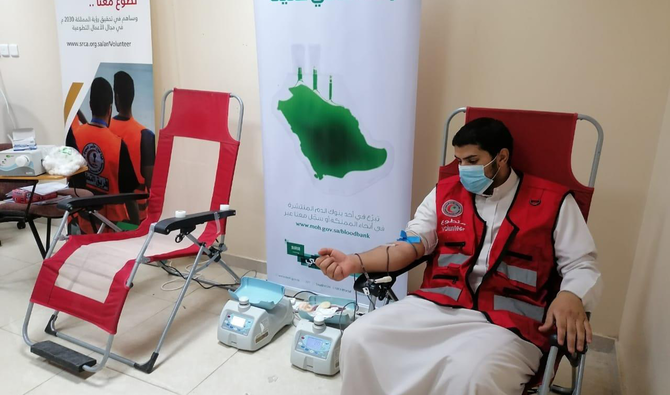
“There are several vehicle donations, which are located in public areas which are providing education and blood collection services.”
Yazeed Al-Ayash, a hospital intern who has donated blood every four months for the past two years, said that the Kingdom needs more regular donors.
“People donate because someone posted something on social media platforms to donate and help a person,” he said. “A culture of blood donation cannot be established out of the blue. It needs proper attention.”
He added: “My reason for donating blood is humanitarian. You can save a person’s life. It doesn’t have to be someone I know; it could be anyone. Plus, it gives me a satisfying feeling.
“I really hope that what happened in Beirut is a wake-up call. Disasters can happen anywhere and we need blood to be ready for that.”
Al-Saweed said that the Kingdom’s donor centers launched a “Donate at your home” initiative during the pandemic to avoid the need to go to hospital or a blood bank.
Some rare blood types are often in short supply, he said.
“Donor centers always face a shortage of Rh negative blood group (O negative, A negative, B negative, and AB negative).”
One of the biggest challenges facing most donor centers is the absence of a national blood donor service responsible for establishing guidelines, uniform policies, a donor registry and nationwide standards, Al-Saweed said.
Yet there is a Saudi application to help blood donors. “Wateen is amazing — it basically gives you a reminder when to donate and records the number of times you donated,” he said.
Wateen is run in cooperation with the health ministry and seeks to bridge the communication gap between donors and blood banks.