ISLAMABAD: Pakistan’s Federal Minister for Information and Broadcasting Senator Shibli Faraz thanked Saudi Arabia on Tuesday for always rescuing his country in difficult times while dismissing rumors of any differences between the two countries.
“Saudi Arabia has always been with us and we are thankful to them,” the minister said while briefing reporters here in Islamabad on various decisions made during the federal cabinet meeting earlier in the day that was chaired by Prime Minister Imran Khan.
The minister said the Kingdom was a brotherly country that had “always stood by us in difficult times.”
He said that a lot of Pakistani labor was working in the Kingdom, adding that the two holiest sites of Islam were also located in the same country.
To a question about the reported return of $1 billion to Saudi Arabia, he said that the money taken as a loan. “It was taken and returned. This is not in our interest to link it [the loan issue] to other things,” he said.
Saudi Arabia extended a $6.2 billion financial package, including $3 billion cash as a soft loan and $3.2 billion of deferred oil payment facility, to Pakistan in November 2018 to help the country stave off its balance of payments crisis.
The minister said that the world was moving toward readjustment as the world order was changing, especially in the last few years.
Faraz said that like every other country, “Pakistan as a sovereign state will work in the direction and pursue objectives that reinforce its national interests.”
He also added that the country could not run an independent foreign policy without acquiring adequate economic strength.
Talking about the government’s economic achievements in the last two years, he said that Pakistan’s current account deficit was brought down from $20 billion to $3 billion while the central bank’s reserves had increased from $8.5 billion to $12.5 billion due to prudent economic policies.
The minister informed that sales of cement, fertilizers, diesel and petrol had increased many times in the last two years, reflecting an improvement of the country’s fragile economy.
He noted that the coronavirus pandemic had not hit the country’s economy as hard as other countries in the region.
“The economic revival has started … Difficult times have almost passed and better days are right ahead of us,” the minister claimed.


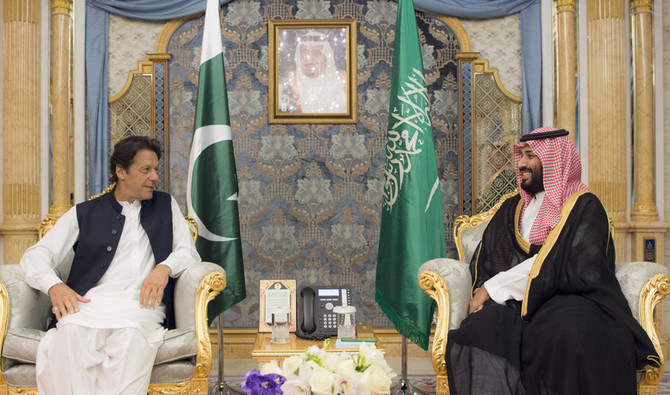
Pakistan says 'thankful' to Saudi Arabia for its continued support
https://arab.news/zp5bs
Pakistan says 'thankful' to Saudi Arabia for its continued support

- Minister Shibli Faraz says the country cannot run independent foreign policy until it gains economic strength
- Claims Pakistan’s economy has improved in the last two years due to the government’s prudent policies

Pakistan reviews austerity measures amid Middle East crisis, urges strict nationwide implementation
- Deputy Prime Minister Ishaq Dar chairs review meeting of austerity steps
- Officials briefed on salary cuts, school closures, four‑day week, petrol conservation
ISLAMABAD: Pakistan’s government on Wednesday assessed progress on a sweeping set of austerity measures introduced to mitigate the country’s economic strain from sharply rising global oil prices and supply disruptions linked to the ongoing war in the Middle East.
Prime Minister Shehbaz Sharif this week announced a series of austerity steps, including a four‑day work week for government offices, requiring 50 percent of staff to work from home, cutting fuel allowances for official vehicles by half, grounding up to 60 percent of the government fleet and closing all schools for two weeks to conserve fuel amid the global oil crisis.
The measures were unveiled in response to global oil market volatility triggered by the conflict involving the United States, Israel and Iran, which has disrupted supply routes such as the Strait of Hormuz and pushed crude prices sharply higher, straining Pakistan’s heavily import‑dependent energy sector.
“The meeting stressed the importance of strict and transparent adherence to the austerity measures, promoting fiscal responsibility and prudent use of public resources,” Deputy Prime Minister and Foreign Minister Senator Mohammad Ishaq Dar said in a statement.
He was chairing a meeting of the Committee for Monitoring and Implementation of Conservation and Additional Austerity Measures, constituted under the directions of the PM, bringing together federal and provincial officials to review execution of the broad cost‑cutting plan.
Dar emphasized the government’s commitment to enforcing the PM’s austerity steps nationwide. The committee’s review also covered reductions in departmental expenditure, deductions from salaries of senior officials earning over Rs. 300,000 ($1,120), and coordination with provincial administrations to ensure uniform implementation of the plan.
Participants at the meeting reiterated that all ministries and divisions must continue strict monitoring and reporting, with transparent oversight mechanisms, as Pakistan navigates the economic pressures from the prolonged Middle East crisis and its fallout on global energy and trade markets.


