

Emirates ramps up Pakistan operations to 60 weekly flights

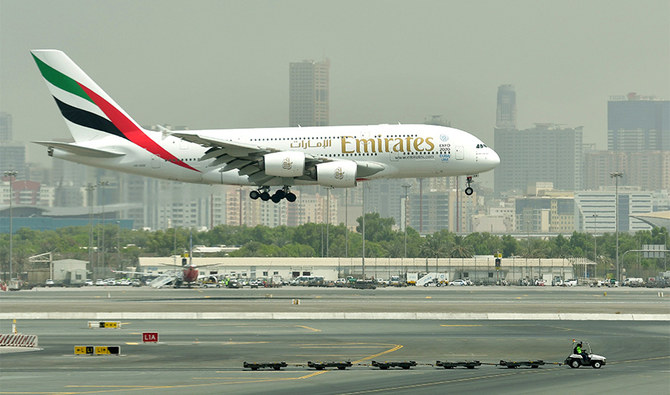
A picture take on September 14, 2017 shows an Airbus A380 of Emirates landing at the tarmac at Dubai's International Airport. (AFP)
Short Url
Updated 10 August 2020
Follow

Emirates ramps up Pakistan operations to 60 weekly flights

  • Dubai-based airline is set to ramp up its flight frequency from major Pakistani cities
  • Pakistan has witnessed a significant decrease in COVID-19 cases

ISLAMABAD: Emirates Airlines has announced it is increasing its passenger services to and from Pakistan starting August 10, offering enhanced connectivity to over 70 destinations within its current network, via Dubai, Dubai-based airline said in a statement on late Sunday.

“Starting with 53 weekly flights to Pakistan, the frequency will be increased to 60 weekly flights starting August 16,” it said.

Emirates is set to ramp up its flight frequency from major Pakistani cities Karachi, Islamabad, Lahore, and Sialkot; and resume passenger services to Peshawar.

“The airline will operate 21 weekly flights to Karachi (increased to 28 weekly flights starting 16 August); 10 weekly flights to Islamabad; 7 weekly flights to Sialkot; 10 weekly flights to Lahore; and 5 weekly flights to Peshawar. For more information on flight schedule,” Emirates statement read.
On July 02 Emirates resumed services to Pakistan after a brief suspension in June, and made coronavirus clearance obligatory for all passengers.

On June 24, Emirates suspended its Pakistan services after some passengers who traveled to the country tested positive for the coronavirus in Hong Kong.

Travel restrictions remain in place, and travelers will only be accepted on these flights if they comply with the eligibility and entry criteria requirements that means travelers coming from Pakistan must carry a negative COVID-19 report from a laboratory approved by the airline.

Pakistan has witnessed a significant decrease in COVID-19 cases.

As of Monday, more than 284,659 people were known to have contracted the disease, with over 539 new infections reported in the past 24 hours, Health Ministry data showed.

6,097 Pakistanis have died from the virus and 776 are in critical condition. Over 260,700 are known to have recovered.


Pakistani court sentences TLP leader for 35 years over incitement against ex-chief justice

Updated 11 sec ago
Follow

Pakistani court sentences TLP leader for 35 years over incitement against ex-chief justice

  • The case stems from a 2024 speech targeting former Chief Justice of Pakistan Qazi Faez Isa over a blasphemy ruling
  • Conviction follows the government’s move to proscribe Tehreek-e-Labbaik Pakistan after clashes with police this year

ISLAMABAD: A Pakistani court this week sentenced a leader of the religio-political party Tehreek-i-Labbaik Pakistan (TLP) to 35 years’ imprisonment on multiple charges for inciting hate against former Chief Justice of Pakistan Qazi Faez Isa.

Peer Zaheer ul Hasan Bukhari made the remarks in a 2024 speech at the Lahore Press Club against the former chief justice for issuing a judgment in a case involving a man named Mubarak Sani under the blasphemy laws, a member of a minority religious community whose death sentence was overturned.

Authorities said Bukhari’s comments amounted to incitement to violence, after which police registered a case against him under various terrorism-related provisions as well as charges of inciting hatred.

The cleric was handed multiple jail terms on a range of charges, with the longest being 10 years of rigorous imprisonment, amounting to a total of 35 years.

“All the sections of imprisonment awarded to the convict shall run concurrently,” Anti-Terrorism Court Judge Arshad Javed said in a letter to the Kot Lakhpat Central Jail superintendent.

A collective fine of Rs600,000 ($,150) was also imposed on the TLP party leader under the provisions of the Anti-Terrorism Act.

The move follows Pakistan’s decision in October to ban the TLP and designate it a proscribed organization under the Anti-Terrorism Act after violent clashes between its supporters and law enforcement in Punjab.

The unrest erupted as demonstrators attempted to travel from Lahore to Islamabad, saying they wanted to stage a pro-Palestine rally outside the US Embassy.

However, officials said TLP supporters were armed with bricks and batons, arguing their intention was to stir violence similar to earlier marches toward the federal capital.

The clashes between TLP supporters and police resulted in the deaths of five people, including two policemen, and injured more than 100 officers and dozens of protesters.

Led by Saad Hussain Rizvi, the TLP is known for its confrontational street politics and mass mobilizations.

Since its emergence in 2017, the party has repeatedly organized sit-ins and marches toward Islamabad, often triggering violent confrontations and prolonged disruptions on major routes to the capital.