

3 days of heavy monsoon rains kill 58 people across Pakistan

A woman carries sack of wheat and household goods while she wades through a flooded area of Dadu, a district in the Pakistan's southern Sindh province, Sunday, Aug. 9, 2020. (AP)
Short Url
Updated 10 August 2020
Follow

3 days of heavy monsoon rains kill 58 people across Pakistan

  • Rains also partially damaged about 100 homes and caused a breach in a main flooded canal
  • In some parts rescuers with the army’s help are still trying to evacuate people from flood-hit villages

KARACHI: Three days of heavy monsoon rains triggering flash floods killed at least 58 people in various parts of Pakistan, as troops with boats rushed Sunday to evacuate people from flood-affected districts in the country’s southern Sindh and southwestern Baluchistan provinces.
Every year, many cities in Pakistan struggle to cope with the annual monsoon deluge, drawing criticism about poor planning. The monsoon season runs from July through September, during which swelling rivers cause damage to crops and infrastructure.
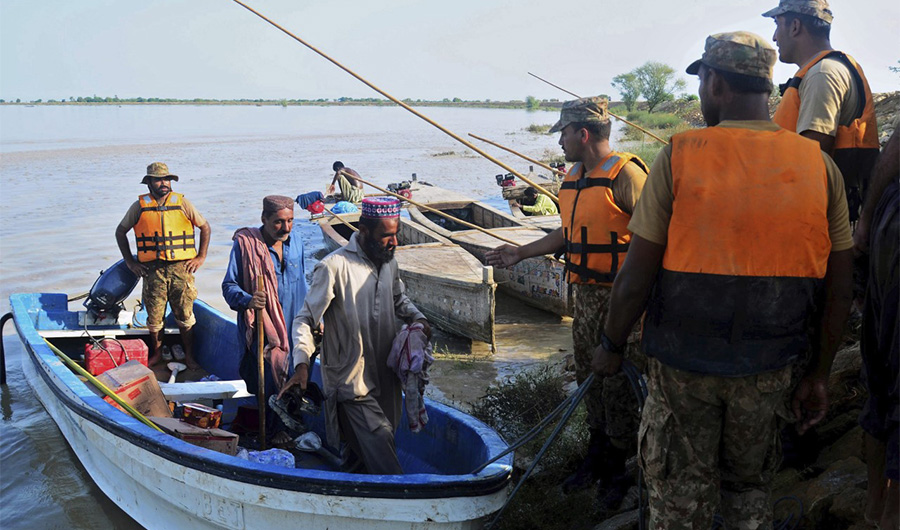


Pakistani army soldiers evacuate villagers from a flooded areas of Dadu, a district in Pakistan's southern Sindh province, Sunday, Aug. 9, 2020. (AP) 

According to Pakistan’s National Disaster Management Authority, 19 people were killed in rain-related incidents in the northwestern Khyber Pakhtunkhwa province, 12 in southern Sindh province, eight in Punjab province and 10 in the country’s scenic northern Gligit Baltistan region in the past three days.
Rains also partially damaged about 100 homes and caused a breach in a flooded main canal, inundating villages in Sindh province. In a statement, the military said troops used boats to rescue stranded people and move them to safety. It said a medical camp was also established and food was being provided to the rescued people.
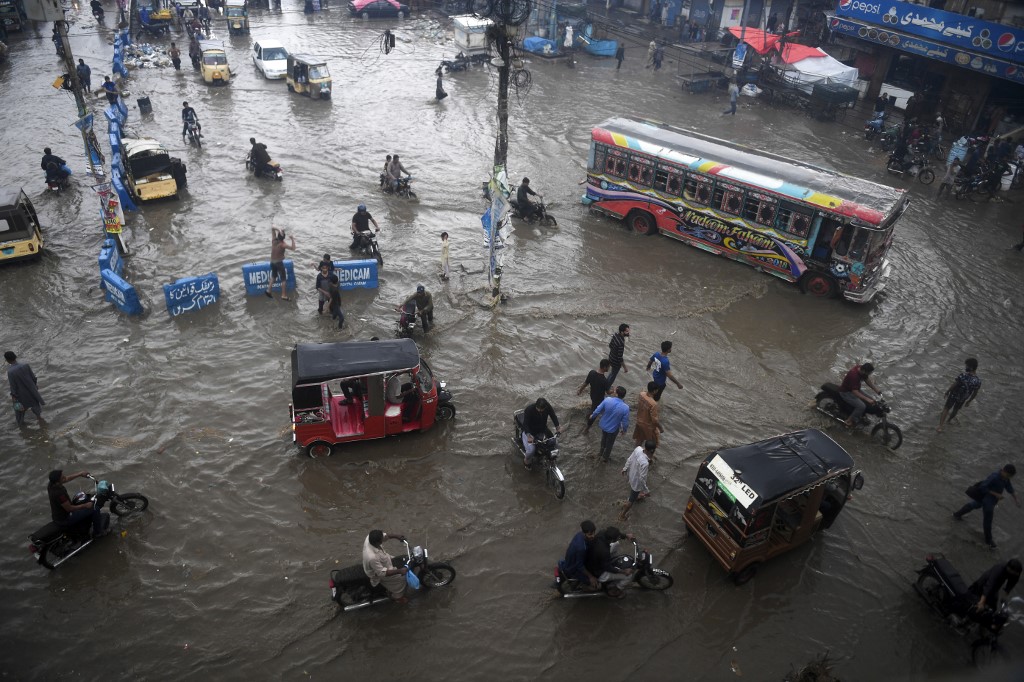


Commuters make their way along a flooded street after heavy monsoon rains in Pakistan's port city of Karachi on August 7, 2020. (AFP)

Heavy rains also lashed many districts in the southwestern Baluchistan province, killing eight people, damaging homes and inundating many villages in the district of Jhal Magsi, according to Saleem Zakir, spokesman for provincial disaster management authority. He said rescuers with the army’s help were still trying to evacuate people from the district’s flood-hit villages.
He said floods damaged a bridge and a gas pipeline and destroyed coastal roads on the Arabian Sea, severing links to the port of Gwadar, part of China’s multi-billion dollar one-road project linking south and Central Asia to China.
According to local media reports, hundreds of people moved to nearby hills when the floodwaters entered their villages in remote areas of Baluchistan, and the military used helicopters and boats to move them to safer places. Authorities were dispatching tents and food for the flood-affected people.
Heavy rainfall began last week and continued Sunday, flooding streets even in the eastern city of Lahore. It especially disrupted normal life last week in Karachi, the provincial capital of Sindh province and Pakistan’s commercial hub, where sewage flooded most of the streets, prompting Prime Minister Imran Khan to order the army to assist authorities in handling the situation.
According to the Meteorological Department, heavy rains are expected to continue next week.
In Pakistan and neighboring India, deadly floods occur regularly during the monsoon season. 


Pakistan promotes JF-17 fighter at Saudi defense show amid export push

Updated 4 sec ago
Follow

Pakistan promotes JF-17 fighter at Saudi defense show amid export push

  • Pakistan courts defense buyers at Riyadh show as it steps up military diplomacy and jet exports
  • JF-17 drew global attention after last year’s India conflict, with officials calling it combat-tested

ISLAMABAD: Pakistan’s air force is promoting its JF-17 fighter jet and Super Mushshak military training aircraft at a major defense exhibition in Saudi Arabia, according to an official statement on Tuesday, as Islamabad intensifies efforts to expand arms exports following heightened regional tensions with India last year.

The exhibition comes as Pakistan leans on defense diplomacy to market the JF-17 to foreign buyers, pitching the jet as a cost-effective, combat-ready alternative for countries in the Middle East, Central Asia and Africa.

Interest in the aircraft has grown since a brief but sharp military confrontation with India in May last year, which Pakistani officials have cited as evidence that the fighter jet is combat-tested.

“Pakistan Air Force contingent is participating in the World Defense Show — 2026 in the Kingdom of Saudi Arabia, featuring its cutting-edge JF-17 Thunder Block-III Multi-role fighter jet and the highly acclaimed Super Mushshak basic trainer aircraft,” the military’s media wing, Inter-Services Public Relations(ISPR), said in a statement.

“World Defense Show 2026 serves as a premier global platform for defense and security,” it added. “PAF’s participation at WDS-2026 reinforces Pakistan’s position as an emerging hub of aerospace innovation, operational competence and reliable defense solutions.”

Pakistan has been seeking to convert defense exhibitions into export opportunities, particularly for the JF-17 — jointly developed with China — and the Super Mushshak trainer, which has already been inducted by several foreign air forces.

ISPR said PAF’s presence at the exhibition in Riyadh reflects its leadership’s vision of fostering defense cooperation, promoting defense exports and strengthening strategic partnerships with friendly nations.

“The exhibition provides an opportunity for international delegations, defense officials and military industry leaders to engage with PAF representatives and explore avenues for collaboration, training and technology transfer,” it added.

The event in Riyadh comes amid closer security ties between Pakistan and Saudi Arabia.

During Prime Minister Shehbaz Sharif’s visit to the Kingdom in September, the two countries signed a joint defense pact pledging that aggression against one would be treated as an attack on both.

The accord was widely viewed as a step to formalize long-standing military cooperation into a binding security commitment aimed at strengthening joint deterrence in an increasingly volatile region.