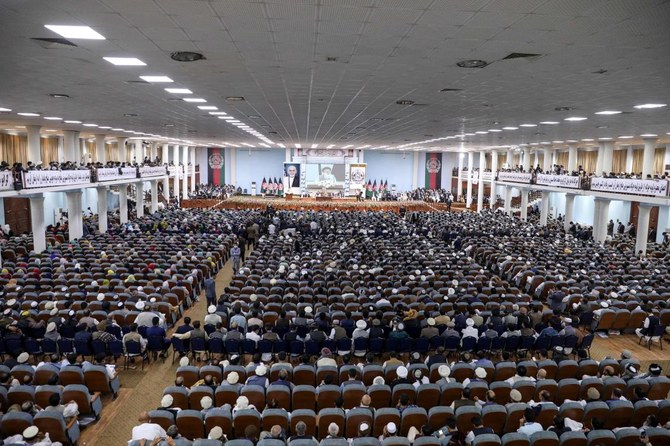

KABUL: Afghan President Ashraf Ghani on Sunday pledged to sign an order for the release of 400 Taliban prisoners after the Loya Jirga, or traditional assembly, voiced support for their freedom, removing the main hurdle for the launch of direct talks with the group.
The decision follows three days of deliberations by the Jirga, which comprises 3,400 delegates and which said on Sunday that its decision was for the sake of the “cessation of bloodshed” and to remove the “hurdle for the peace talks.”
“Today, you made history. The nation was at a crossroads, and you made the path clear. Today, I will sign the decree, which I could not dare to do previously. I will sign the order for the freedom of 400 Taliban prisoners, and they will be freed,” Ghani said while addressing a crowd in Kabul later in the day.
He said that the “ball was now in the Taliban’s court” and that they needed to enforce a nationwide cease-fire and begin talks to bring an end to more than 40 years of war, particularly the latest chapter in a conflict that started with the Taliban’s ousting from power in the US-led invasion in late 2001.
Ghani said there were “ambiguities” with regard to the peace process and “plots” intended to prevent Afghans from uniting, without naming any country or side specifically.
The exchange of prisoners between the government and the Taliban was a major precondition for a historic deal signed between the insurgent group and the US in Doha, Qatar in February this year.
The prisoner swap program — involving the release of 5,000 Taliban inmates in return for 1,000 security forces held by the group — was to be completed within 10 days in early March and be followed by the crucial, intra-Afghan talks.
FASTFACT
Officials say dialogue could start within three days of release of remaining 400 prisoners.
Ghani, whose government was sidelined from the accord, had initially voiced his opposition to free the Taliban inmates.
However, faced with increasing pressure from the US, Kabul began releasing 4,600 of them in a phased manner. Still, it refused to release the remaining 400, arguing they were responsible for some of the worst attacks and crimes in the country in recent years.
After the Eid Al-Adha prayers ten days ago, however, the embattled president announced he would let the Jirga decide the fate of the remaining prisoners whom the Taliban had insisted be freed before the start of the talks.
Former President Hamid Karzai, who was absent from the final two days of discussions at the Jirga, praised Ghani for removing the blockade with the Taliban, adding that he was “aware that the Taliban would begin direct talks three days after the release of their comrades.”
“I appreciate this measure of yours,” he said, referring to Ghani’s decision, “and will pave the ground for the start of talks.”
There was no immediate comment from the Taliban about the Jirga’s decision and Ghani’s announcement.
In a statement circulated among members of the Jirga, US Secretary of State Mike Pompeo said that the Taliban had “committed to beginning direct negotiations” after the prisoners’ release and pledged to reduce violence as well.
“The US commends the participants of the Loya Jirga... to consolidate national support for peace. Following the timely release of these prisoners, the Taliban have committed to enter talks with the national team...The US intends to hold the Taliban to these commitments,” the statement said.
US President Donald Trump, who is standing for reelection in November, has been keen to withdraw all American troops from Afghanistan as part of the Qatar agreement and use the pullout of forces and start of Afghan talks as examples of his successful foreign policies when wooing voters.
US officials have spoken about their frustration with regard to the prevalence of corruption and inefficiency in the Afghan government, in recent years, with Trump arguing that Afghans could decide the future of their own country and that “US troops should not be there as police.”
Experts, however, argue that there is more to the move than what meets the eye.
“The jirga’s decision was designed to give life support to Afghan political elites who have lost all credibility with the public,” Torek Farhadi, an adviser for the previous Afghan government told Arab News.
“This is a hefty price to pay just to get to the doorsteps of the negotiations’ room,” he said, referring to the release of 400 Taliban prisoners. “Talks with the Taliban will be long and drawn, and Kabul will have to make more concessions on its so-called red-lines once they start.”