

TWITTER POLL: Almost 3 of 4 readers think there is more to the massive blast in Beirut

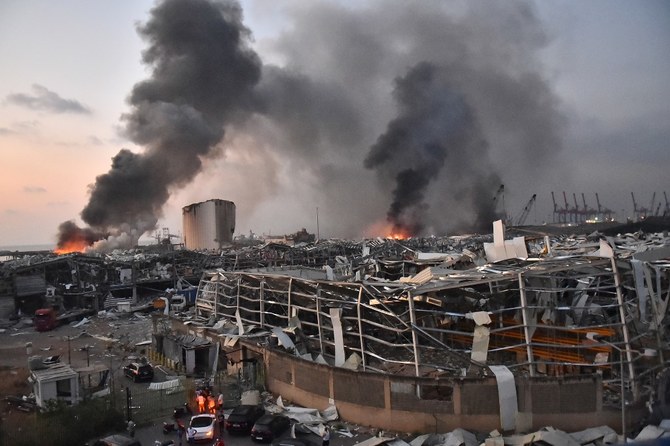
The blast, caused by a stockpile ammonium nitrate stored in a warehouse at a Beirut port, generated a shock wave so devastating that it levelled buildings near the port. (AFP)
Short Url
Updated 07 August 2020
Follow

TWITTER POLL: Almost 3 of 4 readers think there is more to the massive blast in Beirut

  • Impact of the blast was also reportedly felt 200 kilometers away in Cyprus
  • Mushroom clouds and spherical blast waves are conflated as nuclear in nature

DUBAI: Almost three of four readers think there is more to the massive explosions that hit a Beirut port on Tuesday, according to an Arab News straw poll on Twitter.

The blast, caused by a stockpile ammonium nitrate stored in a warehouse, generated a shock wave so devastating that it levelled buildings near the port and caused extensive damage over much of the rest of the capital, killing more than 100 people and injuring thousands.

The impact of the blast was also reportedly felt 200 kilometers away in Cyprus.
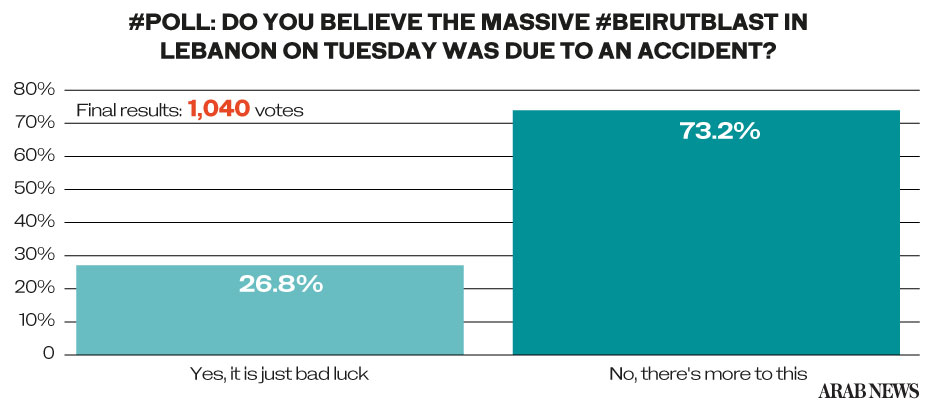
Specifically, 73 percent of more than 1,000 readers who responded to the poll do not believe the explosion was an accident compared to about 27 percent who thought it was back luck that the ammonium nitrate – unsafely stored for six years – has been the cause of the deadly Beirut blast.

The enormous explosion consequently created a mushroom cloud over Beirut, stoking fears and rumors on social media and, among conspiracy theorists, that a nuclear bomb has been detonated in the Lebanese capital due to the sheer magnitude of the blast.

About 2,750 tons of ammonium nitrate was involved during Tuesday’s explosion. Ammonium nitrate is a crystal-like white solid commonly used as a source of nitrogen for agricultural fertilizer, and is relatively safe when stored properly. It, however, becomes deadly as an explosive when mixed with other chemicals and fuel oils.

Some experts pointed out that people who are not accustomed to seeing large explosions may confuse mushroom clouds and spherical blast waves as nuclear in nature.

Others believed the Beirut explosion lacked two hallmarks of a nuclear detonation: a ‘blinding white flash’ and a thermal pulse, or surge of heat, which would otherwise had started fires all over the area and severely burned people’s skin.


6 planets will parade across the night sky at the end of February

Updated 24 February 2026
Follow

6 planets will parade across the night sky at the end of February

NEW YORK: Six planets are linking up in the sky at the end of February, and most will be visible to the naked eye.
It’s what’s known as a planetary parade, which happens when multiple planets appear to line up in the sky at once. The planets aren’t in a straight line, but are close together on one side of the sun.
Skygazers can usually spot two or three planets after sunset, according to NASA. Hangouts of four or five that can be glimpsed with the naked eye are less common and occur every few years. Last year featured lineups of six and all seven planets.

When will they be visible?
On Saturday, Mercury, Venus, Jupiter and Saturn will be visible to the naked eye if clear skies allow. Uranus and Neptune can only be spotted with binoculars and telescopes.

What time is optimal for viewing?
Go outside about an hour after sunset and venture away from tall buildings and trees that will block the view. Look to the western sky and spot Mercury, Venus and Saturn close to the horizon. Jupiter will be higher up, along with Uranus and Neptune.

How to know if you’ve spied a member of the parade?
“If it’s twinkling, it’s a star. If it is not twinkling, it’s a planet,” said planetary scientist Sara Mazrouei with Humber Polytechnic in Canada.
The parade should be visible over the weekend and in the days after. Eventually, Mercury will bow out and dip below the horizon.
At least one bright planet is visible on most nights, according to NASA.
Glimpsing many in the sky at once is a fun way to connect with astronomers of centuries’ past, said planetary scientist Emily Elizondo with Michigan State University.
Ancient astronomers used to make sense of the universe “just by looking up at the stars and the planets,” Elizondo said, “which is something that we can do today.”