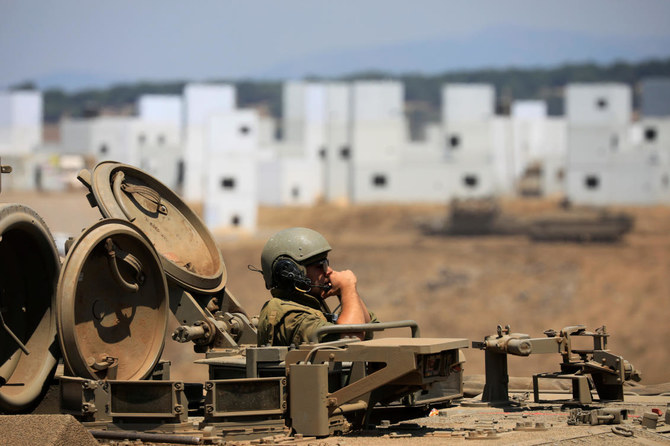
JERUSALEM: Prime Minister Benjamin Netanyahu on Tuesday pledged a tough response to any threats against Israel after the Jewish state struck Syrian military targets in retaliation for an attempted attack in the occupied Golan Heights.
“We hit a cell and now we hit the dispatchers. We will do what is necessary in order to defend ourselves,” he said during a tour of a military facility in central Israel.
“These are not vain words; they have the weight of the State of Israel and the (military) behind them and this should be taken seriously,” the veteran premier added.
Israel launched air strikes on military targets in southern Syria late Monday. The army said it was retaliating after an attempt to lay explosives in the Golan Heights, occupied by Israel since 1967.
Syrian state-run news agency Sana said Israeli helicopters rocketed Syrian army positions near Quneitra in the south but caused only material damage. It also said air defenses had gone into action near the Syrian capital.
Tensions are already high between bitter rivals Israel and Syria.
Last month, Israeli army helicopters struck military targets in southern Syria in retaliation for earlier “munitions” fire toward Israel.
Earlier Monday, the Israeli army said it had killed four men laying explosives near the Israeli-occupied sector of the Golan Heights.
Several Israeli media outlets reported that Monday’s actions were in response to an increased threat from the Iran-backed Lebanese Shiite group Hezbollah, which has a significant presence in Syria.
Last month, five Iran-backed fighters were killed in an Israeli missile strike south of Damascus, according to Britain-based monitoring group the Syrian Observatory for Human Rights.
Then last Monday, Israel said it had thwarted an infiltration attempt from Lebanon by up to five Hezbollah gunmen, a claim denied by the Iran-backed group.
Israel reported an exchange of fire that forced the “terrorists” back into Lebanon. It said it fired artillery across the heavily guarded border for “defensive” purposes.
Since 2011, Israel has launched hundreds of strikes in Syria, targeting government troops and allied Iranian and Hezbollah forces and vowing to end Iran’s military presence in Syria.


Netanyahu warns foes after Israeli retaliatory strikes in Syria
https://arab.news/c7gmm
Netanyahu warns foes after Israeli retaliatory strikes in Syria

- Israel launched air strikes on military targets in southern Syria late Monday
- Monday’s actions were in response to an increased threat from the Iran-backed Hezbollah


UN rights chief slams dangerous ‘tit-for-tat dynamic’ in Mideast war
- Turk deplored the extensive attacks in residential areas, on health facilities, schools, cultural property and water and energy infrastructure
- He stressed that “under the laws of war, civilians and civilian infrastructure must be protected at all costs“
GENEVA: The United Nations rights chief voiced alarm Tuesday at the Middle East conflict’s deepening impact on civilians, warning of the dangers of the seeming “tit-for-tat dynamic” between the warring sides.
The United States and Israel began striking Iran on February 28, prompting waves of Iranian strikes across the Gulf.
With hostilities intensifying, UN High Commissioner for Human Rights Volker Turk deplored the extensive attacks in residential areas, on health facilities, schools, cultural property and water and energy infrastructure.
“This apparent tit-for-tat dynamic, involving essential infrastructure with extremely significant civilian impacts, will only increase risks for civilian populations more broadly, with potentially dire consequences across the entire region,” he warned in a statement.
Turk stressed that “under the laws of war, civilians and civilian infrastructure must be protected at all costs.”
“All parties are bound by these rules, and must be held to account if they do not,” he said, warning: “the world is watching.”
The UN rights chief warned that “strikes against vital civilian infrastructure in the Middle East — as well as the widening geographic spread of strikes — are further increasing risks for populations across the region, and beyond.”
He pointed to strikes on a water desalination plant and fuel facilities in Iran over the weekend, igniting fires and reportedly disrupting water access for dozens of villages.
It also prompted warnings of “acid rain” that could cause chemical burns and serious lung damage.
“The foreseeable impacts on civilians and the environment of these strikes raise serious questions as to compliance of these attacks with the requirements of international humanitarian law of proportionality and precaution,” Turk said.
“This warrants careful legal scrutiny.”
He also highlighted the broader impact of the war.
The plunge in commercial shipping activity through the Strait of Hormuz was taking a severe toll on access to energy, food and fertilizer across the region and beyond — hitting the world’s most vulnerable people the hardest.
Turk raised concern about reports of detentions, charges and other forms of repression and intimidation against people in a number of countries, in connection with their expression of opinions around the Middle East conflict.
He demanded that all those arbitrarily detained be released immediately and unconditionally.
“States are reminded of their obligation under international human rights law to respect and protect people’s right to freedom of expression — particularly in times of crisis,” he said.


