New 'political map' hardens Pakistani position with India over disputed Kashmir region

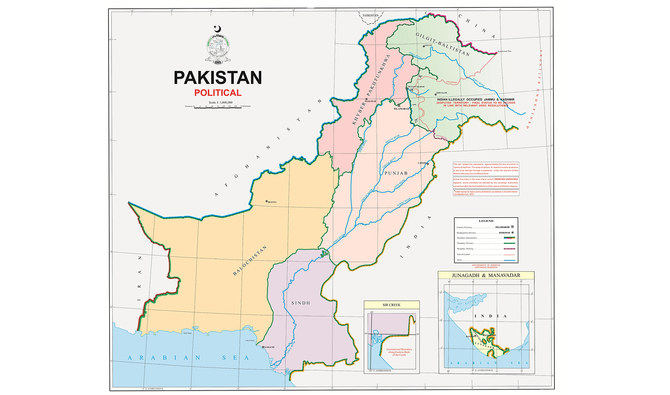
A new map approved by Pakistani Prime Minister Imran Khan shows areas in the Himalayan Kashmir valley disputed with India to be a part of Pakistan. August 4, 2020. (Photo courtesy: Pakistan Prime Minister's Office)
Short Url
Updated 05 August 2020
Follow

New 'political map' hardens Pakistani position with India over disputed Kashmir region

  • Pakistan PM says new map approved by his cabinet and endorsed by Kashmiri and Pakistani opposition leaders
  • Indian news agency quotes ministry of foreign affairs as saying new map had no “legal validity nor international credibility”

ISLAMABAD: Pakistani prime minister Imran Khan said on Tuesday his cabinet had approved a new ‘political map’ which should be considered the official map of the country both inside Pakistan and internationally.
An image of the map was shared with Pakistani media by the PM’s office in Pakistan and showed areas in the Himalayan Kashmir valley disputed with India as a part of Pakistan with these words printed across the relevant parts of the map: “Indian illegally occupied Jammu and Kashmir. (Disputed territory — Final status to be decided in line with relevant UNSC [United Nations Security Council] resolutions.)”
A dotted line that previously marked the disputed areas has been removed from the new map.
The UN Security Council adopted several resolutions in 1948 and in the 1950s on the dispute between India and Pakistan over the region, including one which says a plebiscite should be held to determine the future of mostly Muslim Kashmir. Another resolution also calls upon both sides to “refrain from making any statements and from doing or causing to be done or permitting any acts which might aggravate the situation.”
But Pakistan’s move to release the new map signals a hardening of Islamabad’s position over a decades-long border row that has strained ties between the South Asian neighbors.
“This is a historic day in Pakistan,” PM Khan said in a televised address. “Today we are bringing a new political map of Pakistan before the world.”
“From today, in all of Pakistan, our official map of Pakistan will be this, which has been passed by the cabinet of Pakistan.” he said. “From now, in schools, colleges, internationally, this is the map that will appear.”


The PM said his cabinet, leaders of Kashmir as well as opposition parties in Pakistan had all endorsed the map.
In an address following the PM’s, Pakistani foreign minister Shah Mahmood Qureshi said the dotted line in the old map that indicated a ‘disputed territory’ has been done away with. He said Siachen, which always belonged to Pakistan, had also been included in the new map.
The Siachen Glacier in the Karakorum range is known as the highest militarized zone in the world. Thousands of Indian and Pakistani troops contest an area at altitudes above 20,000 feet where they must deal with altitude sickness, high winds, frostbite and temperatures as low as minus 60 degrees Celsius.
Qureshi claimed that the “Kashmiri leadership” had endorsed the new map, without naming anyone.
“This map sends a message to India, it sends a message to the unarmed youth of Kashmir who martyr themselves for the cause, that Pakistan stands with them,” Qureshi said. “This map represents our goal.”
The Press Trust of India, the largest news agency in India, quoted the Indian ministry of foreign affairs as saying the new map had no “legal validity nor international credibility.”
India’s ANI news agency tweeted, quoting the government of India: “We’ve seen a so-called ‘political map’ of Pakistan that has been released by PM Imran Khan. This is an exercise in political absurdity, laying untenable claims to territories in the Indian state of Gujarat and our union territories of Jammu Kashmir and of Ladakh: Govt of India.”
The Muslim-majority Himalayan region of Kashmir has been at the heart of more than 70 years of animosity since the partition of British-ruled India into Muslim Pakistan and majority Hindu India in 1947.
Tensions reached a new high since August 5 last year when Indian Prime Minister Narendra Modi’s government took away Indian-administered Kashmir’s special privileges, provoking anger in the region and in neighboring Pakistan. It also took away the region’s status as a state by creating two federally controlled territories, splitting off the thinly populated, Buddhist-dominated region of Ladakh.
Jammu & Kashmir had been the only Muslim-majority state in mainly Hindu India. India and Pakistan have fought two of their three wars over the region.
For decades, India has battled insurgency in the portion of Kashmir it controls. It blames Pakistan for fueling the strife, but Pakistan denies this, saying it gives only moral support to non-violent separatists.


Pakistan's Sindh announces judicial inquiry into deadly Karachi plaza fire

Updated 10 sec ago
Follow

Pakistan's Sindh announces judicial inquiry into deadly Karachi plaza fire

  • Around 80 people were killed in Karachi Gul Plaza fire that broke out on Jan. 17, says Sindh information minister
  • Says initial fact-finding committee discovered fire tenders were provided water with delay, which affected firefighting

ISLAMABAD: Sindh Information Minister Sharjeel Inam Memon announced on Thursday that the provincial government has requested a judicial inquiry into a deadly Karachi shopping plaza inferno that killed around 80 people earlier this month. 

The fire broke out at Karachi's famous Gul Plaza, a multi-story shopping complex in the city's Saddar area, on the night of Jan. 17. The blaze killed 80 and took three days to extinguish, while rescue and relief efforts took over a week. 

Speaking to reporters during a news conference, Memon said a Sindh cabinet sub-committee, chaired by Chief Minister Murad Ali Shah, reviewed a fact-finding committee report on the Karachi Gul Plaza fire. 

He said the fact-finding committee discovered that the Civil Defense department conducted fire safety audits of the mall and other buildings since 2023, but no effective, precautionary or legal action was taken to ensure such incidents were avoided. He said as a result, the Civil Defense director and the department's additional controller for district South were both suspended. 

"A letter is being written to the honorable chief justice of the Sindh High Court in which we are requesting the chief justice to appoint a serving judge for a judicial inquiry," Memon said. 

"So that we can review everything in accordance with the law himself and take decisions on it."

Memon said that there were around 2,000 to 2,500 people in the building when the fire broke out, adding that these included workers and visitors. 

He said the sub-committee had also noted that fire tenders were provided water with delay which affected the firefighting services of the Karachi Municipal Corporation (KMC), Rescue 1122 and fire brigades. 

The minister said the government had also suspended the chief engineer and in-charge hydrants of the Karachi Water and Sewerage Corporation, and that action will be taken against them. 

Memon said the committee had also concluded that the KMC, Rescue 1122 and fire brigades' firefighting tools and training to deal with an inferno of such a scale were "inadequate."

He said the government has also suspended the senior director of municipal services in the KMC and that departmental action against him will be taken for not ensuring that the fire staff was properly prepared to tackle such a blaze. 

The minister said the sub-committee had directed the relevant department to carry out a needs assessment so that the firefighting capabilities of the provincial and local government are further strengthened. 

Fires have become an increasingly frequent occurrence in Karachi, a megacity of more than 20 million people, where fire services remain severely overstretched and under-resourced relative to population density and the scale of commercial activity.

Successive deadly incidents have drawn criticism of the provincial Sindh administration over lax enforcement of building codes, inadequate inspections and limited emergency response capacity.

Sindh's opposition parties, especially the Muttahida Quami Movement-Pakistan, accuse the Sindh government of neglecting Karachi's infrastructural development. The provincial government rejects these allegations.