

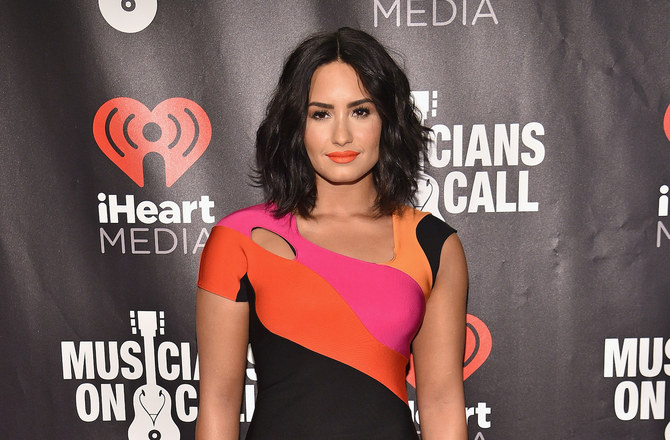
Demi Lovato steps out in Jordanian-Romanian designer after engagement

The singer was seen wearing Amina Muaddi’s glitzy Naima leather sandals. (Getty Images)
Short Url
Updated 03 August 2020
Follow

Demi Lovato steps out in Jordanian-Romanian designer after engagement

DUBAI: American pop star Demi Lovato has been spotted championing a pair of sandals by Jordanian-Romanian footwear designer Amina Muaddi, who is famous for her signature flared heels. 

In a picture the star shared with her 89.7 million Instagram followers on Monday, the “Sorry Not Sorry” singer was seen wearing Muaddi’s glitzy Naima leather sandals in white during a romantic dinner date with her fiancé, actor Max Ehrich, at the celebrity hotspot Nobu in Malibu, California.

The two-time Grammy nominee matched the heels with a dusty rose velvet form-fitting minidress that had a low-cut neckline and cuffed sleeves.  


Date night at Nobu I love you @maxehrich - also shout out to @brianbonifassi for the pic!!!

A post shared by Demi Lovato (@ddlovato) on

She accessorized her look, which featured a sleek low bun hairstyle, with a pair of golden hoop earrings and a glittery purple purse. 

The 27-year-old star announced her engagement last month on Instagram with a series of heart-warming images of her dreamy proposal.

The couple, who confirmed their relationship in May, celebrated their special moment by a beach in Malibu.

Lovato also shared images of her wedding ring by celebrity jeweler Peter Marco.

Muaddi, whose eponymous footwear label is designed in Paris and produced in Italy, has also been in the spotlight, with the likes of Kylie and Kendall Jenner, Dua Lipa and Hailey Bieber showing off their favorite pairs at a number of star-studded events since the launch of the brand.

The 34-year-old designer, who grew up in Italy, launched her eponymous footwear line in August 2018, approximately one year after departing from her role as co-founder and creative director of luxury footwear label Oscar Tiye.


Kylie @aminamuaddiofficial

A post shared by AMINA MUADDI (@aminamuaddi) on

Just last month, the entrepreneur released a limited edition Fenty x Amina Muaddi footwear capsule collection in collaboration with singer-turned-entrepreneur Rihanna. 

Multi-hyphenate “Wild Thoughts” singer tapped Muaddi to design a collection of shoes for her luxury label Fenty back in December, the designer revealed in an interview with Footwear News.

The news wasn’t all that surprising, considering that Rihanna has been a longtime fan of Muaddi’s glitzy footwear.

The singer and beauty mogul would go on to be spotted wearing Muaddi’s designs on multiple occasions, including a trip to Barbados where she accessorized a long, green sweater dress from Jacquemus with a pair of strappy sandals by Amina Muaddi.


Rih & me

A post shared by AMINA MUADDI (@aminamuaddi) on

​​​​​​​


Decoding villains at an Emirates LitFest panel in Dubai

Updated 25 January 2026
Follow

Decoding villains at an Emirates LitFest panel in Dubai

DUBAI: At this year’s Emirates Airline Festival of Literature in Dubai, a panel on Saturday titled “The Monster Next Door,” moderated by Shane McGinley, posed a question for the ages: Are villains born or made?

Novelists Annabel Kantaria, Louise Candlish and Ruth Ware, joined by a packed audience, dissected the craft of creating morally ambiguous characters alongside the social science that informs them. “A pure villain,” said Ware, “is chilling to construct … The remorselessness unsettles you — How do you build someone who cannot imagine another’s pain?”

Candlish described character-building as a gradual process of “layering over several edits” until a figure feels human. “You have to build the flesh on the bone or they will remain caricatures,” she added.

The debate moved quickly to the nature-versus-nurture debate. “Do you believe that people are born evil?” asked McGinley, prompting both laughter and loud sighs.

Candlish confessed a failed attempt to write a Tom Ripley–style antihero: “I spent the whole time coming up with reasons why my characters do this … It wasn’t really their fault,” she said, explaining that even when she tried to excise conscience, her character kept expressing “moral scruples” and second thoughts.

“You inevitably fold parts of yourself into your creations,” said Ware. “The spark that makes it come alive is often the little bit of you in there.”

Panelists likened character creation to Frankenstein work. “You take the irritating habit of that co‑worker, the weird couple you saw in a restaurant, bits of friends and enemies, and stitch them together,” said Ware.

But real-world perspective reframed the literary exercise in stark terms. Kantaria recounted teaching a prison writing class and quoting the facility director, who told her, “It’s not full of monsters. It’s normal people who made a bad decision.” She recalled being struck that many inmates were “one silly decision” away from the crimes that put them behind bars. “Any one of us could be one decision away from jail time,” she said.

The panelists also turned to scientific findings through the discussion. Ware cited infant studies showing babies prefer helpers to hinderers in puppet shows, suggesting “we are born with a natural propensity to be attracted to good.”

Candlish referenced twin studies and research on narrative: People who can form a coherent story about trauma often “have much better outcomes,” she explained.

“Both things will end up being super, super neat,” she said of genes and upbringing, before turning to the redemptive power of storytelling: “When we can make sense of what happened to us, we cope better.”

As the session closed, McGinley steered the panel away from tidy answers. Villainy, the authors agreed, is rarely the product of an immutable core; more often, it is assembled from ordinary impulses, missteps and circumstances. For writers like Kantaria, Candlish and Ware, the task is not to excuse cruelty but “to understand the fragile architecture that holds it together,” and to ask readers to inhabit uncomfortable but necessary perspectives.