KARACHI: As a socially distant Hajj began in Saudi Arabia this week, Pakistani celebrities recalled their experiences of performing the pilgrimage in recent years, before the coronavirus pandemic made large gatherings impossible.
Only a few thousand pilgrims who reside in Saudi Arabia are gathering this year on Mount Mercy on the plains of Arafat for Islam’s most important ritual.
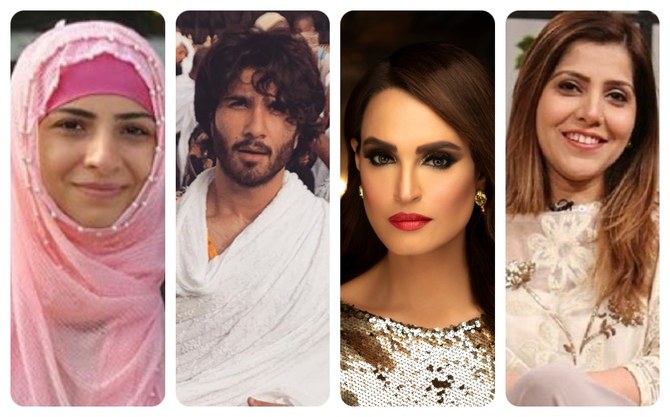
“It was something I had never experienced in my life before,” said prominent film and television actor Feroze Khan, adding that he would still often feel overwhelmed by the memory of being able to perform Hajj last year.
“I have a firm belief that if a person reaches that holy place just in the obedience of his creator, then he or she must get some reward in return,” Khan said. “I had a feeling that an invisible dead layer was peeled off from my heart … to make it much lighter.”
Famous model and beautician Nadia Hussain, who went for Hajj three years ago, said she was relieved when she heard that a ‘limited’ Hajj would be held this year, rather than the event being canceled entirely.
Though Hussain and her family booked the luxurious executive Hajj package, on the day of the pilgrimage, they decided at Arafat to experience the “hardship”of the blistering sun among the crowds.
“So we [Husain and her husband] both came out of our air-conditioned tent and walked to Masjid Nimra to listen to the sermon,” the model said. “Though in Arabic, and very little that we could understand, the experience to be there in the heat with thousands of others was an exhilarating one, which I would always remember.”
Pakistani actor and singer Dua Malik, who went to Hajj with her husband in 2017, said Hajj taught her how to coexist with others: “You have a very little space left for yourself to adjust to ... while not disturbing others around you.”
That lesson, Malik says, led her to continue her education and become a professional psychotherapist.
Renowned writer and poet Asma Nabeel, a cancer survivor, went for Hajj soon after her recovery began.
“What we used to hear about the hardship of the pilgrimage proved to be true when I myself was there three years back,” Nabeel said, recalling how she nearly fainted due to dehydration while sitting in the scorching heat at Arafat with her mother and aunt.
“After the incident, I really was afraid whether I would be able to do the remaining rituals,” she said, “But suddenly the rain started pouring and the weather became cooler.”


![]()

Memories of Hajj: Pakistani celebrities remember the pilgrimage before the pandemic
Short Url
https://arab.news/nswyz
Memories of Hajj: Pakistani celebrities remember the pilgrimage before the pandemic
- Thousands of Muslim celebrities go for Hajj each year before this year’s event was downsized due to COVID-19
- Pakistani models, actors and writers speak to Arab News about their Hajj experiences, express sadness and hope
Latest updates


© 2026 SAUDI RESEARCH & PUBLISHING COMPANY, All Rights Reserved And subject to Terms of Use Agreement.