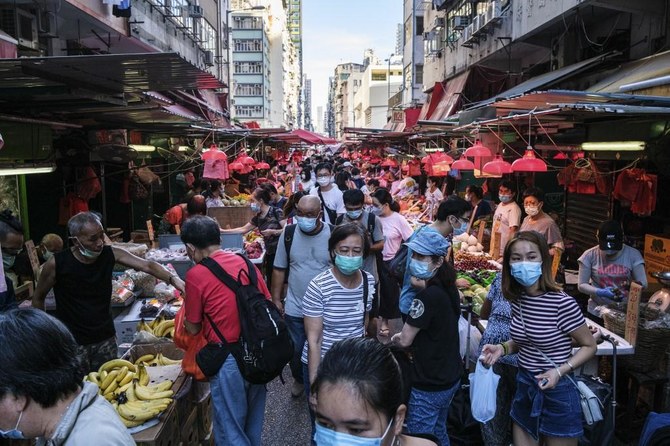
BEIJING: China asked local authorities to carry out regular coronavirus tests at wholesale markets, the country’s health authority said on Thursday, part of an all-out effort to control the spread of the COVID-19 epidemic.
China’s National Health Commission (NHC) has urged local authorities to strengthen monitoring for the coronavirus at major wholesale markets that can cover extensive neighboring areas, especially those with stands selling frozen and refrigerated meats and seafood, or with moist and closed spaces, according to a notice published on the commission’s website.
The guideline come after China’s capital city Beijing reported in early June a cluster of coronavirus infections that centered around a major wholesale market.
Local working groups in charge of coronavirus control and prevention must collect samples from major wholesale markets, especially those selling meats and seafood, once every week for coronavirus tests. However, smaller wholesale markets can do testing once a month.
Areas and objects at the markets that should be tested for the coronavirus include knives used at major stands, workers’ clothes surface, freezers, meats and seafood, sewage, restrooms, garbage trucks, and offices, according to the NHC notice.
China has already started COVID-19 testing on imported meats and seafood, and at domestic meat processors. It has also banned shipments from a list of meat processing plants overseas.


China orders regular coronavirus tests at wholesale markets
https://arab.news/zqqg3
China orders regular coronavirus tests at wholesale markets

- China’s National Health Commission urged local authorities to strengthen monitoring for the coronavirus at major wholesale markets
- The guideline come after China’s capital city Beijing reported in early June a cluster of coronavirus infections


China says Philippines distorted facts about incident near disputed atoll
- The Chinese ministry defended its coast guard’s actions as “reasonable, lawful, professional and restrained”
BEIJING: China’s defense ministry accused the Philippines on Wednesday of distorting the facts about an incident involving the Chinese coast guard and Filipino fishermen near a South China Sea shoal, a charge Manila strongly rejected.
The Philippine coast guard said over the weekend that three Filipino fishermen were injured and two fishing vessels damaged when Chinese coast guard ships cut their anchor lines and fired water cannon near the Sabina Shoal on Friday, actions the Philippine defense secretary denounced as “dangerous” and “inhumane.”
The Chinese ministry defended its coast guard’s actions as “reasonable, lawful, professional and restrained,” and vowed to “take strong and effective measures” in response to “all acts of infringement and provocation,” according to a statement released on its social media account.
“The Philippine side amassed a large number of ships in an organized and premeditated manner to illegally intrude” into the atoll’s lagoon, the ministry said. “Philippine personnel even threatened Chinese coast guard on site with a knife,” it added.
Philippine defense ministry spokesperson Arsenio Andolong maintained that Manila has evidence to counter China’s assertions.
“The facts are not distorted. They are documented, timestamped, and corroborated by video recordings, vessel logs, and on-site reporting by the Philippine Coast Guard,” Andolong said in a statement.
“The Philippines is not hyping the issue, the facts speak for themselves. These are aggressive and excessive actions of an encroaching state,” he added.
Sabina Shoal, which China refers to as Xianbin Reef and the Philippines as the Escoda Shoal, lies in the Philippines’ exclusive economic zone 150 km (95 miles) west of Palawan province.
China claims almost the entire South China Sea, a waterway supporting more than $3 trillion of annual commerce. The areas Beijing claims cut into the exclusive economic zones of Brunei, Indonesia, Malaysia, the Philippines and Vietnam.
An international arbitral tribunal ruled in 2016 that Beijing’s sweeping claims had no basis under international law, a decision China rejects.


