


JEDDAH: About 1,000 pilgrims converge on the Mina Valley outside Makkah on Wednesday to begin their spiritual journey
of a lifetime.
The Day of Tarwiyah (fetching water) marks the beginning of Hajj. There are no major rituals, so the pilgrims will spend their time praying and reflecting until sunrise on Thursday.
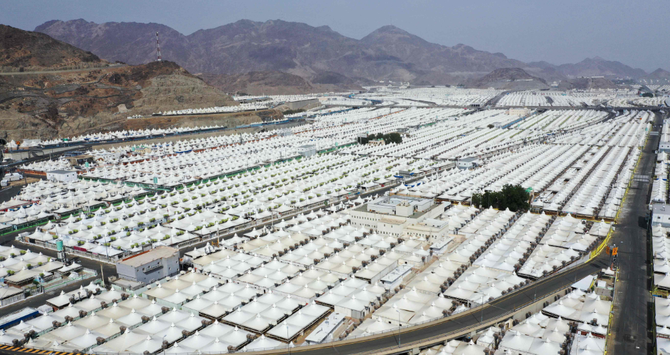
Mina, 7 km northeast of the Grand Mosque in Makkah and within its boundaries, would normally be the site of the world’s largest tent city, accommodating about 2.5 million pilgrims.
However, Hajj participation is restricted this year to curb the spread of the coronavirus pandemic, and the pilgrims are all Saudis or expatriates who live in the Kingdom.
Those selected to take part in this year’s Hajj were subject to temperature checks and placed in quarantine as they began arriving in Makkah, and health workers sanitized their luggage.
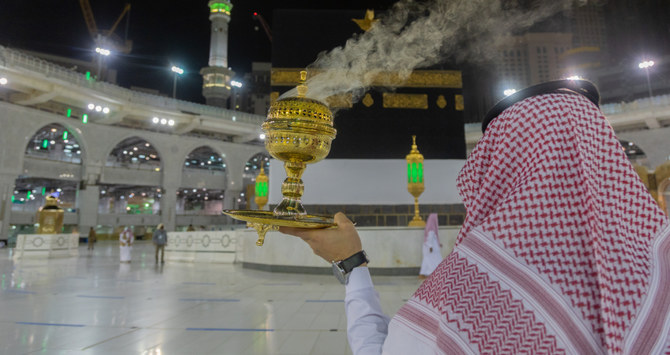
Health and safety staff with disinfectant cleaned the area around the Kaaba, the structure at the center of the Grand Mosque draped in gold-embroidered cloth toward which Muslims around the world pray.
Hajj authorities have cordoned the Kaaba this year, and pilgrims will not be allowed to touch it, to limit the chances of infection. They have also set up dedicated health centers, mobile clinics and ambulances to care for the pilgrims, who will be required to wear masks and observe social distancing.
All pilgrims were required to be tested for coronavirus before they arrived in Makkah, and they will be quarantined after the pilgrimage.
They were given amenity kits that include sterilized pebbles for the Jamarat stoning ritual, disinfectants, masks, a prayer rug and the ihram, the seamless white garment worn by pilgrims.
“There are no security-related concerns in this pilgrimage, but it is to protect pilgrims from the danger of the pandemic,” said Khalid bin Qarar Al-Harbi, Saudi Arabia’s director of public security.
On Thursday the pilgrims will travel to Arafat to listen to the sermon, the pinnacle of Hajj. They then go to Muzdalifah and stay overnight, before returning to Mina for the Jamarat ritual.
Among the pilgrims in Mina on Tuesday were Zaker Kareem and Saifullah Al-Mohammedani, two Iranian friends who met at university in Madinah 6 years ago and live in the Kingdom. Al-Mohammedani is finishing his last year at university. They both registered their names on the Hajj portal at the same time.
“I was checking the portal all the time to see if my application was accepted or not,” said Al-Mohammedani.
“I was delighted when I saw the approval. I called Zaker and he told me that he was also accepted.”
“I was really happy,” said Kareem.
Zelkin, an Azerbaijani pilgrim who lives and works in Jubail, said: “I would like to thank the Saudi government for this opportunity at such a difficult time.
“I know it’s really hard when there is coronavirus disease everywhere, to make this kind of arrangement in such a short time.
“I couldn’t believe this. It’s a once-in-a-life-time opportunity. It’s not my luck, it’s Allah’s will and you should follow his will.”


