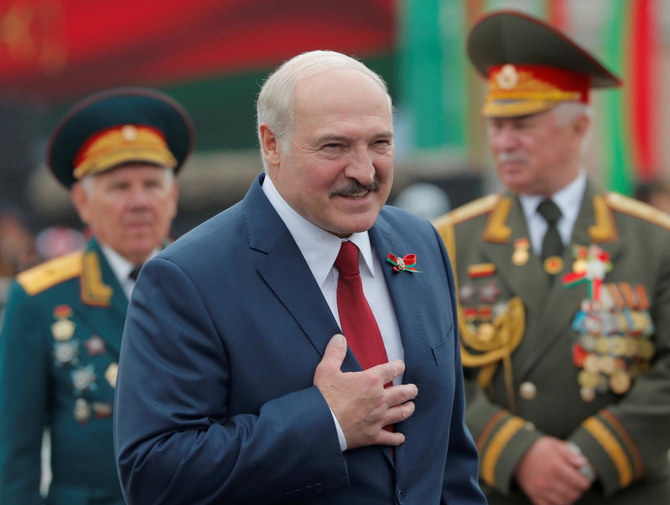
MINSK: Belarusian President Alexander Lukashenko said on Tuesday he caught the coronavirus and recovered “on his feet” without showing any symptoms, sounding a defiant tone as he addressed military leaders in Minsk.
Lukashenko, 65, has resisted calls for strict lockdown measures to contain the pandemic, dismissing fears about COVID-19 as a “psychosis” and suggesting remedies such as drinking vodka, taking saunas and playing ice hockey.
Public frustration over his handling of the pandemic has fueled the biggest protests in years against his rule ahead of a presidential election on Aug. 9. He has jailed two of his main electoral rivals in a widening crackdown on dissent.
“Today you are meeting a man who managed to survive the coronavirus on his feet. This is what doctors concluded yesterday. Asymptomatic,” Lukashenko said.
“As I said, 97% of our population carry this infection asymptomatically,” he added. He did not give a source for that figure.
Belarus, with a population of 9.5 million, has registered 67,366 coronavirus infections with 543 deaths.
Lukashenko did not say when or how he might have contracted the virus. He met Russian President Vladimir Putin at a military parade in Moscow last month. Putin was fine, TASS news agency quoted Kremlin spokesman Dmitry Peskov as saying.
Lukashenko, a former Soviet collective farm boss, said in April that no one would die from the coronavirus in Belarus, and that any deaths would be a result of underlying conditions, such as heart disease or diabetes.
In stark contrast to other European countries, Belarus kept its borders open and even allowed soccer matches in the national league to be played in front of spectators.
His attitude sharpened discontent against the president, whose iron-fisted rule since 1994 saw him dubbed “Europe’s last dictator” by Washington.
Lukashenko was speaking on Tuesday at a military base, after overseeing televised drills by special police who fired tear gas and used a water cannon in a practice crackdown on street protests. Lukashenko urged police to be tough.
“Under no circumstances should you create provocations,” he instructed the riot police chief. “But you also should not allow (the protesters) to insult the guys.”
Lukashenko has made several such visits to military units and the army staged exercises with tanks last weekend on the streets of Minsk.
Political analyst Alexander Klaskovsky said Lukashenko’s campaign was taking place in an atmosphere of “repression and intimidation.”
“The authorities hope that the display of muscle and threats will keep people from going out into the streets,” he said.
Human rights groups say more than 1,100 people have been detained in recent weeks. Protesters have rallied behind Svetlana Tikhanouskaya, the wife of one of the jailed candidates, who is campaigning in her husband’s place.
On Tuesday, several journalists were briefly arrested outside the state security service (KGB) headquarters, taken to a local police station and then released.
Lukashenko has compared the opposition to criminal gangs and accuses protesters of wanting to stage a violent revolution with the help of foreign backers.


Belarus president says he survived coronavirus ‘on his feet’
https://arab.news/5guse
Belarus president says he survived coronavirus ‘on his feet’

- Lukashenko, 65, has resisted calls for strict lockdown measures to contain the pandemic, dismissing fears about COVID-19 as a “psychosis”
- Public frustration over his handling of the pandemic has fueled the biggest protests in years against his rule ahead of a presidential election on Aug. 9


Russian minister visits Cuba as Trump ramps up pressure on Havana
- The Russian embassy in Havana said the minister would “hold a series of bilateral meetings” while in Cuba
HAVANA: Russia’s interior minister began a visit to ally Cuba on Tuesday, a show of solidarity after US President Donald Trump warned that the island’s longtime communist government “is ready to fall.”
Trump this month warned Havana to “make a deal,” the nature of which he did not divulge, or pay a price similar to Venezuela, whose leader Nicolas Maduro was ousted by US forces in a January 3 bombing raid that killed dozens of people.
Venezuela was a key ally of Cuba and a critical supplier of oil and money, which Trump has vowed to cut off.
“We in Russia regard this as an act of unprovoked armed aggression against Venezuela,” Russia’s Interior Minister Vladimir Kolokoltsev told Russian state TV Rossiya-1 of the US actions after landing in Cuba.
“This act cannot be justified in any way and once again proves the need to increase vigilance and consolidate all efforts to counter external factors,” he added.
The Russian embassy in Havana said the minister would “hold a series of bilateral meetings” while in Cuba.
Russia and Cuba, both under Western sanctions, have intensified their relations since 2022, with an isolated Moscow seeking new friends and trading partners since its invasion of Ukraine.
Cuba needs all the help it can get as it grapples with its worst economic crisis in decades and now added pressure from Washington.
Trump has warned that acting President Delcy Rodriguez will pay “a very big price” if she does not toe Washington’s line — specifically on access to Venezuela’s oil and loosening ties with US foes Cuba, Russia, China and Iran.
On Tuesday, Russia’s ambassador to Havana, Victor Koronelli, wrote on X that Kolokoltsev was in Cuba “to strengthen bilateral cooperation and the fight against crime.”
The US chief of mission in Cuba, Mike Hammer, meanwhile, met the head of the US Southern Command in Miami on Tuesday “to discuss the situation in Cuba and the Caribbean,” the embassy said on X.
The command is responsible for American forces operating in Central and South America that have carried out seizures of tankers transporting Venezuelan oil and strikes on alleged drug-trafficking boats.
- Soldiers killed -
Cuba has been a thorn in the side of the United States since the revolution that swept communist Fidel Castro to power in 1959.
Havana and Moscow were close communist allies during the Cold War, but that cooperation was abruptly halted in 1991 with the dissolution of the Soviet bloc.
The deployment of Soviet nuclear missile sites on the island triggered the Cuban Missile Crisis of 1962, when Washington and Moscow came close to war.
During his first presidential term, Trump walked back a detente with Cuba launched by his predecessor Barack Obama.
Thirty-two Cuban soldiers, some of them assigned to Maduro’s security detail, were killed in the US strikes that saw the Venezuelan strongman whisked away in cuffs to stand trial in New York.
Kolokoltsev attended a memorial for the fallen men on Tuesday.


