

Banksy painting raises millions for Palestinian children’s hospital

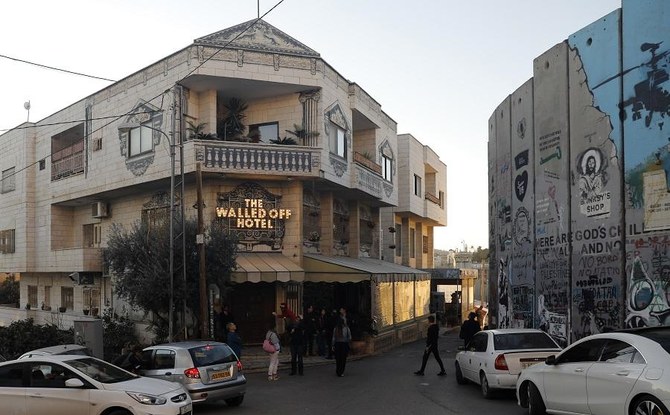
British artist Banksy’s Walled-Off Hotel in the West Bank town of Bethlehem. (File/AFP)
Short Url
Updated 29 July 2020
Follow

Banksy painting raises millions for Palestinian children’s hospital

  • The three-paneled work, “Mediterranean Sea View 2017,” was put up for sale at Sotheby’s auction house on July 29

LONDON: A triptych by British artist Banksy of the Mediterranean Sea depicting the European refugee crisis has sold for more than £2.2 million ($2.9 million) at auction in London.

The three-paneled work, “Mediterranean Sea View 2017,” was put up for sale at Sotheby’s auction house on July 29, where it was initially expected to fetch £1.2 million for a children’s hospital in the West Bank, the Bethlehem Arab Society for Rehabilitation.

The money raised will be put toward an acute stroke unit and children’s rehabilitation equipment.

The work was based on three romantic-period oil paintings of the sea, and depicted life jackets, oars and other detritus on the shore from abandoned refugee boats — a comment on the mass movement of people from the Middle East and North Africa to Europe due to a series of ongoing natural and man-made events, including the wars in Iraq, Syria and Libya.

“In ‘Mediterranean Sea View 2017,’ Banksy corrupts three found oil paintings with his own witty re-workings to create something that, while posing as a 19th-century seascape, spotlights one of the burning issues of the 21st century,” said Alex Branczik, Sotheby’s head of contemporary art for Europe.

“This triptych hangs in Sotheby’s galleries alongside works by some of history’s greatest landscape painters, including Bellotto, Van Goyen and Turner. Banksy’s work, however, stands alone for its potent political message.”

Banksy, who keeps his true identity a well-guarded secret, rose to international prominence on the back of graffiti art with strong themes of political and social commentary.

In recent years, the twin issues of the Mediterranean migration crisis and the Israel-Palestine conflict have played a major role in his work.

In 2015, he created an interactive work in the form of dystopian theme park “Dismaland,” in the British town of Weston-super-Mare, featuring refugee boats and anarchist themes.

He also opened the Walled-Off Hotel in Bethlehem in 2017, a play on the name of the famous Waldorf hotel chain.

The Walled-Off Hotel boasts the “worst view of any hotel in the world,” located next to Israel’s barrier wall in the West Bank.

Guests can experience just 25 minutes of direct sunlight per day. “Mediterranean Sea View 2017” had previously hung in the hotel. 

In “The Son of a Migrant from Syria,” daubed on a wall in a French migrant camp dubbed “The Jungle” in the port of Calais in 2015, Banksy showed the deceased billionaire founder of tech giant Apple, Steve Jobs, as a refugee, carrying nothing but a sack of belongings and an early Apple computer. Jobs’s biological father Abdulfattah Jandali was from the Syrian city of Homs. 

Banksy’s most recent work involved spraying a train carriage on the London Underground with messages about COVID-19.

Controversy was caused when it emerged that it was removed as part of routine cleaning by the network’s operator, Transport for London.


BMW Art Cars mark 50 years at inaugural Art Basel Qatar

Updated 8 sec ago
Follow

BMW Art Cars mark 50 years at inaugural Art Basel Qatar

DIHA: BMW’s long-running Art Car initiative took center stage at the inaugural Art Basel Qatar, with Thomas Girst, BMW Group’s head of cultural engagement, reflecting on five decades of collaboration between artists, engineers and the automobile.

Speaking at the fair, Girst situated the Art Car program within BMW’s broader cultural engagement, which he said spanned “over 50 years and hundreds of initiatives,” ranging from museums and orchestras to long-term partnerships with major art platforms.

“Every time Art Basel moves — from Miami to Hong Kong to Qatar — we move along with them,” he said. “That’s why we’re here.”


A post shared by Art Basel (@artbasel)

The occasion also marked the 50th anniversary of the BMW Art Car series, which began in 1975 with Alexander Calder’s painted BMW 3.0 CSL. Since then, the project has grown into a global collection that brings together motorsport, engineering, design and contemporary art. “Those Art Cars speak to a lot of people at the intersection of motorsports, technology, racing engineering, arts, lifestyle and design,” Girst said.

For Girst, the relationship between art and the automobile has deep historical roots. He pointed to early modernist fascination with cars, noting that “since the inception of the automobile,” artists have seen it as both a subject and a symbol of modernity. “There’s a reason for arts and culture and cars to mix and mingle,” he said.

At Art Basel Qatar, visitors were invited to view David Hockney’s BMW Art Car — Art Car No. 14 — displayed nearby. Girst described the work as emblematic of the program’s ethos, highlighting how Hockney painted not just the exterior of the vehicle but also visualized its inner life. The result, he suggested, is a car that reflects both movement and perception, turning the act of driving into an artistic experience.

Central to BMW’s approach, Girst stressed, is the principle of absolute artistic freedom. “Whenever we work with artists, it’s so important that they have absolute creative freedom to do whatever it is they want to do,” he said. That freedom, he added, mirrors the conditions BMW’s own engineers and designers need “to come up with the greatest answers of mobility for today and tomorrow.”

The Art Car World Tour, which accompanies the anniversary celebrations, has already traveled to 40 countries, underscoring the project’s global reach. For Girst, however, the enduring value of the initiative lies less in scale than in its spirit of collaboration. Art, design and technology, he said, offer a way to connect across disciplines and borders.

“That’s what makes us human. We can do better things than just bash our heads in — we can create great things together,” he said.