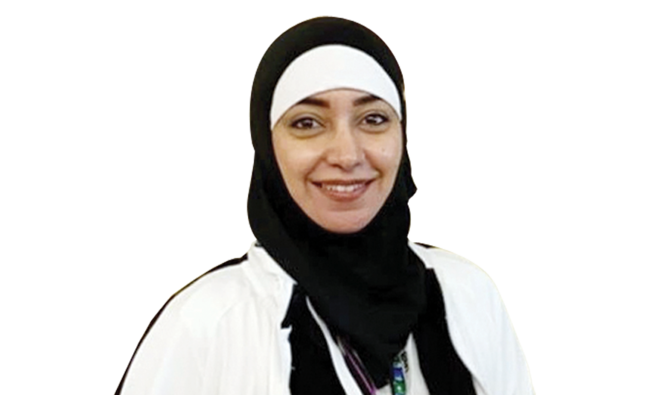
Roaa Qattan, Asian Football Confederation-certified Saudi football coach

Roaa Qattan. (Supplied)
Short Url
Updated 26 July 2020
Follow

Roaa Qattan, Asian Football Confederation-certified Saudi football coach

  • Qattan was one of only three female Saudi football coaches certified by the AFC

Roaa Qattan is an Asian Football Confederation-certified Saudi football coach. In February, the Saudi Sports for All Federation (SFA) launched the Women’s Football League (WFL), the first of its kind in the Kingdom, to develop the sport for Saudi women and promote inclusivity.
Qattan was one of only three female Saudi football coaches certified by the AFC and selected to lead Arabic training sessions as part of the international UN Global Goals World Cup 2019 Virtual Clubhouse, which ran online until July 9.
Qattan said the Virtual Clubhouse offers a chance to those who wish to join the Green Team in its Arabic training sessions.
“We were selected and tasked with preparing content for the training sessions in a way that was easy to set up and using simple Arabic. I wouldn’t be able to succeed without the support of the Green Team members and SFA management, which is committed to achieving the General Sports Authority goals under Vision 2030,” she said.
Qattan completed her bachelor’s degree in accounting from King Abdul Aziz University (KAU) in 2005. In 2011, she received an open water diver’s license from the Professional Association of Diving Instructors in Jeddah. She holds an INSEP diploma of sport sciences and has a C-license from the Asian Football Confederation, which she earned in 2018.
She is the founder of the Jeddah Wave football team and has been coaching teams since its establishment in 2018. A year later, she joined Green Team, the official women’s football team representing Saudi Arabia for the Global Goals World Cup, and helped coach it.
She was named best physical education teacher in the Arab region at the Women Sport Conference in Cairo in 2019.


Iranian ambassador thanks Saudi for not allowing territory to be used during war

Updated 05 March 2026
Follow

Iranian ambassador thanks Saudi for not allowing territory to be used during war

  • Alireza Enayati tells AFP Iran appreciates Kingdom's pledge not to allow its 'airspace, waters, or territory' to be used in US attacks
  • Envoy also denies that his country hit the US embassy in Riyadh this week with drones

RIYADH: Iran’s ambassador to Saudi Arabia Alireza Enayati said on Thursday his country remained appreciative of Saudi Arabia’s pledge to not allow its airspace or territory to be used during the ongoing war with the US and Israel.
“We appreciate what we have repeatedly heard from Saudi Arabia — that it does not allow its airspace, waters, or territory to be used against the Islamic Republic of Iran,” he told AFP.
Before the outbreak of war, Riyadh had thrown its support behind diplomatic efforts to diffuse tensions between Tehran and Washington and vowed that its airspace would not be allowed to be used for attacks against Iran.
Enayati also categorically denied that his country hit the US embassy in Riyadh this week, after Saudi officials said Iran targeted the compound with drones.
Saudi Arabia has repeatedly accused Tehran of launching missile salvos and drone attacks at its territory and warned that the kingdom reserved the right to defend itself, including by retaliating.
Iran had earlier denied attacking the sprawling Ras Tanura refinery — one of the largest in the Middle East — which Riyadh had also accused Tehran of targeting twice with drones.
Enayati added to the denial, saying Iran also had no hand in the targeting of the US embassy that triggered a fire at the compound.
“We confirmed that Iran has no role in the attack on the US embassy in Riyadh,” the ambassador told AFP.
“If the operations command in Tehran attacks somewhere, it takes responsibility for it.”
The war in the Middle East has engulfed the otherwise stable Gulf region as Iran retaliates over US and Israeli strikes that killed its supreme leader, launching strikes at Israel, the wider region and beyond.
At least 13 people have been killed in the Gulf, including seven civilians, since Iran began its attacks on Saturday.
Enayati, however, denied that Iran was waging a regional war as retaliation for the attacks on his country by the US and Israel.
“This is not a regional war and it is not our war. It was imposed on the region,” he told AFP.