ISLAMABAD: Authorities in Pakistan’s Punjab province have given seven working days to dozens of educational book publishers to withdraw their publications from the market or face criminal charges for circulating material that contains “factual mistakes,” a top government official said on Saturday.
The Punjab Curriculum and Textbook Board (PCTB) on Thursday banned 100 textbooks of 31 publishers from being used in private schools of the province, citing cultural and religious sensitivities in their content. If the publishers fail to comply with the board’s directions, they may face two years in prison.
“We have given the publishers seven days to withdraw their stock from the market, otherwise we will lodge criminal cases against them as per the law,” PCTB managing director Rai Manzoor Hussain Nasir told Arab News.
He said some of the banned books contain “factual mistakes regarding Pakistan’s map, and the dates of birth and death of the country’s founding fathers.”
“We have found some textbooks with inaccurate translations of Qur’anic verses,” he said, adding that the board is likely to ban more books as its staff are currently examining 10,000 publications.
The PCTB is a provincial regulator that reviews the content of textbooks, manuscripts and supplementary reading material and issues clearance for its publication.
The publishers whose books have been banned include Oxford University Press, Cambridge University Press, Paragon Books and Ameer Haider and Company.
Nasir said the publishers should have obtained a “no-objection” certificate for their publications to serve as school textbooks, but “they did so without the government’s consent.”
While publishers refuse to comment at this stage, the private schools which use their books for teaching said the PCTB had not consulted them before taking the decision.
“This is an arbitrary action, and we demand the board to at least consult us before initiating anything,” Kashif Adeeb Jawadani, president of All Pakistan Private Schools Management Association, told Arab News.
He said that private schools would support the board to ban the books if there was anything in them against Pakistan or Islam. One of the banned books, he said, included material on procreation.
“We understand the reproduction process shouldn’t be taught in primary classes,” Jawadani said, “But it can be made part of higher school syllabus.”


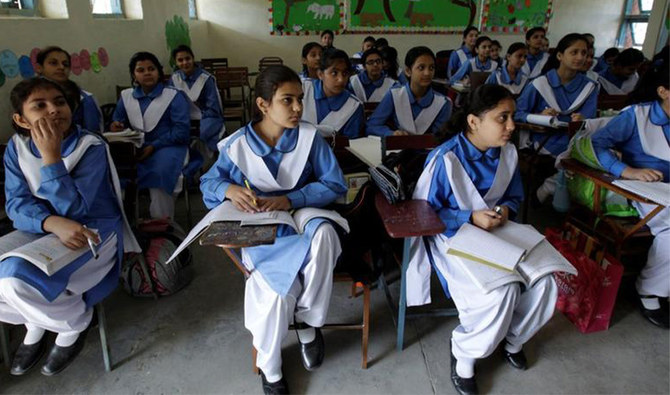
Punjab authorities order publishers to withdraw 'inaccurate' schoolbooks or face prosecution
https://arab.news/vkmtp
Punjab authorities order publishers to withdraw 'inaccurate' schoolbooks or face prosecution

- Publishers of the books banned by Punjab authorities include Oxford University Press and Cambridge University Press
- The books were banned over ‘factual mistakes’ regarding Pakistan’s geography and history

EU, Pakistan sign €60 million loan agreement for clean drinking water in Karachi
- Project will finance rehabilitation, construction of water treatment facilities in Karachi city, says European Investment Bank
- As per a report in 2023, 90 percent of water samples collected from various places in city was deemed unfit for drinking
ISLAMABAD: The European Investment Bank (EIB) and Pakistan’s government on Wednesday signed a €60 million loan agreement, the first between the two sides in a decade, to support the delivery of clean drinking water in Karachi, the EU said in a statement.
The Karachi Water Infrastructure Framework, approved in August this year by the EIB, will finance the rehabilitation and construction of water treatment facilities in Pakistan’s most populous city of Karachi to increase safe water supply and improve water security.
The agreement was signed between the two sides at the sidelines of the 15th Pak-EU Joint Commission in Brussels, state broadcaster Radio Pakistan reported.
“Today, the @EIB signed its first loan agreement with Pakistan in a decade: a €60 million loan supporting the delivery of clean drinking water for #Karachi,” the EU said on social media platform X.
Radio Pakistan said the agreement reflects Pakistan’s commitment to modernize essential urban services and promote climate-resilient infrastructure.
“The declaration demonstrates the continued momentum in Pakistan-EU cooperation and highlights shared priorities in sustainable development, public service delivery, and climate and environmental resilience,” it said.
Karachi has a chronic clean drinking water problem. As per a Karachi Water and Sewerage Corporation (KWSC) study conducted in 2023, 90 percent of water from samples collected from various places in the city was deemed unsafe for drinking purposes, contaminated with E. coli, coliform bacteria, and other harmful pathogens.
The problem has forced most residents of the city to get their water through drilled motor-operated wells (known as ‘bores’), even as groundwater in the coastal city tends to be salty and unfit for human consumption.
Other options for residents include either buying unfiltered water from private water tanker operators, who fill up at a network of legal and illegal water hydrants across the city, or buying it from reverse osmosis plants that they visit to fill up bottles or have delivered to their homes.
The EU provides Pakistan about €100 million annually in grants for development and cooperation. This includes efforts to achieve green inclusive growth, increase education and employment skills, promote good governance, human rights, rule of law and ensure sustainable management of natural resources.


