

Opposition group presents a secular alternative to Iran’s clerical regime

People hold pictures of Maryam Rajavi, leader of the People's Mujahedin of Iran, and former Iranian flags during a demonstration of the exiled Iranian opposition to protest against the celebration in Iran of the 40th anniversary of the Islamic Revolution, on February 8, 2019 in Paris. (AFP/File Photo)
Short Url
Updated 27 July 2020
Follow

Opposition group presents a secular alternative to Iran’s clerical regime

  • The NCRI is vehemently opposed to the regime’s use of terrorism as a tool of Iranian foreign policy
  • Up to 30,000 NCRI supporters and members were killed in 1988 on the basis of a Khomeini edict

LONDON: “A force capable of overthrowing the regime is lurking in the heart of Iranian cities. From all indications, the ruling theocracy is at the point of being overthrown,” the leader of the global Iranian resistance declared to an audience of thousands tuning in to the online Free Iran Global Summit on July 17.

Five years ago, this declaration might have sounded like empty rhetoric from a fringe group. Now, two years after Tehran’s failed attempt at bombing the National Council of Resistance of Iran’s (NCRI) annual rally in Paris, the words of Maryam Rajavi, a former militant commander and now the NCRI’s president-elect, look much less like an empty threat and much more like a promise.

The NCRI is an umbrella group encompassing a broad spectrum of groups opposed to the Iranian regime, and is often described as the country’s government in waiting.
With its charismatic leader at the helm and thousands of Iranian, Western and Arab supporters behind its cause, the NCRI is increasingly being recognized as the legitimate and progressive alternative to the supreme leader and the cohort currently in power.

The NCRI, also known as the Mojahedin-e Khalq (MEK) in Persian, has three aims for Iran: The demise of the clerical regime, universal suffrage and people’s sovereignty, and social freedom and justice.

Its swelling legitimacy, and the credible alternative it presents for Iran’s future, have not gone unnoticed among political and security establishments in the West.
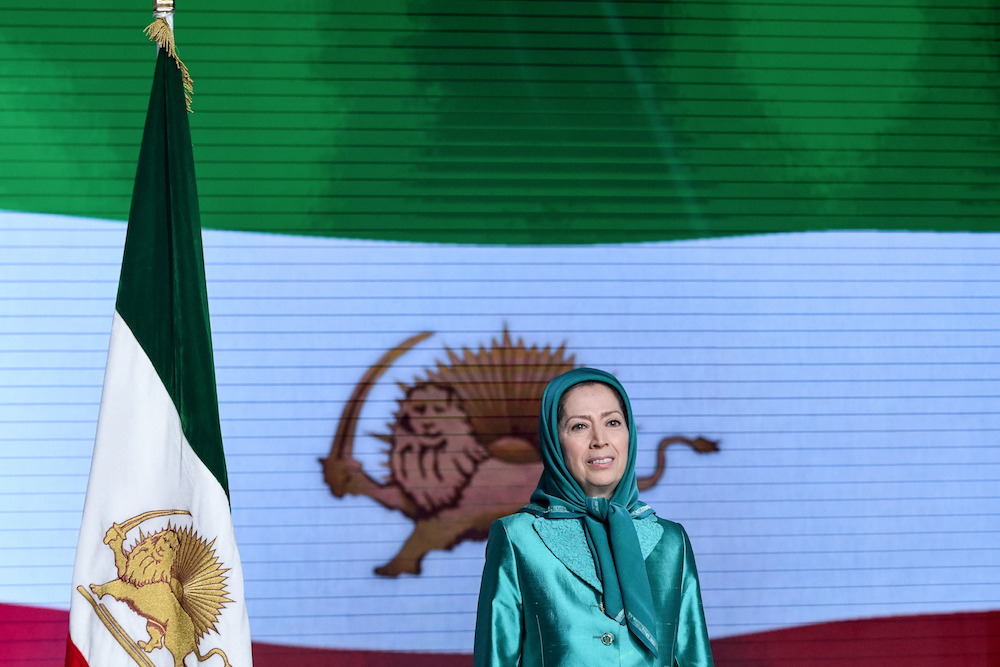


Iran Maryam Rajavi speaks during a conference "120 Years of Struggle for Freedom Iran" at Ashraf-3 camp on July 13, 2019. (AFP/File Photo)

One long-time supporter of the NCRI, and a speaker at the 2020 Free Iran Global Summit, is Tom Ridge, who was the first ever US secretary of homeland security after the 9/11 attacks.

He is a former governor of Pennsylvania and an outspoken advocate for an Iran “free from tyranny.”

Ridge spoke with Arab News during the summit, and explained his long-running support for the NCRI — despite its designation by the US as a terrorist organization until 2012.


While secretary of homeland security, he had never seen any credible reports that justified the group’s terrorist designation, Ridge said.

“I began every day, for several years, in the Oval Office alongside President George Bush being presented with a threat report. I never ever saw a reference to the MEK in any plot that threatened Americans or American interests,” he added.

Having been removed from the US list of terrorist organizations in 2012, the NCRI is increasingly being recognized as the most important player in the landscape of resistance to Tehran’s clerical regime — both at home and abroad.

READ: Why Iran’s agents hound political refugees in distant Albania

“Within American political circles, these days there’s growing bipartisan recognition of the NCRI’s legitimacy,” Ridge said.

He argues that this consensus and recognition of the NCRI’s legitimacy are in the best interests of not just the Iranian people, but also of regional states and the US.

“Recognizing the existence of both an internal and external opposition group that rejects terrorism and embraces principles like gender equality and, most importantly, a non-nuclear Iran seems to be in everyone’s best interest in the globe, not to mention regional states such as Saudi Arabia,” he said.

Ridge spoke at the summit to highlight and denounce Iranian support for terrorism, and many other speakers did the same.

The issue of Iranian terrorism is central to the NCRI’s campaigning, and it is an issue the group is tragically familiar with.

FASTFACT

NCRI

Was founded by Massoud Rajavi and former Iranian President Abolhassan Banisadr in 1981 after their joint escape from the country.

In 2013, Islamic Revolutionary Guard Corps (IRGC) forces and their Iraqi militia proxies attacked and killed over 50 NCRI members, and kidnapped more, from their base in Ashraf, Iraq.

This brazen attack was mortifying for the NCRI, but looking further back, the persecution that members of the Iranian opposition have experienced at the hands of the regime becomes even more egregious.

Up to 30,000 of the NCRI’s supporters and members were murdered by the regime in 1988, following a religious edict by hardline revolutionary Ruhollah Khomeini.
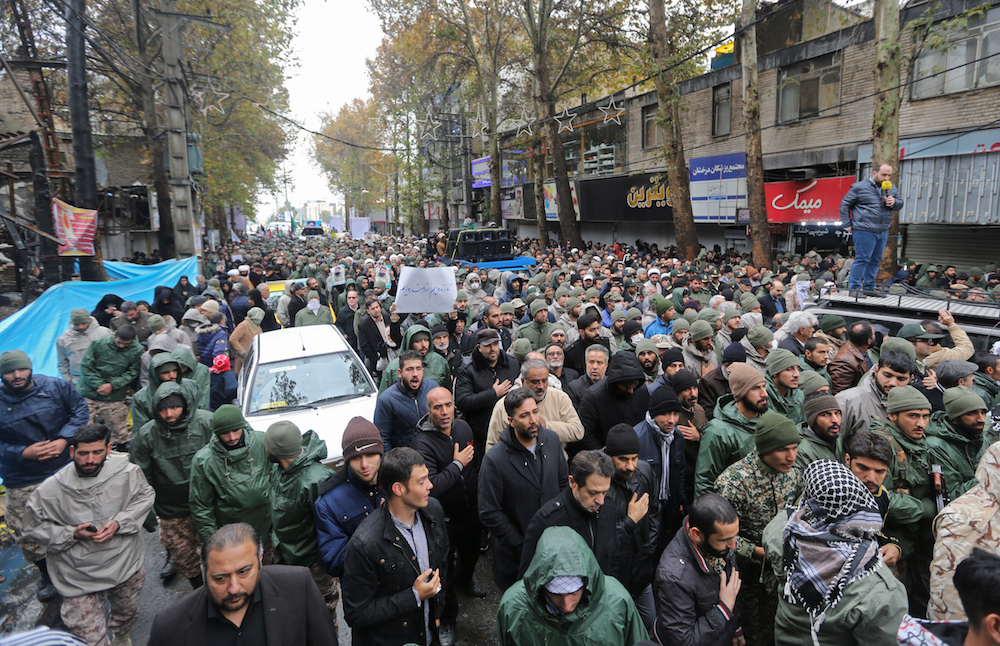


Iranian mourners attend the funeral of Morteza Ebrahimi, a commander of the Islamic Revolutionary Guard Corps, who was killed in violent demonstrations in November 2019. (AFP/File Photo)

Amnesty International has referred to these murders as “ongoing crimes against humanity.” It continues to call for justice over the killings, and has implored the UN to set up an independent inquiry into the mass murders.

The most recent assault on the Iranian resistance — a bomb plot targeting its 2018 annual summit — was organized in part by an official Iranian diplomat, who just days ago began his trial in France for his role.

After 30 years of bombings, violence and targeted attacks, it is perhaps no surprise that the NCRI is so vehemently opposed to the regime’s use of terrorism as a tool of foreign policy.

These attacks, Ridge argues, are more than illegal and unjust. He believes that Tehran’s relentless assaults on the NCRI betray its fear of the movement’s popular appeal.
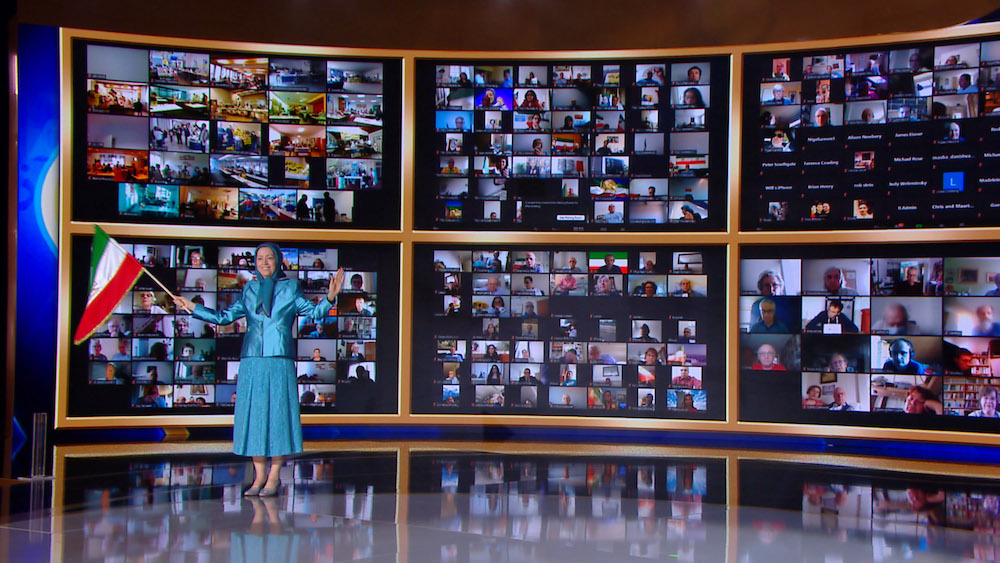


Leader of the People's Mujahedin of Iran Maryam Rajavi during an event. (Supplied)

“If an oppressive regime highlights an internal and external group as the enemy of the state, then there’s a pretty good justification to conclude that they’re fearful that their appeal is large,” he said.

NCRI members believe that Tehran is taking increasingly drastic measures against them because it knows that their appeal is increasing every year, and the West is starting to take notice of the credible, progressive alternative they present for Iran’s future.

Ali Safavi, a member of the NCRI’s foreign affairs committee, told Arab News that from the 2020 Free Iran Global Summit onward, its activities are only going to expand and intensify.

He said the group “aims to pave the way for more uprisings, like those witnessed in November 2019,” when huge anti-regime protests swept across virtually every Iranian city and town.
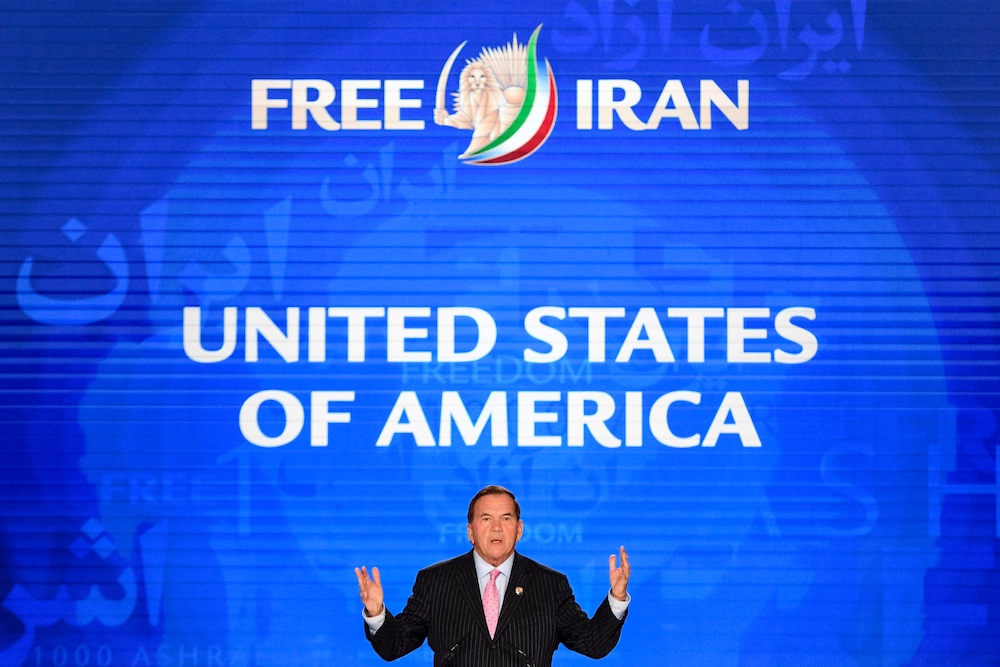


Former US Secretary of Homeland Security Tom Ridge speaks during a conference at Ashraf-3 camp on July 13, 2019. (AFP/File Photo)

Safavi added that the NCRI will “step up its campaign to hold the regime leaders accountable for their atrocities, first and foremost the 1988 massacre of 30,000 political prisoners,” and that it will continue to work on “breaking the climate of fear and repression” that Tehran has manufactured at home and pursues abroad through terrorism.

Rajavi, Safavi and their cohort in the NCRI were on the frontlines of the 1979 revolution, and it is looking increasingly likely that they will take leading roles in the next Iranian revolution.

This time, though, they say they will not allow their vision for Iran’s future to be distorted, as it was by Khomeini and his extremist ilk in 1979.

The next Iranian revolution will truly be of the people, and if the NCRI’s predictions are correct, it could be sooner than anyone expects.

----------------

Twitter: @CHamillStewart 


2025: The most successful year in Syrian history since 1970

Updated 6 sec ago
Follow

2025: The most successful year in Syrian history since 1970

  • First year without Bashar Assad brought sweeping diplomatic gains and sanctions relief
  • War-torn nation re-entered global forums, saw sanctions lifted even as scars persisted

LONDON: One year after the fall of Bashar Assad, Syrians are holding fast to hope as 2025 emerges as the country’s most diplomatically successful year in about five decades, marked by renewed international engagement and regional reintegration, even as the legacy of repression and war remains deeply etched into daily life.

The scale of that change is best understood against the longevity of the rule that preceded it. Modern Syria was shaped by more than five decades of Assad family dominance, beginning when Hafez Assad, then defense minister, seized power in a military coup on Nov. 16, 1970.

He formally became president in March 1971, inaugurating an era of centralized authority and political repression that would persist through his son’s presidency.

Over the following decades, Syria drifted deeper into rigid Cold War alignments, recurrent confrontations with its neighbors and, eventually, entrenched international isolation. That trajectory hardened under both Hafez and Bashar Assad, leaving little room for political reform and laying the groundwork for the uprising that erupted in 2011.

But today, post-Assad optimism was on display earlier this month, when thousands gathered in cities including Damascus, Homs, and Aleppo to mark the anniversary of Assad’s downfall.

In Damascus’s Umayyad Square, crowds danced to an Arabic song repeating the chorus, “Raise your head up high, you’re a free Syrian,” reflecting aspirations shaped by nearly 14 years of civil war.

Behind the public celebrations, analysts say Assad’s removal opened a rare historical window.

“Syria has opened a new chapter that many once thought impossible,” Nanar Hawach, a senior Syria analyst at the International Crisis Group, told Arab News. “Diplomatic ties are rebuilding, investment is returning, and the country is beginning to shake off years of isolation.”

Even so, he added, the country’s future hinges on developments at home. “To maintain this momentum, the government needs to focus internally: prioritizing day-to-day security and building trust with all communities.

“External support remains vital, but lasting peace will depend on Syrians feeling safe, included, and represented in the new order they are working to build.”

That view is shared by Comfort Ero, the ICG’s president and CEO. “Syria has made incredible strides forward on the international stage in the past year — forging partnerships, attracting funding and securing the easing of some of its most crippling sanctions,” she told Arab News. “But its future now depends on what happens at home.”

Indeed, the past year brought a wave of diplomatic normalization. Syria restored regional and international ties, saw US and European sanctions lifted or suspended, and rejoined major global forums.

The war-weary country reappeared at high-profile gatherings including the Arab League Summit in Baghdad, the Russian-Arab Summit, the World Economic Forum in Davos, and the Doha Forum.

That momentum culminated in November with interim President Ahmad Al-Sharaa’s visit to the White House, the first such visit by a Syrian leader since independence from France in 1946.

During the trip, Syria formally joined the US-led Global Coalition Against Daesh, days after the US Treasury removed Al-Sharaa, a former Al-Qaeda supporter who once had a $10 million bounty for his capture, from its Specially Designated Global Terrorist sanctions list.

Similarly, the UN Security Council adopted on Nov. 6 a US-backed resolution delisting Al-Sharaa and Interior Minister Anas Hasan Khattab, a move widely seen as a powerful signal of international recognition of Syria’s political transition.

These diplomatic gains followed the dramatic moment on Dec. 8, 2024, when Assad fled to Moscow as a coalition of rebel groups, led by Al-Sharaa, then-commander of the armed group Hayat Tahrir Al-Sham, seized Damascus in a lightning offensive.

Within two months, the new military command named Al-Sharaa transitional president, repealed the 2012 constitution, and dissolved the regime’s parliament, army, and security agencies.

In March, he signed a draft constitutional declaration establishing a five-year transitional period and announced a transitional cabinet.

Economic relief soon followed. The EU suspended major sanctions; the UK lifted asset freezes and most sanctions; and the US ended its comprehensive sanctions program and twice suspended the Caesar Act before permanently repealing it on Dec. 17 — a move many believe will facilitate foreign investment and speed reconstruction.

The Caesar Act had long blocked Syrian banks from accessing the global financial system, restricting external transfers and limiting correspondent banking relationships. Its repeal marked the culmination of a sustained diplomatic push led by Riyadh.

In May, during a high-level visit to Saudi Arabia, US President Donald Trump announced from Riyadh the lifting of sanctions on Syria and met the following day with Al-Sharaa. Around the same time, Saudi Arabia and Qatar paid off Syria’s $15.5 million World Bank debt.

Investment activity soon accelerated. In July and August, Syria had signed 47 investment agreements worth more than $6.4 billion with Saudi companies and secured $14 billion in deals with companies from Qatar, the UAE, Italy, and Turkiye, targeting transport, infrastructure, and real estate.

Opinion

This section contains relevant reference points, placed in (Opinion field)

Diplomatic engagement continued into the fall. In September, Al-Sharaa addressed the UN General Assembly — the first Syrian head of state to do so since 1967. He pledged accountability and national rebuilding.

While in New York, he held meetings across diplomatic and policy circles, including a highly symbolic discussion with former CIA director David Petraeus.

Assad’s fall and early signs of recovery have also encouraged many displaced people to return to their original towns and villages.

According to the UN Refugee Agency, more than 1.2 million Syrians have voluntarily returned from neighboring countries since December 2024, alongside nearly 1.9 million internally displaced people who have gone back to their home areas.

At the same time, Syrians with the means to do so are reopening small businesses and rebuilding homes, even without reliable public services and amid widespread destruction.

Marking the anniversary of Assad’s fall on Dec. 7, UN Secretary-General Antonio Guterres urged the international community to “stand firmly behind this Syrian-led, Syrian-owned transition,” stressing the need for sustained humanitarian support, fewer barriers to reconstruction, and backing for economic recovery.

“On this anniversary,” he said, “we stand united in purpose — to build a foundation of peace and prosperity and renew our pledge to a free, sovereign, united, and inclusive Syria.”