

Pakistani journalist recounts ordeal, abduction by armed men

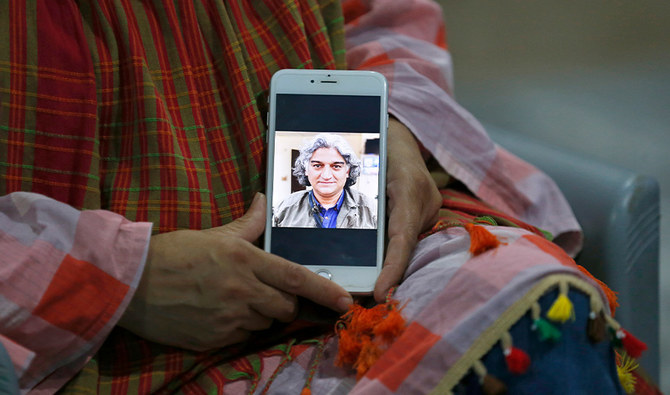
Kaneez Sughra, wife of kidnaped prominent Pakistani journalist Matiullah Jan, shows a picture her husband to journalists at a relative's home, in Islamabad, Pakistan, Tuesday, July 21, 2020. (AP Photo)
Short Url
Updated 24 July 2020
Follow

Pakistani journalist recounts ordeal, abduction by armed men

  • Matiullah Jan shares details of his abduction on Tuesday and 12-hour detention 
  • Says will not be deterred from speaking for democracy, rule of law

ISLAMABAD: A Pakistani journalist known for his criticism of the country’s military on Thursday recounted his ordeal this week when armed men abducted him in broad daylight and held him captive for a day.

It was the first time Matiullah Jan, who was freed on Tuesday, shared details about his 12-hour detention.

Enforced disappearances are common in Pakistan but it’s rare that a victim and survivor of such an incident goes public about it.

Jan chose to release a video in which he explains how he had dropped off his wife on Tuesday morning at a school in Islamabad where she works and was checking messages on his phone, his car still parked, when armed men arrived in several vehicles. They surrounded his car, dragged him out, threw him into a vehicle and sped away.

Jan said the men wore a mix of plainclothes and police uniform. He said he threw his mobile phone into the school yard as he was being dragged away, hoping someone would later notice it and realize what had happened.

But one of his abductors saw he had thrown the phone and asked a school guard to retrieve it. The phone was returned, and the cars sped away with Jan. Minutes later, news of his abduction broke on social media.

Closed-circuit TV footage from the school area showed the entire abduction.

His wife, Kaneez Sughra, spoke to the media outside the family’s home, showing a photo of her husband on her smart phone and appealing for his life.

The abduction quickly drew outrage and condemnation from fellow journalists and human rights activists in Pakistan and across the world who rallied in support of Jan and demanded Prime Minister Imran Khan’s government ensure the journalist’s release and freedom. Jan was released later that evening.

The government has so far not commented on Jan’s abduction.

“I think those who abducted me are the same people who are against democracy, who are against the political system, and who do not accept the supremacy of the constitution, those who do not accept the supremacy of parliament and have been conspiring from day one against the constitutional system and rule of law,” Jan said in the video, without naming anyone.

He said his captors brought him inside a building with iron doors, put a black hood over his head and handcuffed him. They forced him to sit on the floor and repeatedly beat him, he said.

Jan said he was not formally questioned but that his abductors kept saying: “What do you think you are? Don’t you know what you are doing? Why do you say such things”.

At one point, his abductors started saying how they had gotten the wrong man but he didn’t know whether that was meant to frighten him even more.

Jan said the most terrifying moment came at the end, when his abductors took him out of the building and drove him to a deserted area outside Islamabad where they threw him into the bushes. He thought they would then kill him, Jan said.

But instead they went back to their cars and drove away. He said he later signaled to a passing vehicle and contacted his family to let them know he was free and coming home.

Jan concluded his video message by saying he would not be swayed in his intention to speak up for democracy and rule of law, and thanked all those who had rallied in his defense and demanded his freedom — voices Jan credited with helping bring about his release so quickly.


EU, Pakistan sign €60 million loan agreement for clean drinking water in Karachi

Updated 5 sec ago
Follow

EU, Pakistan sign €60 million loan agreement for clean drinking water in Karachi

  • Project will finance rehabilitation, construction of water treatment facilities in Karachi city, says European Investment Bank
  • As per a report in 2023, 90 percent of water samples collected from various places in city was deemed unfit for drinking

ISLAMABAD: The European Investment Bank (EIB) and Pakistan’s government on Wednesday signed a €60 million loan agreement, the first between the two sides in a decade, to support the delivery of clean drinking water in Karachi, the EU said in a statement. 

The Karachi Water Infrastructure Framework, approved in August this year by the EIB, will finance the rehabilitation and construction of water treatment facilities in Pakistan’s most populous city of Karachi to increase safe water supply and improve water security. 

The agreement was signed between the two sides at the sidelines of the 15th Pak-EU Joint Commission in Brussels, state broadcaster Radio Pakistan reported. 

“Today, the @EIB signed its first loan agreement with Pakistan in a decade: a €60 million loan supporting the delivery of clean drinking water for #Karachi,” the EU said on social media platform X. 

https://x.com/eupakistan/status/2001258048132972859

Radio Pakistan said the agreement reflects Pakistan’s commitment to modernize essential urban services and promote climate-resilient infrastructure.

“The declaration demonstrates the continued momentum in Pakistan-EU cooperation and highlights shared priorities in sustainable development, public service delivery, and climate and environmental resilience,” it said. 

Karachi has a chronic clean drinking water problem. As per a Karachi Water and Sewerage Corporation (KWSC) study conducted in 2023, 90 percent of water from samples collected from various places in the city was deemed unsafe for drinking purposes, contaminated with E. coli, coliform bacteria, and other harmful pathogens. 

The problem has forced most residents of the city to get their water through drilled motor-operated wells (known as ‘bores’), even as groundwater in the coastal city tends to be salty and unfit for human consumption.

Other options for residents include either buying unfiltered water from private water tanker operators, who fill up at a network of legal and illegal water hydrants across the city, or buying it from reverse osmosis plants that they visit to fill up bottles or have delivered to their homes.

The EU provides Pakistan about €100 million annually in grants for development and cooperation. This includes efforts to achieve green inclusive growth, increase education and employment skills, promote good governance, human rights, rule of law and ensure sustainable management of natural resources.