

Egypt’s homeless children hit hard by pandemic scourge

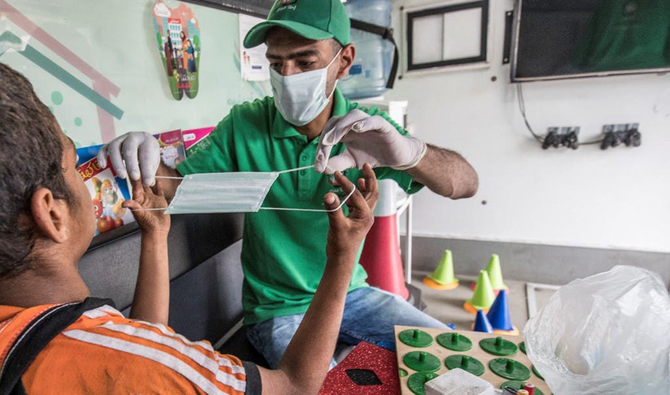
A social worker shows a homeless child the proper way to use a face mask inside one of the mobile units run by the Egyptian authorities in Cairo’s Abbasia district. (AFP)
Short Url
Updated 23 July 2020
Follow

Egypt’s homeless children hit hard by pandemic scourge

  • The novel coronavirus, which has killed nearly 4,000 people and infected around 83,000 more in Egypt

CAIRO: Wandering Cairo’s bustling streets, Zeinab was struggling to survive by selling tissues when the coronavirus left her even more vulnerable, along with thousands of other homeless people and street children.

The only good news was that, amid the pandemic fears, physical violence against the destitute has declined, Zeinab told AFP at a mobile shelter for the poor in Abbassiya, a working-class district.

“People attack us less because they are afraid,” she said.

But with fewer people in the streets, “we have less work and less money,” added the young woman, while keeping an eye on her 1-year-old son, Abdallah.

Young people and children who roam the streets are among the poorest and are regularly exposed to verbal, physical and sexual violence and exploitation.

The novel coronavirus, which has killed nearly 4,000 people and infected around 83,000 more in Egypt, has compounded their vulnerability, as the country battles an economic downturn and access to support is reduced due to lockdown measures.

“They are isolated, the population at large avoids them ... and their meagre income has been hit hard,” said Youssef Bastawrous, manager of the French civil society group Samusocial International, which works with street children in Egypt.

In 2014, authorities estimated Egypt had around 16,000 youngsters and children living rough on the streets.

The UN Children’s Fund (UNICEF) believes this a massive “underestimation” of actual numbers, said its communications head in Egypt Jonathan Crickx.

The problem of compiling reliable figures on street children is compounded because many are from families long trapped in poverty and without stable housing who may not be listed in civil status registries.

In 2016, Egyptian authorities launched the national program “Atfal bala ma’wa” (Children Without a Home) with the aim of “integrating” street children and helping them “abandon street behavior,” said Mohamed Shaker, head of the program at the Ministry of Social Solidarity.

The program deploys 17 mobile units throughout the country, providing a place to rest, food and games as well as medical, social and psychological support to street children.

“The aim is to build a relationship with the homeless children and help them build trust between each other,” said Salma Ismail, communications officer at a nongovernmental group Bannati.

At the Abbassiya mobile unit, Karim tentatively approached and grabbed a snack on offer.

He said he was 12 years old but staff cautioned that most of the children who use the services do not know, or prefer not to disclose, their real ages.

Karim said he sleeps in a local park and earns his living by cleaning car windshields.

He said he was attending a public school before authorities shut them down in late March as part of efforts to stem the spread of the virus.

“I come here to play,” Karim told AFP. “I miss school.

“Since it has been closed, I have forgotten everything. Before, I used to learn how to read and count.”

The economic impact of Egypt’s lockdown measures has stretched already overextended aid offered to street children.

With the financial crunch, some charities have concentrated efforts on health and sanitation to help children protect themselves against the disease.

“We make them aware of health issues, we distribute masks and explain to them how to wash their hands,” said Samusocial International’s Bastawrous.

The lifting of a three-month curfew in late June brought some reprieve for street children, who could again sell trinkets and tissues or beg for money as people returned to cafes and restaurants.

Restrictions have also been partially lifted on mosques and churches, which have long provided sanctuary for street children.

At some mosques, the bathrooms usually used by worshippers to perform their ablutions act as a one-stop shop for the children’s hygiene needs.


Israel says it has launched ‘broad wave’ of strikes on Iran, as Tehran widens its response across the region

Updated 04 March 2026
Follow

Israel says it has launched ‘broad wave’ of strikes on Iran, as Tehran widens its response across the region

  • ​US military says 17 Iranian navy ships destroyed, struck nearly ‌2,000 targets ‌in ​Iran thus far
  • US and Israeli attacks have killed 787 people in Iran:  Iranian Red Crescent

JERUSALEM/DUBAI/TEHRAN: Israel early Wednesday launched new attacks on Iran as the US military said it has hit nearly 2,000 targets inside the Islamic republic, which tried to impose a cost by expanding a missile and drone barrage across the region.
With global energy prices on the rise, President Donald Trump said the US Navy was ready to escort oil tankers through the Strait of Hormuz, the vital chokepoint into the Gulf that Iran has threatened to seal off.
Israel’s military said it launched a “broad wave of strikes” after midnight across Iran, which in the hours before had launched three separate missile barrages at Israel, causing mild injuries to a woman in Tel Aviv.

The US military has ​destroyed 17 Iranian ships, including a submarine, and struck nearly ‌2,000 targets ‌in ​Iran, ‌the ⁠commander ​of the ⁠US Central Command said on Tuesday.

“Today, there is ⁠not a ‌single ‌Iranian ​ship ‌underway ‌in the Arabian Gulf, Strait of Hormuz, or ‌Gulf of Oman,” US ⁠Central Command’s Brad ⁠Cooper said in a video posted to X. 


Cooper said the US military has “severely degraded Iran’s air defenses” and taken out hundreds of ballistic missiles, launchers and drones.
The video showed missiles and jets launching from US ships, and targets exploding on the ground.
Cooper noted that Iran has launched over 500 ballistic missiles and more than 2,000 drones in retaliation.
But he said the US is “hunting” Iran’s last remaining mobile ballistic missile launchers to eliminate their “lingering launch capability.”
Cooper said the operation has involved more than 50,000 troops, 200 fighter jets, two aircraft carriers and bombers, and “more capability is on the way.”
“We’ve just begun,” Cooper said, adding that the US military is targeting “all the things that can shoot at us.”

“These forces bring a massive amount of firepower, representing the largest buildup by the US in the Middle East in a generation,” he said in the video message, describing the first day’s barrage as bigger than the so-called “shock and awe” against Saddam Hussein’s Iraq in 2003.

Iran‘s response

The US and Israeli attacks have killed 787 people in Iran, according to the Iranian Red Crescent, a toll that could not be independently confirmed.
Iran vowed to inflict a heavy price in retaliation. Drones struck adjacent the US consulate in Dubai, starting a fire but inflicting no casualties, and against the US military base at Al-Udeid in Qatar.
The attacks came a day after strikes on the US embassies in Riyadh and Kuwait City and on a US air base in Bahrain.
“We are saying to the enemy that if it decides to hit our main centers, we will hit all economic centers in the region,” Islamic Revolutionary Guard General Ebrahim Jabbari said.

Iranian attacks have killed at least nine people and wounded dozens in the Gulf region, according to various reports quoting local authorities.

Mourners gather at Kuwait's Sulaibikhat cemetery on March 3, 2026, during the funeral of Kuwait Army soldiers who were killed in an Iranian strike. (AFP) 

Among the latest death was an 11-year-old girl who was killed after shrapnel fell in a residential area in Kuwait City, health authorities said Wednesday.
The Kuwait army said in a statement the shrapnel fell over a house and left casualties while forces were intercepting “several hostile aerial targets” over the country.
The Health Ministry said in a separate statement that the child died of her wounds at the hospital.
The child’s mother and three other relatives were injured and being treated at the hospital, it said.

Vessel hit in Gulf of Oman
A vessel was hit by a projectile early Wednesday in the Gulf of Oman off the United Arab Emirates, an agency of the UK military said.
There were no reported casualties.
The United Kingdom Maritime Trade Operations Center said the vessel was struck 8 miles east of Fujairah, one of the UAE’s seven emirates.
The attack damaged the vessel’s steel plating.
No fire or water intake was reported, it said.

​  Tankers are seen off the coast of the Fujairah, United Arab Emirates, on March 3, 2026. President Trump said the US Navy was ready to escort oil tankers through the Strait of Hormuz , which Iran has threatened to close. (REUTERS)  ​

Iran hits US embassies

The US State Department said Tuesday it’s preparing military and charter flights for Americans who want to leave the Middle East. Several other countries also arranged evacuation flights for their citizens.

An attack from two drones on the US Embassy in Riyadh caused a “limited fire,” according to the Saudi Arabian Defense Ministry, and the embassy urged Americans to avoid the compound.
An Iranian drone struck a parking lot outside the US consulate in Dubai, sparking a small fire, Secretary of State Marco Rubio said in Washington. He said all personnel were accounted for.
The United Arab Emirates said it has intercepted the vast majority of more than 1,000 Iranian missile and drone attacks against it.
US embassies in Saudi Arabia, Kuwait and Lebanon said they were closed to the public.
The US State Department ordered the evacuation of non-emergency personnel and family in Kuwait, Bahrain, Iraq, Qatar, Jordan and the United Arab Emirates. And US citizens were urged to leave more than a dozen Middle Eastern countries, though many were stranded because of airspace closures.

The US military has confirmed six deaths of American service members.
Four of the American soldiers killed were identified as Capt. Cody A. Khork, 35, of Winter Haven, Florida; Sgt. 1st Class Noah L. Tietjens, 42, of Bellevue, Nebraska; Sgt. 1st Class Nicole M. Amor, 39, of White Bear Lake, Minnesota; and Sgt, Declan J. Coady, 20, of West Des Moines, lowa, who received a posthumous promotion in rank. They were assigned to the Iowa-based 103rd Sustainment Command.

Ghost town

In Tehran, residents who have not fled remained shut away in their homes for fear of the US-Israeli bombardment.
The Iranian capital is normally home to around 10 million people, but in recent days “there are so few people that you’d think no one ever lived here,” said Samireh, a 33-year-old nurse.
Authorities had previously urged people to leave the city, and police officers, armed security forces and armored vehicles have been stationed at main junctions, carrying out random checks on vehicles.
In the more upmarket north of Tehran, the meowing of cats and chirping of birds replaced the usual din of traffic jams.
Iranian authorities said a strike on a school in the city of Minab on the first day of the war killed more than 150 people.