

Gulf economies shrinking sharply in 2020, to pick up in 2021

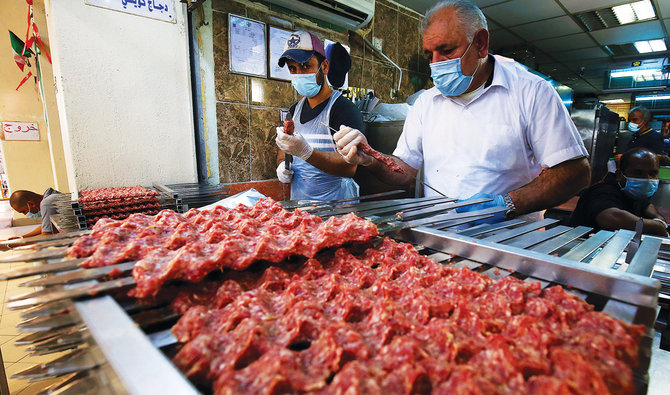
Food vendors prepare kebabs at a market in Kuwait City. Kuwait’s GDP is expected to shrink by the most out of the six GCC states this year. (AFP)
Short Url
Updated 22 July 2020
Follow

Gulf economies shrinking sharply in 2020, to pick up in 2021

  • The pace of recovery in H2 and beyond may disappoint, particularly with the coronavirus set to linger

DUBAI: Economic activity in the Gulf will contract sharply this year before recovering in 2021, hit by the double shock of the coronavirus pandemic and an oil price crash, a quarterly Reuters poll showed on Tuesday.

Analysts in the July 7-20 poll see a deep economic contraction in the hydrocarbon-producing region this year as oil prices were hit on the supply and demand sides simultaneously.

Saudi Arabia’s GDP was seen shrinking 5.2 percent this year before rebounding to 3.1 percent growth next year. A similar poll conducted three months ago saw the region’s biggest economy and world’s largest oil exporter growing 1 percent in 2020 and 2 percent in 2021.

“Three months ago, most forecasts didn’t yet factor in the oil production cuts or the full extent of the COVID-19 fallout,” said Maya Senussi, senior economist at Oxford Economics, adding that limiting the Hajj pilgrimage, an important source of tourism revenue, also weighed on Saudi Arabia’s outlook.

Kuwait’s GDP was seen shrinking the most out of the six Gulf Cooperation Council (GCC) members, contracting 6.1 percent in 2020 before growing 2.5 percent next year. Three months ago, it was seen shrinking 2.9 percent in 2020 and growing 2 percent next year.

Medians forecast a 5.1 percent contraction for the United Arab Emirates’ economy this year and 2.6 percent growth in 2021. Three months ago, they expected the economy to shrink 0.4 percent this year. Tourism, a major source of revenue for the emirate of Dubai, has been hit hard by lockdown measures and travel restrictions.

“We expect revenues for the tourism and hospitality sectors to be under particular pressure given an expected sharp decline in the visitor numbers,” S&P Global Ratings said in a research note, adding that it continues to observe “broad-based pressures across various sectors” in the GCC.

Qatar, Oman and Bahrain’s outlooks also worsened for this year, with analysts expecting their economies to shrink 4 percent, 4.7 percent and 4.4 percent respectively. Their growth outlooks for 2021 improved from expectations three months ago.

“While activity is now picking up across much of the region as lockdown restrictions are relaxed, the pace of recovery in H2 and beyond may disappoint, particularly with the coronavirus set to linger,” Oxford Economics said in a research note.


Saudi POS stays above $4bn as Ramadan spending lifts home goods

Updated 16 sec ago
Follow

Saudi POS stays above $4bn as Ramadan spending lifts home goods

RIYADH: Saudi point-of-sale transactions remained above $4 billion in the week ending Feb. 14, with spending on furniture and home supplies rising ahead of Ramadan, central bank data showed. 

Overall POS activity totaled SR15.34 billion ($4.09 billion), representing a 4.8 percent week-on-week decrease, while the number of transactions dipped 1.6 percent to 252 million, according to the Saudi Central Bank. 

Spending on furniture and home supplies rose 5.9 percent to SR697.35 million, marking the strongest weekly increase among major retail categories. 

Expenditure on electronics increased 2.9 percent, while spending on construction and building materials rose 1.1 percent.

Sectors that saw declines includes freight transport and courier services, which posted a drop of 5 percent to SR64.86 million.

Pharmacy and medical supplies spending fell 8.2 percent to SR223.81 million, but outlays on medical services rose 5.7 percent to SR539.68 million. 

Food and beverage expenditure decreased 4.3 percent, but the total spend of SR2.57 billion meant it retained the largest share of POS activity.

Restaurants and cafes followed with SR1.73 billion, despite a 4.7 percent decline. Apparel and clothing outlays represented the third-largest share of POS spending during the monitored week, up 0.5 percent to SR1.38 billion.

The Kingdom’s major urban centers mirrored the mixed national changes. Riyadh, which accounted for the largest share of total POS spending, saw a 3.4 percent drop to SR5.32 billion. The number of transactions in the capital reached 80.7 million, down 0.8 percent week on week. 

In Jeddah, transaction values decreased 4.4 percent to SR2.12 billion, while Dammam reported a 3.3 percent decrease to SR746.29 million. 

POS data, tracked weekly by SAMA, provides an indicator of consumer spending trends and the ongoing growth of digital payments in Saudi Arabia.  

The data also highlights the expanding reach of POS infrastructure, extending beyond major retail hubs to smaller cities and service sectors, supporting broader digital inclusion initiatives.  

The growth of digital payment technologies aligns with Saudi Arabia’s Vision 2030 objectives, promoting electronic transactions and contributing to the Kingdom’s broader digital economy.