Pakistan’s science minister opposes telco regulator’s ban on social media apps

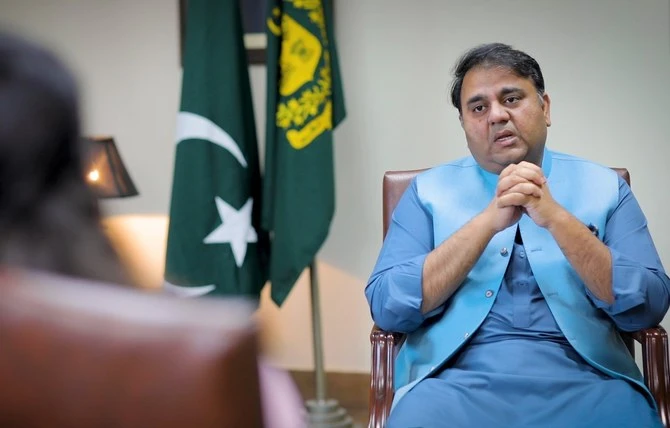
Pakistan Minister for Science and Technology Fawad Chaudhry during an interview with Arab News in Islamabad, Pakistan June 12, 2020. (AN photo)
Short Url
Updated 22 July 2020
Follow

Pakistan’s science minister opposes telco regulator’s ban on social media apps

  • Pakistan Telecommunication Authority has banned Bigo over “obscene and vulgar content” and issued a “final warning” to Tiktok
  • Fawad Chaudhry says such bans not "conducive" to helping the technology industry grow in Pakistan

ISLAMABAD: Pakistan’s Science Minister Fawad Ahmed Chaudhry said on Tuesday he had advised the country’s telecommunications regulator against blanket bans on social media apps and suggested regulations instead that would help the technology industry grow.
His comments came just hours after the Pakistan Telecommunication Authority (PTA) said it had banned the Singaporean live-streaming app Bigo over “immoral, obscene and vulgar content” and issued a “final warning” to Chinese video sharing platform Tiktok for "similar" reasons.
Earlier this month, PTA also banned the hugely popular online game, PlayerUnknown’s Battlegrounds, or PUBG, saying it was addictive, a waste of players’ time and was having an adverse effect on the mental and physical health of the country’s youth.
“I’ve already advised PTA that they should not slap such bans,” Chaudhry said in a phone interview. “All such one-sided bans, I think, won’t help the tech industry.”
“Regulation is something else, ban is something else,” he added. “Regulation? Yes. But, no bans.”
PTA has said it had issued several warnings to social media companies to moderate their content and bring it in line with Pakistani laws, but was not satisfied with the “response.”
Therefore, the regulator said, it had “decided to immediately block Bigo and issue final warning to TikTok to put in place a comprehensive mechanism to control obscenity, vulgarity and immorality through its social media application.”
But Chaudhry said such decisions were not “conducive” to helping Pakistan’s tech industry grow.
The information technology sector is one of the fastest growing sectors in Pakistan and contributes about one percent of GDP at about $3.5 billion, according to government data. IT exports were recorded to be the highest in Pakistan’s history at $1.067 billion in 2017-18, compared to $939 million registered the previous year.
In accordance with the digital policy of Pakistan, announced in 2018, the government aims to achieve an IT export target of $20 billion by 2025.
“Internet is like a library, it’s up to you which kind of book you want to choose,” the science minister said. “If you say the whole library should be shut down because it contains some vulgar books, it’ll obviously not really help Pakistan, especially when Pakistan is growing in the field of technology. Such bans are actually not conducive for the environment.”
Chaudhry also said he was against the ban on PUBG because while Pakistan was the world’s fourth largest software exporter, it was not a significant player in the gaming world.
“We need to take our share [in gaming] because our youth is good at it,” he said.
PTA did not respond to multiple calls and text messages for this story.
Punjab expands Pakistan-India Wagah border arena with museum, partition-themed park

Updated 4 sec ago
Follow

Punjab expands Pakistan-India Wagah border arena with museum, partition-themed park

  • The border crossing, near eastern city of Lahore, is the primary land route between Pakistan and India and one of the most recognizable symbols of their often-tense relations
  • The site is best known for its daily flag-lowering ceremony, a choreographed military ritual performed by border forces from both countries that draws thousands of spectators

ISLAMABAD: Maryam Nawaz, chief minister of Pakistan’s Punjab province, on Thursday inaugurated the newly constructed arena at Wagah border cross between Pakistan and India, which includes a museum and a partition themed park.

The Wagah border crossing, located near the eastern city of Lahore, is the primary land route between Pakistan and India and one of the most recognizable symbols of the often-tense relationship between the two neighbors. It serves as a key point for prisoner exchanges and limited movement of travelers, while remaining tightly regulated due to security considerations.

The site is best known for its daily flag-lowering ceremony, a choreographed military ritual performed by border forces from both countries that draws thousands of spectators. Over the years, the ceremony has evolved into a popular tourist attraction, blending displays of nationalism with public spectacle and making it one of Pakistan’s most visited landmarks, which connects with India’s Attari.

Flanked by military officials, CM Nawaz visited the crossing and inaugurated the new arena, with its seating capacity increased from 7,500 to 25,000 spectators, the state-run Radio Pakistan broadcaster reported. The chief minister also visited the martyrs’ monument and offered her respects.

“In addition to the arena’s expansion, several new constructions have been added at the Joint Check Post Wagah. These new developments include a theme park depicting the partition of the Subcontinent, featuring models of a railway station, military equipment and a Martyrs’ Memorial,” the broadcaster reported.

“A Pakistan Museum has also been established within the arena, showcasing the country’s history and culture from the Freedom Movement to the present day.”

In August 1947, Britain divided the Indian Sub-continent, its former colony, into two countries — Hindu-majority India and Muslim-majority Pakistan.

Excitement over independence was quickly overshadowed by some of the worst bloodletting that left up to 1 million people dead as gangs of Hindus and Muslims slaughtered each other.

Creating two independent nations also tore apart millions of Hindu and Muslim families in one of the world’s largest peacetime migrations, which displaced at least 15 million people.

The fate of Kashmir, then a princely state, was left undecided. The Himalayan territory continues to remain a flashpoint in relations between the neighbors, who have fought multiple wars over it.