



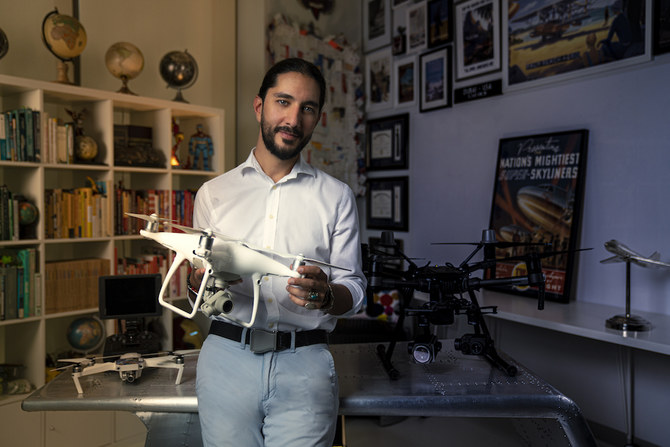




KAUST, Saudi Arabia: The use of drones has changed rapidly over recent years, offering limitless innovative opportunities for game-changing businesses through its dynamic technology.
The adoption of Unmanned Aerial Vehicle (UAV) technology in Saudi Arabia is still in its infancy as regulations are constantly changing. Young Saudi entrepreneurs are keen to foster the demand for drone-based innovative solutions aimed at facilitating and revolutionizing how we get things done.
The pioneering Saudi startup company, Firnas Aero, wants to bring its Drone as a Service (DaaS) concept to the regional market, where it has developed new applications for inspection purposes, to solve problems more efficiently.
Inspired by the father of aviation Abbas ibn Firnas, Tariq Nasraldeen and his friend Sariah Aljefri founded the company in 2018 to provide inspection services that target the aviation, security, industrial, and delivery sectors.
“When we first started, the idea of the drone as a service was getting a drone off the shelf and doing some kind of footage for clients and hoping the images or videos were beneficial for them. If you want to go further you need to differentiate yourself. Therefore, we decided to specialize in inspections,” CEO Nasraldeen told Arab News.
Nasraldeen said that Firnas Aero offers more flexible, sustainable, accurate, and continually evolving solutions than manual inspection, as the company has developed their own drones and AI-equipped software, which they customize to serve each client’s needs.
His experience in aviation and airports management formed the idea of the startup. He noticed the inefficiency in performing periodic maintenance and scanning of runways for foreign objects that can threaten airplane safety. These missions carried out manually by inspection workers take a long time and risk human error.
“At present we are competing mainly with manual inspection, by that I mean two guys with a truck going up a crane and looking at something and deciding whether it needs to be fixed or not,” said Nasraldeen. “By the time you do manual inspection for one spot for instance, we can do 50 (spots) with a drone.”
The drone can take thousands of high-resolution pictures of one location in a short time and send them to be analyzed by the AI-equipped software, which will identify the exact location of the problem for the inspection workers. As a result, it allows clients to overcome the limitations of manual work in speed, accuracy, and human error potential.
Nasraldeen noted that the highly repetitive nature of the inspection tasks would train the AI algorithms. Hence the drone and the software improve its abilities to do that specific task each time.
“We are in the 90 percent accuracy range, whereas most manual inspection is in the 50 or 60 percent,” Nasraldeen added.
The company’s journey started at TAQADAM Startup Accelerator at King Abdullah University of Science and Technology (KAUST) in 2019, the six-month program that supports startups with training and mentorship. Firnas Aero were the first winners of that year and received startup funding.

After TAQADAM, Firnas Aero was incorporated at KAUST Research and Technology Park (KRTP), which provides an environment for technology-based businesses to access the university’s laboratories, faculty and student talent and network of public spaces and facilities designed for creative collision and knowledge-sharing.
The ambitious company with their team of three has been involved in various projects; the most recent was a collaboration with the health ministry to help identify COVID-19 suspected cases in crowds using drones with infrared cameras.
“We used our drone to spot people with a high body temperature at the central market in Madinah city. We reported that information to the Ministry of Health team, which was working alongside us, and then they would go and double-check with the individual,” said Nasraldeen. “This was one of the most interesting projects that we’ve worked on.”
Currently, Firnas Aero is in discussion with KAUST to implement their drone-in-a-box service, which offers perimeter surveillance drones.
“It is the next step of having a fully autonomous system. So that box will house the drone and all its vital systems. Whether it’s cooling data transmission, the charging pad, etc, it will be located in a specific area, and once you have an emergency or a routine controlling mission, the drone is already programmed to fly that out, and you would cover that specific area from your station,” said Nasraldeen.
This technology does not require a pilot to manually control the drone in the same spot; it is an efficient solution to control and monitor projects and huge complexes with the least effort and in the quickest way possible.
“The drone can live in the box in remote areas securely for a few months or a few weeks, depending on the project,” he said.

Potential beneficiaries of such services are airports, industrial complexes, and various governmental institutions. “It increases the coverage or the quality, which will have an indirect effect on the level of services that the government offers to citizens and residents,” said Aljefri, Firnas Aero’s director of strategy.
In the long run, Firnas Aero believes that it can reduce all kinds of car-based patrolling operations gradually until they reach zero
“In a sense, these types of jobs are no longer needed, you can monitor autonomously without the support of people driving vehicles,” said Aljefri.
However, Aljefri said this technology does generate other kinds of jobs, mainly technological or in the backend, where workers will have to analyze images, make decisions, and dispatch teams.
So drone technology is not only speed and cost-cutting, it should also help to lower the environmental impact of inspection and delivery missions using vehicles.
Firnas Aero aspires to conquer the delivery sector too. “The second phase for us is we want to go into light cargo, or what they call in the industry, last-mile delivery, which is the most expensive part of the logistic supply chain,” said Nasraldeen.
“In a five to ten years’ time frame, we’re looking to move into bigger cargo and hopefully moving people using drones,” he added.
Nasraldeen believes that in the 2020s, and beyond, the world will witness huge shifts in technology. He thinks that there is a crucial need to re-evaluate how we do business and provide services in today’s on-demand economy, where consumers expect immediate solutions.
“Artificial Intelligence was a very futuristic word five years ago. But now the filter in Snapchat uses AI, so it’s not that far-fetched,” Nasraldeen said. “It’s not that science fiction terminology anymore. It’s real. It’s day-to-day stuff.”
Regardless of challenges with cash flow, regulations, and permissions that can slow down progress, Firnas Aero aspires to cover the Saudi market and expand to GCC countries within two years and the MENA region within three to five years. After establishing a good track record, the company wants to reach out to Europe, the US, Australia and South East Asia.


