

Afghan lawmakers, experts blast Iran deputy FM over remarks on migrant drownings

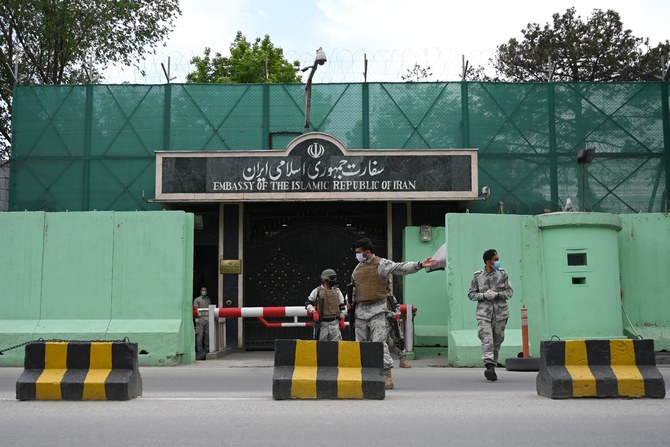
Afghan security personnel stand guard in front of the Iranian embassy as civil society activists hold banners and shout slogans against the Iranian government during a protest, in Kabul on May 11, 2020. Afghanistan on May 01, 2020 has recovered 18 bodies of migrants who were allegedly beaten and tortured before being forced into a river by Iranian border guards. ( AFP photo)
Short Url
Updated 20 July 2020
Follow

Afghan lawmakers, experts blast Iran deputy FM over remarks on migrant drownings

  • Afghanistan says Iranian border guards killed at least 46 Afghan migrant workers trying to enter Iran in May
  • Incident has triggered a diplomatic crisis between the neighbours, Iran denies the event took place on its soil

KABUL: Afghan lawmakers and experts said on Monday Tehran could no longer “cover up” the drowning of Afghan migrant workers who had tried to cross into Iran in May, a day after Iran’s deputy foreign minister denied Iran's role in the incident and accused Kabul of having "no control" over its border.
Afghanistan says Iranian border guards killed at least 46 Afghan migrant workers trying to enter Iran by forcing them into a raging mountain torrent at gunpoint.
The incident has triggered a diplomatic crisis between the neighbours, who share trade, economic and cultural ties. Iran has denied that such an event took place on its soil.


Demonstrators hold banners and shout slogans against the Iranian government during a protest in front of the Iranian consulate in Herat on May 11, 2020. Afghanistan on May 01, 2020 has recovered 18 bodies of migrants who were allegedly beaten and tortured before being forced into a river by Iranian border guards. (AFP Photo)

In an interview with an Afghan private TV station on Sunday, Iran’s Deputy Foreign Minister Sayed Abbas Araghchi had said: “The problem is...no border control from Afghanistan; all control is by our side. The problem is that Afghan nationals have illegal roaming,” adding that human traffickers had forced the Afghan nationals to cross the Harirud River, which forms much of the northern, mountainous section of Afghanistan’s border with Iran.
Araghchi’s comments have drawn stern criticism from Afghan experts and officials.
“They can not hide their cruelty this way, Afghans will never forget what Iranian forces did to our migrants,” Abdul Sattar Husseini, a lawmaker from western Afghanistan, told Arab News.
Nasratullah Haqpal, an analyst, said Iran had long mistreated Afghan migrants.
“He [Iran's deputy FM] is trying to cover the crime Iran has committed,” he told Arab News.
Gran Hewad, a spokesman for the Afghan foreign ministry, said the Iranian foreign minister had said the country's investigation into the incident was ongoing: “We are still waiting for the completion of their investigation and to receive its results.” 
The drowning incident was followed by the killing of another three Afghan migrants three weeks later after Iran’s police in the Yazd province fired at a car, claiming the driver refused to stop for routine police checking.
The two events sparked anti-Iranian protests in Kabul and among Afghans living overseas. Iran subsequently summoned the Afghan envoy and demanded an end to the protests, with officials from both countries saying they would work toward legalizing the nearly three million Afghan migrants in Iran.


Pakistan’s Sharif hopes to further ties with Bangladesh as Rahman takes oath as PM

Updated 5 sec ago
Follow

Pakistan’s Sharif hopes to further ties with Bangladesh as Rahman takes oath as PM

  • Tarique Rahman’s election comes amid a thaw in relations between Pakistan and Bangladesh
  • Planning Minister Ahsan Iqbal also met Rahman after oath-taking, invited him to visit Pakistan

ISLAMABAD: Pakistan Prime Minister Shehbaz Sharif on Tuesday said he hoped to further strengthen relations with Bangladesh as Tarique Rahman took oath as the country’s new premier.

Rahman was sworn in on Tuesday after his Bangladesh Nationalist Party’s landslide win in parliamentary elections last week, the country’s first since the massive 2024 uprising and a vote billed as key to the nation’s future political landscape after years of intense rivalry and disputed polls.

The 60-year-old, whose term will last for five years, is the son of former prime minister Khaleda Zia and former president Ziaur Rahman. He is also Bangladesh’s first male prime minister in 35 years. Since 1991, when Bangladesh returned to democracy, either Rahman’s mother or her archrival Sheikh Hasina had served as PMs.

His election as PM comes at a time when Pakistan and Bangladesh appear to be coming increasingly closer, following a thaw in their relations since the ouster of Hasina, who was widely viewed as an India ally. Ties between Bangladesh and New Delhi remain strained over India’s decision to grant asylum to Hasina.

“Warmest felicitations to Tarique Rahman on having been sworn in as the Prime Minister of the People’s Republic of Bangladesh,” Pakistan’s Sharif said on X Tuesday evening.

“I look forward to close and meaningful engagements with my brother, to further strengthen our bilateral cooperation across mutually beneficial areas and to deepen the historic ties between our two countries.”

Earlier in the day, Pakistani Planning Miniter Ahsan Iqbal called on Rahman after his oath-taking ceremony in Dhaka and conveyed warm congratulations on behalf of the government and people of Pakistan on his election, according to the Pakistani information ministry.

“He extended best wishes for the peace, progress and prosperity of Bangladesh under his leadership,” the ministry said. “Iqbal conveyed a formal invitation from the prime minister of Pakistan to Prime Minister Tarique Rahman to undertake an official visit to Pakistan at a mutually convenient date.”

Pakistan and Bangladesh were part of the same country until Bangladesh’s secession following a bloody civil war in 1971. However, Islamabad and Dhaka have lately been looking to strengthen institutional linkages to broaden their cooperation, following a reset of ties.