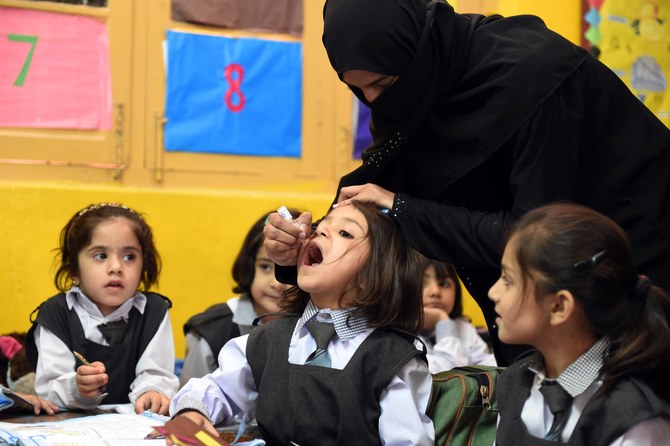
ISLAMABAD: Pakistan on Monday resumed its anti-polio vaccination drive for nearly 800,000 children in five districts, four months after suspending the campaign due to the coronavirus outbreak and after reporting a significant drop in the number of COVID-19 infections in the past few weeks.
“Polio Vaccination Campaign begins in selected areas of Pakistan. Cooperate with the teams to ensure adherence to COVID-19 preventive measures and make a healthy and polio-free life for your child a reality,” representatives from the country’s Polio Eradication Program (PEP) tweeted on Monday.
The World Health Organization (WHO) in late March had issued a directive to cancel all anti-polio activities “to avoid placing communities and frontline workers at the risk of contracting COVID-19.”
However, in the first phase of the campaign, officials said they aimed to vaccinate 800,000 children under the age of five from the districts of Faisalabad, Attock, South Waziristan, and parts of Karachi and Quetta.
Earlier in a statement on July 12, Dr. Rana Muhammad Safdar, coordinator of the National Emergency Operations Center at the health ministry’s PEP said: “We are initially aiming to target areas with continuous poliovirus circulation to protect children against the crippling polio disease during this case response.”
Safdar added that polio workers had been trained in COVID-19 protocols and that the anti-polio campaign would be utilized to raise awareness about preventive measures against coronavirus as well.
Polio is endemic in Pakistan and neighboring Afghanistan, with both countries making concerted efforts to eradicate the problem.
According to data provided by the PEP, 58 polio cases have been reported across Pakistan’s provinces since the beginning of the year, with 21 in Khyber Pakhtunkhwa, 20 in Sindh, 14 in Balochistan, and three in Punjab.

Anti-polio drive resumes in Pakistan after drop in coronavirus infections
https://arab.news/b75u7
Anti-polio drive resumes in Pakistan after drop in coronavirus infections
- Campaign had been suspended in March due to lockdown measures
- Door-to-door immunization program seeks to vaccinate 800,000 children in five districts
Pakistan says defense pact with Saudi Arabia elevated brotherly ties to ‘new heights’
- Pakistan, Saudi Arabia signed strategic defense pact last year pledging aggression against one will be treated as attack on both
- Deputy PM Ishaq Dar says enduring bonds with Islamic and Arab nations form vital pillar of Pakistan’s foreign policy
ISLAMABAD: Deputy Prime Minister Ishaq Dar said on Wednesday that Pakistan’s defense pact with Saudi Arabia elevated its brotherly ties with the Kingdom to “new heights,” stressing that close ties with Arab and Islamic nations form a key pillar of Islamabad’s foreign policy.
Pakistan and Saudi Arabia signed a Strategic Mutual Defense Agreement on Sept. 17 last year, pledging that aggression against one country would be treated as an attack on both, enhancing joint deterrence and formalizing decades of military and security cooperation.
Both nations agreed in October 2025 to launch an economic cooperation framework to strengthen trade and investment ties.
“In the Middle East, our landmark Strategic Mutual Defense Agreement with Saudi Arabia has elevated our brotherly ties to new heights,” Dar said while speaking at the Pakistan Governance Forum 2026 event in Islamabad.
The Pakistani deputy prime minister was speaking on the topic “Navigating International Relations Amidst Changing Geo-Politics.”
Dar noted that Pakistan has reinforced partnerships with other Middle Eastern nations such as the UAE, Qatar, Jordan, Oman, Egypt and Bahrain. He said these partnerships have yielded “concrete agreements” in investment, agriculture, infrastructure, and energy sectors.
“Our enduring bonds with Islamic and Arab nations form a vital pillar of our foreign policy, and we will continue to expand our partnerships across Asia, Latin America, and Africa,” he said.
Dar pointed out that the presidents of Kazakhstan, Uzbekistan and Kyrgyzstan have undertaken visits to Pakistan in recent months, reflecting Central Asian nations’ desire to boost cooperation with Islamabad.
On South Asia, the Pakistani deputy PM said Pakistan has successfully transformed its fraternal ties with Bangladesh into “a substantive partnership.”
“Similarly, the trilateral mechanism involving China, Pakistan, and Bangladesh has been launched with a view to expanding and deepening regional cooperation and synergy,” the Pakistani minister said.
He said Islamabad has strengthened its “all-weather” partnership with China via the second phase of the multi-billion-dollar China-Pakistan Economic Corridor agreement and “unwavering support” from both sides for each other’s core interests.
Dar said Pakistan had also reinvigorated its partnership with the US, advancing cooperation in trade, technology, investment, and regional stability.
“This calibrated approach has enhanced our ability to navigate complexity with skill and confidence, ensuring that our national interests are served without compromising our core foreign policy principles,” he said.


