

Opposition chiefs blast ‘charade’ of Syrian vote

1 / 3
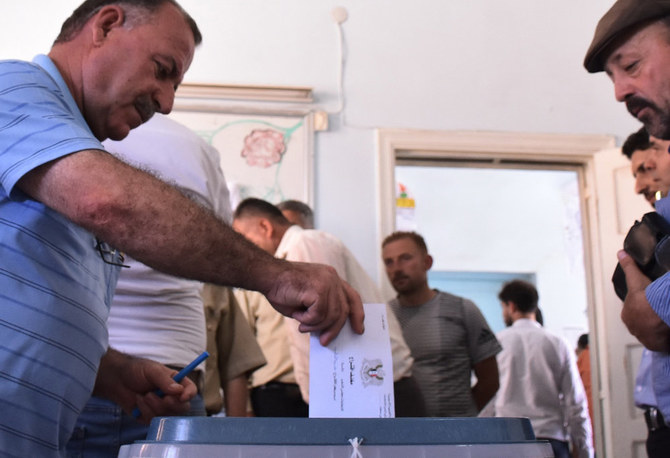
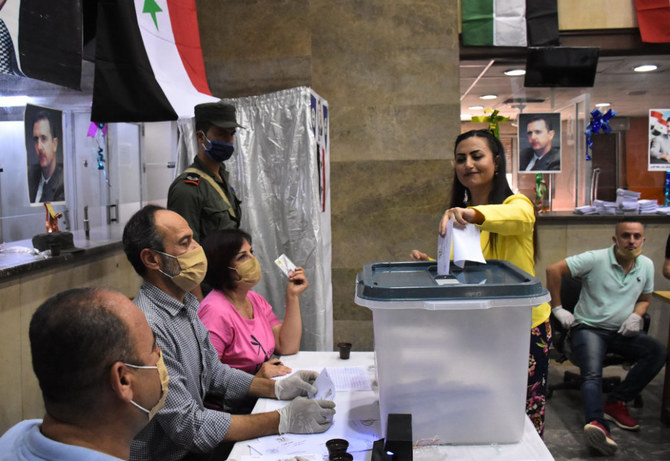
A Syrian woman casts her ballot at a polling station in the Nubl neighbourhood of Aleppo on July 19, 2020, during the parliamentary elections. (AFP)
2 / 3
A Syrian man casts her ballot at a polling station in the Nubl neighbourhood of Aleppo on July 19, 2020, during the parliamentary elections. (AFP)
3 / 3
A Syrian woman casts her ballot at a polling station in the Nubl neighbourhood of Aleppo on July 19, 2020, during the parliamentary elections. (AFP)
Short Url
Updated 20 July 2020
Follow

Opposition chiefs blast ‘charade’ of Syrian vote

  • Assad regime to win almost all 250 seats in parliamentary poll

JEDDAH: Syrians voted for a new parliament on Sunday in elections denounced by exiled opposition leaders as a farce and a charade.

Regime leader Bashar Assad’s Baath Party and its allies will win almost all 250 seats in the third poll since the civil war began in 2011. Millions of Syrian refugees and those in opposition-held territory did not vote.

The election took place against a background of a collapsing economy, crippling international economic sanctions, and the fallout from the coronavirus pandemic.

There have been no genuine elections in Syria since the Assad family seized power 50 years ago, said senior opposition figure Nasr Al-Hariri.

“Everything called an election has been a farce under security and military grip ... to form a sham parliament for the regime to use to pass legislation to serve the gang in power,” he said.

 “All that has changed today is that half the Syrian people have been forced to flee.” 

 More than 380,000 people have been killed and millions have been displaced from their homes since the conflict began with a violent crackdown on anti-government protests.

 The opposition Syrian National Coalition said the vote was a “theatrical election by the Assad regime.” Another opposition leader, Obeida Nahhas, said the elections were a “blatant charade” that had been going on for 50 years.

 “The length of the era of dictatorship and tyranny has produced a situation that does not reflect the opinion of the popular majority,” he said. “It has emptied elections of their true democratic meaning.”

The elections, originally scheduled for April, were postponed twice because of the pandemic. There were more than 1,600 candidates, many of them prominent business figures, and voting took place at more than 7,000 polling stations in regime-held areas and territory recaptured from opposition forces in the past two years.

At a polling station in Damascus, voters said they were worried about the rising cost of living.

 “We have to find a solution for the living conditions,” said Samer Mahmoud, who owns a clothing shop. 


Iranian attacks wound 16 Qatari citizens: Interior Ministry

Updated 7 sec ago
Follow

Iranian attacks wound 16 Qatari citizens: Interior Ministry

The latest round of Iran’s retaliatory attacks had injured 16 Qatari citizens by early Sunday, as the country intercepted more than 60 missiles and over ten drones launched from Iran, according to official data.

From Saturday night to Sunday morning, multiple explosions were heard southwest of the capital city of Doha as Qatar’s air defense systems repeatedly activated to intercept incoming Iranian missiles.

According to data released by Qatar’s Ministry of Defense, since the attacks began on Saturday, Qatar has been targeted by 65 missiles and 12 drones.

Among these, 63 missiles and 11 drones were successfully intercepted before reaching their intended targets while two missiles struck the US military’s Al-Udeid Air Base in Qatar and one drone hit an early warning radar facility in the country.

Qatar’s Interior Ministry announced on Sunday that the attacks had wounded 16 of its citizens, all due to scattered missile debris, with limited property damage in some areas.

The ministry urged citizens to remain indoors whenever possible, avoid non-essential outings, and steer clear of any unidentified objects.

Despite Sunday being the first working day of the week in Qatar, a noticeable decrease in vehicles and pedestrians was observed on the streets.

Following the Saturday attack, Qatar closed its airspace and territorial waters, suspended all public events and gatherings, and shifted all schools to remote learning.

Except for military, security, and healthcare systems, most government agencies implemented remote work arrangements.

Qatar’s Ministry of Commerce and Industry also advised the private sector to adopt remote work practices where possible.

Meanwhile, the Qatari government continues to send signals of stability.

The Ministry of Defense said it possesses full capabilities to protect national security, with the current security situation remaining stable and under control.

The Interior Ministry announced that security and civil defense forces have entered a state of full emergency readiness, capable of responding to any emergency.

The Ministry of Commerce and Industry stressed that domestic supplies of daily necessities are enough to meet public demand.