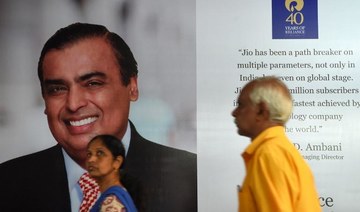
MUMBAI: Backed by multi-billion-dollar investments from global tech giants, India’s richest man is ready to rumble with Amazon and Walmart for the country’s huge e-commerce market through his conglomerate Reliance.
But it is far from certain that Mukesh Ambani’s latest gamble will pay off in a crowded market where many suppliers are not well-versed in digital business.
The mogul has long trumpeted his ambition to revolutionise retail in the country of 1.3 billion by convincing farmers and shopkeepers to sell their goods on his new JioMart platform.
But modernising India’s creaky, inefficient supply chains will not be easy, even for Reliance, the nation’s largest retailer by revenue with a portfolio including supermarkets, electronics stores and fast-fashion outlets.
Google on Wednesday became the latest Silicon Valley player to invest in the digital unit of the Indian oil-to-telecoms juggernaut, following in the footsteps of Facebook and Intel.
Despite these votes of confidence, Ambani’s success will depend on India’s mom-and-pop stores and their ability to adapt to the demands of an online business, analysts say. Keeping bargain-hungry consumers satisfied in a fiercely contested market may be even harder.
Early signs have not been promising for JioMart since its roll-out in 200 Indian cities in May.
Customers have complained about everything from rotting vegetables to missing deliveries and delayed refunds.
An avid online shopper who buys electronics from Amazon and clothing from Walmart-owned retailer Myntra, Mehul Shah is the kind of customer Ambani and his rivals want to catch.
The 22-year-old placed his first JioMart order soon after the platform’s hotly-anticipated launch. “I wanted to experience what it was like... because there was so much hype around it,” he said.
But fewer than half his items were delivered and mint leaves he ordered arrived rotten.
Shah’s experience underlines the challenges facing Ambani as he attempts to take on Amazon, BigBasket and Grofers, all of which have established supply and delivery networks in India.
The 63-year-old tycoon may deploy the same strategy he used to make his Jio mobile service a market leader after its 2016 launch.
Jio’s cut-price discounts put phones in the hands of millions of first-time buyers in India, driving rivals out of the race.
Ambani has raised more than $22 billion in a rights issue and through selling stakes in Reliance to foreign investors. The conglomerate is now net-debt-free and has cash to burn, analysts say.
“JioMart will use the money by offering deep discounting to get consumers, and is in it for the long haul,” said independent analyst Minakshi Ghosh.
But the firm will also need to pump funds into training local shopkeepers in online trading. Many say their businesses have been badly hit by the rise of supermarkets and e-commerce.
“Even in my dreams I never imagined running such a modern business... or receiving card payments,” said Kavita Chowdhury, a 30-year-old shopkeeper in Navi Mumbai, a city neighbouring India’s financial capital.
The partnership with JioMart come at the right time for her, with the pandemic forcing her to close her doors. She can now sell online instead, and business is booming.
A Reliance source said JioMart had received an “amazing” response from consumers.
“People in small towns are buying Del Monte olives and focaccia bread... They are aware of global trends and want more options,” he said.
But he acknowledged the company faced “teething issues” in logistics — problems which analysts believe could prove its Achilles heel.
“You need consistent delivery models and customer satisfaction” to run a successful e-commerce operation, said Forrester Research senior forecast analyst Satish Meena. Reliance will not “have a walkover just because of their financial strength,” he said.
Some customers have already sworn off the platform. Vamshi Krishna, 28, said he would never again buy anything from JioMart after his first order went missing.
“I decided to give them a second chance... because it is an Ambani company,” he said. “Now I seriously doubt whether I will ever get my money back.”