

Kuwait reopens mosques after months of coronavirus closure

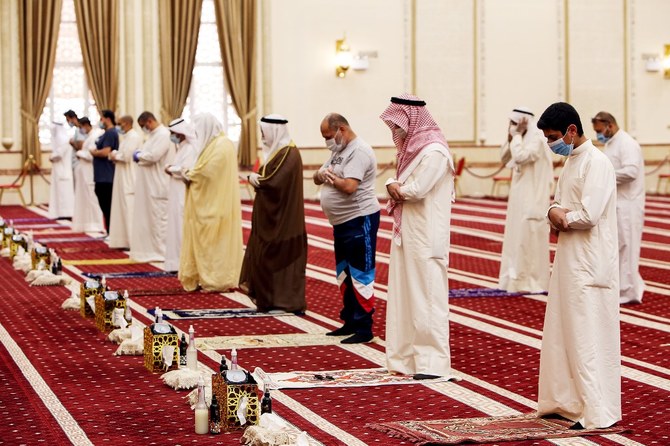
The Ministry of Awqaf has allowed some mosques to reopen for prayer in calmer areas since June. (File/AFP)
Short Url
Updated 17 July 2020
Follow

Kuwait reopens mosques after months of coronavirus closure

  • Worshipers will also be required to perform ablution at home and bring their own prayer mats
  • Mosques will open 30 minutes before prayer and close 15 minutes after Friday’s sermon

DUBAI: Mosques across Kuwait have reopened for Friday prayer for the first time since the coronavirus pandemic forced a shutdown in March, local daily Kuwait Times reported.

The Kuwaiti Ministry of Awqaf previously allowed some mosques to reopen for prayer in calmer areas since June, but worshipers were not allowed to perform Friday prayer.

The new announcement will see over 1,000 mosques reopening their doors to worshipers while following safety measures issued by authorities. These include the sanitization of the premises, installations of signs for social distancing and enforcing face masks.

Worshippers will also be required to perform ablution – wudu – at home and bring their own prayer mats as mosques water fountains and toilets will remain closed until further notice.

Mosques will open 30 minutes before prayer and close 15 minutes after Friday’s sermon. The whole prayer will not exceed 15 minutes in total.

Individuals who are still on quarantine and children below 15 will not be allowed into the premises, while those with compromised immune systems, chronic disease or any illness symptoms were advised to stay at home.


Series of Israeli strikes hit Lebanon

Updated 1 sec ago
Follow

Series of Israeli strikes hit Lebanon

BEIRUT: A series of Israeli strikes hit south and east Lebanon on Friday, state media reported, as Israel’s army said it was targeting Hezbollah sites, the latest such raids despite a year-old ceasefire.
Lebanon’s state-run National News Agency (NNA) reported strikes in around a dozen locations, including up to around 30 kilometers (20 miles) from the Israeli border, citing at times “heavy raids.”
Israel has kept up strikes on Lebanon despite a November 2024 ceasefire that was supposed to end more than a year of hostilities with the Iran-backed militant group Hezbollah, and has also kept troops in five areas it deems strategic.
The Israeli military said in a statement that its forces “struck a training and qualification compound” used by Hezbollah’s elite Radwan Force where operatives “underwent shooting exercises and additional training on the use of various types of weapons.”
The army also “struck additional Hezbollah military infrastructure in several areas in southern Lebanon,” it said.
According to the ceasefire, Hezbollah was required to pull its forces north of the Litani River, some 30 kilometers from the border with Israel, and have its military infrastructure there dismantled.
Under a government-approved plan, Lebanon’s army is to dismantle Hezbollah’s military infrastructure south of the Litani by the end of the year, before tackling the rest of the country.
The sites struck on Friday were generally north of the river.
Earlier this week, Israel launched a series of strikes on southern Lebanon, also saying it hit a Hezbollah training center and other targets.