Kuwait reopens mosques after months of coronavirus closure

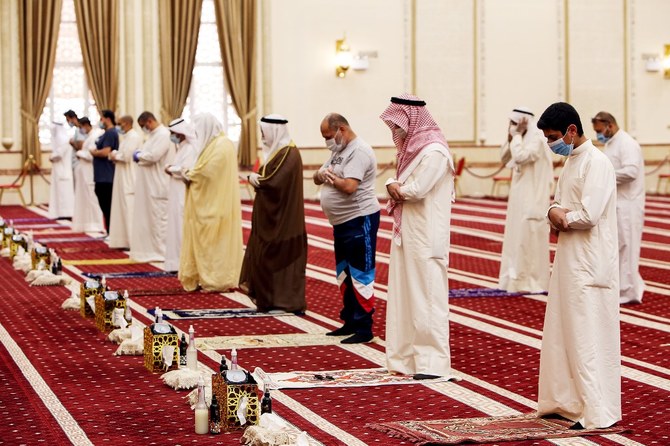
The Ministry of Awqaf has allowed some mosques to reopen for prayer in calmer areas since June. (File/AFP)
Short Url
Updated 17 July 2020
Follow

Kuwait reopens mosques after months of coronavirus closure

  • Worshipers will also be required to perform ablution at home and bring their own prayer mats
  • Mosques will open 30 minutes before prayer and close 15 minutes after Friday’s sermon

DUBAI: Mosques across Kuwait have reopened for Friday prayer for the first time since the coronavirus pandemic forced a shutdown in March, local daily Kuwait Times reported.

The Kuwaiti Ministry of Awqaf previously allowed some mosques to reopen for prayer in calmer areas since June, but worshipers were not allowed to perform Friday prayer.

The new announcement will see over 1,000 mosques reopening their doors to worshipers while following safety measures issued by authorities. These include the sanitization of the premises, installations of signs for social distancing and enforcing face masks.

Worshippers will also be required to perform ablution – wudu – at home and bring their own prayer mats as mosques water fountains and toilets will remain closed until further notice.

Mosques will open 30 minutes before prayer and close 15 minutes after Friday’s sermon. The whole prayer will not exceed 15 minutes in total.

Individuals who are still on quarantine and children below 15 will not be allowed into the premises, while those with compromised immune systems, chronic disease or any illness symptoms were advised to stay at home.


Israel army says striking Hezbollah targets in Lebanon

Updated 4 sec ago
Follow

Israel army says striking Hezbollah targets in Lebanon

JERUSALEM: The Israeli military announced a series of strikes on Hezbollah targets in Lebanon on Friday, including weapons depots and a training complex.
“A number of weapons storage facilities and terrorist infrastructure sites were struck, which were used by Hezbollah to advance terror attacks against the state of Israel,” a military statement said.
Despite a November 2024 ceasefire that was supposed to end more than a year of hostilities between Israel and the Iran-backed Hezbollah group, Israel has continued to strike in Lebanon and has maintained troops in five areas it deems strategic.
More than 340 people have been killed by Israeli fire in Lebanon since the ceasefire, according to an AFP tally of Lebanese health ministry reports.
The strikes on Friday come a day after similar Israeli attacks near the Syrian border and in southern Lebanon left three people dead.
The Israeli military had reported on Thursday it had killed a member of arch-foe Iran’s elite Quds Force in a strike in Lebanon.
On Friday, the military said it had struck several military structures of Hezbollah, warning it would “remove any threat posed to the state of Israel.”
Under heavy US pressure and fears of expanded Israeli strikes, Lebanon has committed to disarming Hezbollah, starting in the south of the country near the frontier.
Lebanon’s army plans to complete the disarmament south of the Litani River — about 30 kilometers (19 miles) from the border with Israel — by year’s end.
Israel has questioned the Lebanese military’s effectiveness and has accused Hezbollah of rearming, while the group itself has rejected calls to surrender its weapons.