

Pakistan welcomes decision by UN to add head of Pakistan Taliban to sanctions list

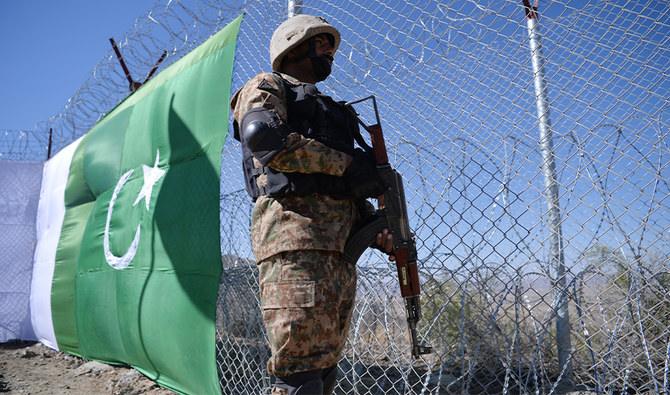
A Pakistani soldier keeps vigil next to a newly fenced border fencing along with Afghan's Paktika province border in Angoor Adda in Pakistan's South Waziristan tribal agency on October 18, 2017. ( AFP/ File)
Short Url
Updated 17 July 2020
Follow

Pakistan welcomes decision by UN to add head of Pakistan Taliban to sanctions list

  • United Nations said on Friday it had added Mufti Noor Wali Mehsud to its Daesh and Al-Qaeda sanctions list
  • Mehsud became leader of Pakistani Taliban in June 2018 after previous chief Fazlullah was killed in US-Afghan airstrike

ISLAMABAD: Pakistan said on Friday it welcomes the decision by the United Nations to add the head of the Pakistan Taliban, Mufti Noor Wali Mehsud, to its Daesh and Al-Qaeda sanctions list, thereby freezing his assets and imposing a travel ban and arms embargo on him.
The Pakistani Taliban named Mehsud as the new leader in June 2018, a week after the previous chief Mullah Fazlullah was killed in a US-Afghan airstrike in Afghanistan.



An undated photo of Tehreek-i-Taliban Pakistan (TTP) leader Mufti Noor Wali Mehsud. (Source: Social media)

On 16 July, the UN Security Council Committee said pursuant to a number of resolutions concerning Daesh, Al-Qaeda, and associated individuals, groups, undertakings and entities, it had approved the addition of Mehsud “to its ISIL (Daesh) and Al-Qaeda Sanctions List of individuals and entities subject to the assets freeze, travel ban and arms embargo set out in paragraph 1 of Security Council resolution 2368 (2017), and adopted under Chapter VII of the Charter of the United Nations.”
“Pakistan welcomes the designation of Noor Wali Mehsud, the leader of TTP [Tehrek-i-Taliban Pakistan] by the UNSC 1267 Sanctions Committee on its ISIL (Daesh) and Al-Qaeda Sanctions List,” the foreign office said. “The sanctions are being implemented by Pakistan in compliance with the relevant UNSC resolutions and we hope that other countries will also follow suit.”
“Pakistan will continue to pursue its policy of fighting against those involved in participating, financing, planning, facilitating and perpetrating terrorism,” the foreign office added.
Mehsud was appointed deputy leader by Fazlullah in February 2018 after the previous second in command Khalid Mehsud was killed in Afghanistan’s Paktika province.
The Pakistani Taliban have waged a decade-long insurgency seeking to establish a harsh interpretation of religious rule but most of their fighters have now fled to Afghanistan.
They are separate from the Afghan Taliban who ruled Afghanistan for five years before being ousted in a 2001 US-led military intervention.


Pakistan urges world to treat water insecurity as global risk, flags India treaty suspension

Updated 5 sec ago
Follow

Pakistan urges world to treat water insecurity as global risk, flags India treaty suspension

  • Pakistan says it is strengthening water management but national action alone is insufficient
  • India unilaterally suspended Indus Waters Treaty last year, leading to irregular river flows

ISLAMABAD: Pakistan on Tuesday urged the international community to recognize water insecurity as a “systemic global risk,” warning that disruptions in shared river basins threaten food security, livelihoods and regional stability, as it criticized India’s handling of transboundary water flows.

The call comes amid heightened tensions after India’s unilateral decision last year to hold the 1960 Indus Waters Treaty “in abeyance,” a move Islamabad says has undermined predictability in river flows and compounded climate-driven vulnerabilities downstream.

“Across regions, water insecurity has become a systemic risk, affecting food production, energy systems, public health, livelihoods and human security,” Pakistan’s Acting Permanent Representative to the United Nations, Ambassador Usman Jadoon, told a UN policy roundtable on global water stress.

“For Pakistan, this is a lived reality,” he said, describing the country as a climate-vulnerable, lower-riparian state facing floods, droughts, accelerated glacier melt, groundwater depletion and rapid population growth, all of which are placing strain on already stressed water systems.

Jadoon said Pakistan was strengthening water resilience through integrated planning, flood protection, irrigation rehabilitation, groundwater replenishment and ecosystem restoration, including initiatives such as Living Indus and Recharge Pakistan, but warned that domestic measures alone were insufficient.

He noted the Indus River Basin sustains one of the world’s largest contiguous irrigation systems, provides more than 80 percent of Pakistan’s agricultural water needs and supports the livelihoods of over 240 million people.

The Pakistani diplomat said the Indus Waters Treaty had for decades provided a framework for equitable water management, but India’s decision to suspend its operation, followed by unannounced flow disruptions and the withholding of hydrological data, had created an unprecedented challenge for Pakistan’s water security.

Pakistan has said the treaty remains legally binding and does not permit unilateral suspension or modification.

The issue has gained urgency as Pakistan continues to recover from last year’s monsoon floods, which killed more than 1,000 people and devastated farmland in Punjab, the country’s eastern breadbasket, in what officials described as severe riverine flooding.

Last month, Deputy Prime Minister Ishaq Dar said Pakistan had observed abrupt variations in river flows from India, creating uncertainty for farmers in Punjab during critical periods of the agricultural cycle.

“As we move toward the 2026 UN Water Conference, Pakistan believes the process must acknowledge water insecurity as a systemic global risk, place cooperation and respect for international water law at the center of shared water governance, and ensure that commitments translate into real protection for vulnerable downstream communities,” Jadoon said.